

Whether Private Unaided College Can Charge Tuition Fees From Students During Mandatory Internship Period: Supreme Court To Examine
The Petitioner-College assailed the order of the High Court, which directed the college to refund internship-period tuition fees to graduates within three months.

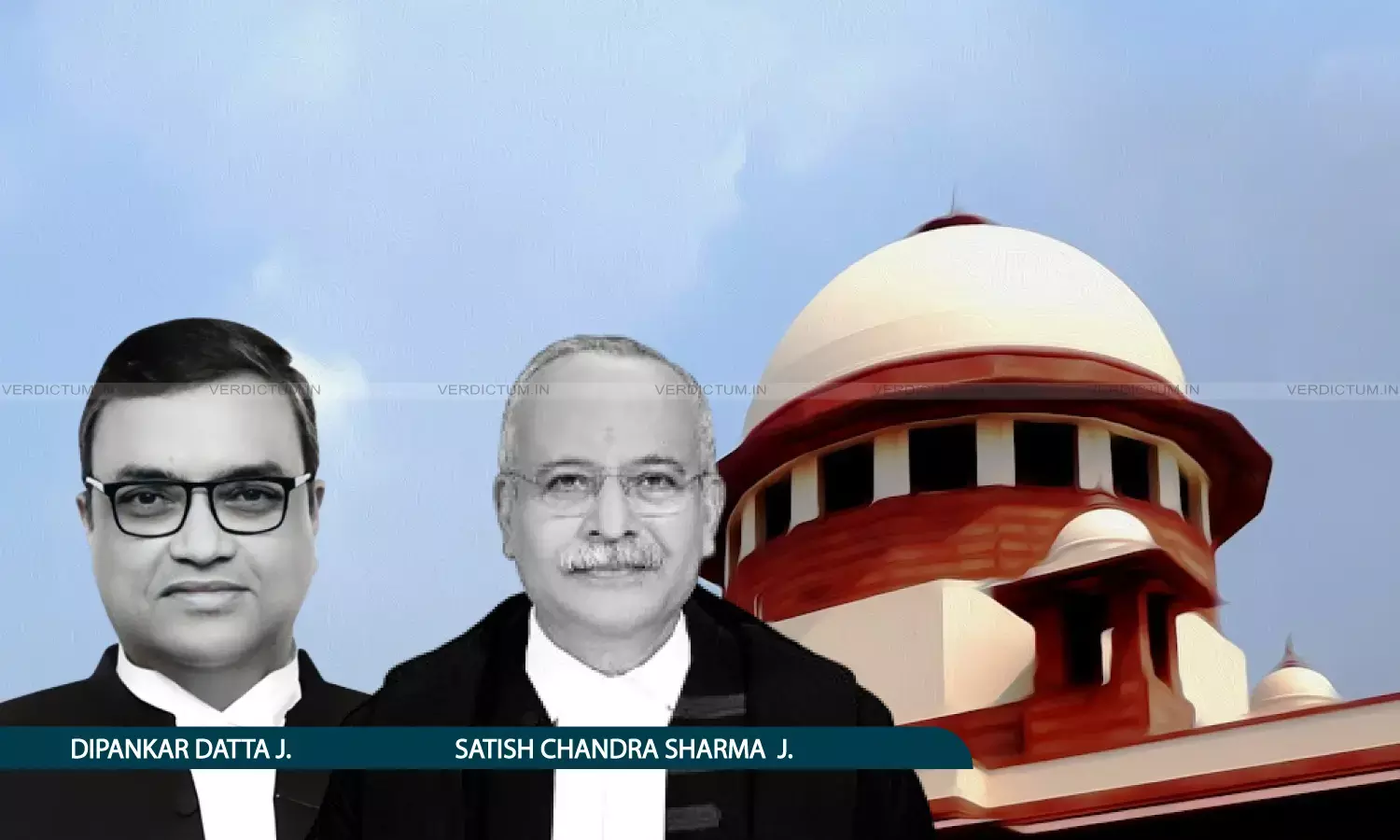
The Supreme Court has recently stayed the operation of the judgment of the Punjab & Haryana High Court, which held that a private unaided veterinary college cannot charge tuition fees from students during the mandatory internship period of the B.V.Sc. & A.H. course.
The Bench of Justice Dipankar Datta and Justice Satish Chandra Sharma ordered, "Issue notice...Till the next date of hearing, there shall be a stay of operation of the impugned judgment and order."
Senior Advocate Devadatt Kamat appeared for the Petitioner-College.
A Special Leave Petition was filed by Khalsa College of Veterinary and Animal Sciences, assailing the order of the High Court, which partly allowed a few writ petitions filed by veterinary graduates and directed the Petitioner-College to refund the tuition fee collected during the internship period within three months.
Aggrieved by the decision, the Petitioner-College contended that the High Court judgment raised substantial questions of law affecting private unaided professional institutions. It has been contended by the Petitioner-College in its petition that the fee for the entire course is determined by the State, and therefore, cannot be varied to its detriment in the absence of any finding of profiteering. The Petition further states that if the fee during the internship period is waived, the fee for the preceding semesters would have to be proportionally increased, since the net fee that is to be received by the College for the entire course needs to be sufficient to meet its expenditure.
A few persons had filed petitions before the High Court seeking to quash the action of the Petitioner-College, whereby tuition fee has been charged for the ‘internship period’, which, according to the writ-petitioners before the High Court, was illegal as no study or examination is conducted during such period and to the contrary, they are to perform duties as provisionally registered veterinary doctors as per the regulations of the Veterinary Council of India (‘VCI’). Further, it was prayed to command the Petitioner-College to pay internship allowance to the petitioners at par with the allowance being paid by other Colleges/Universities, regulated by the VCI.
The Petitioner-College, before the High Court, had submitted that while refuting the claim of the writ-petitioners before the High Court, had taken a stand that it is a private unaided institute, cannot be equated with any government-aided University or Institute, since it has to cater to all its expenses from its own finances. In the case of NRI quota seats, the fee is being charged annually for the entire duration of 5 years. It was further averred that under the internship programme, the interns are to render veterinary services under the supervision of experienced teachers and the internship programme is monitored by a committee comprising the Dean and HOD’s.
The High Court had observed, "Applying the ratio of the above judgements, the legal position that emerges is, that to ensure that an educational institute is kept within its bounds and does not indulge in profiteering or otherwise exploiting its students financially, it will be open to the statutory authorities and in their absence, to the State to regulate the fee structure, till appropriate statutory regulations are made in that behalf. In absence of any such mechanism, the Constitutional Courts, may also intervene in exercise of their powers of judicial review, if it is found in the given facts of a case, that the action of any educational institution tantamounts to illegal profiteering or exploitation of the students."
The High Court also added that as per the VCI regulations, the institutes are mandated to pay the internship allowance to the interns, in lieu of the services that they are to perform during the period of internship. This is in addition to the facilities of boarding/lodging and transportation that were required to be provided.
"Careful perusal of the regulations would show that the interns are to assist/perform all duties of a veterinary doctor and are therefore granted provisional registration by the competent authority for the said purpose," the High Court said.
The High Court had held, "The internship programme is full-time and includes emergencies and night duties, even on Sundays and holidays. The interns are not allowed any full or part time appointment paid or otherwise. It is important to note that the internship can only be undertaken after completion of all credit requirements of the veterinary course curriculum, tracking programme and all other co-curricular activities, including entrepreneurship project. Issuance of professional course completion certificate and grant of provisional registration by the State/Union Territory Council or Veterinary Council of India, ‘precedes’ registration for internship. It is, thus, abundantly clear that internship allowance is mandatorily required to be paid under the VCI regulations, upon the recognition of the fact, that the interns are performing all functions of ‘assisting veterinary doctors’, and are required to be paid remuneration for their services. Their engagement amounts to employment and deployment in the veterinary clinics is not for training simplicitor."
Accordingly, the matter is now pending consideration before the Apex Court and is listed for a further date.
Cause Title: Khalsa College of Veterinary and Animal Sciences [Special Leave to Appeal (C) No(s).733/2026]
Appearances:
Petitioner: Senior Advocate Devadatt Kamat with Advocates Nipun Arora, Himanshu Malik and Revanta Solanki
Click here to read/download the order