

"People Reject You, Then You Use Judicial Platforms To Get Popular": Supreme Court Refuses To Entertain Petition Filed By Prashant Kishore's Jan Suraaj Party
The Court refused to issue notice in the petition asked the Petitioner to approach the High Court.

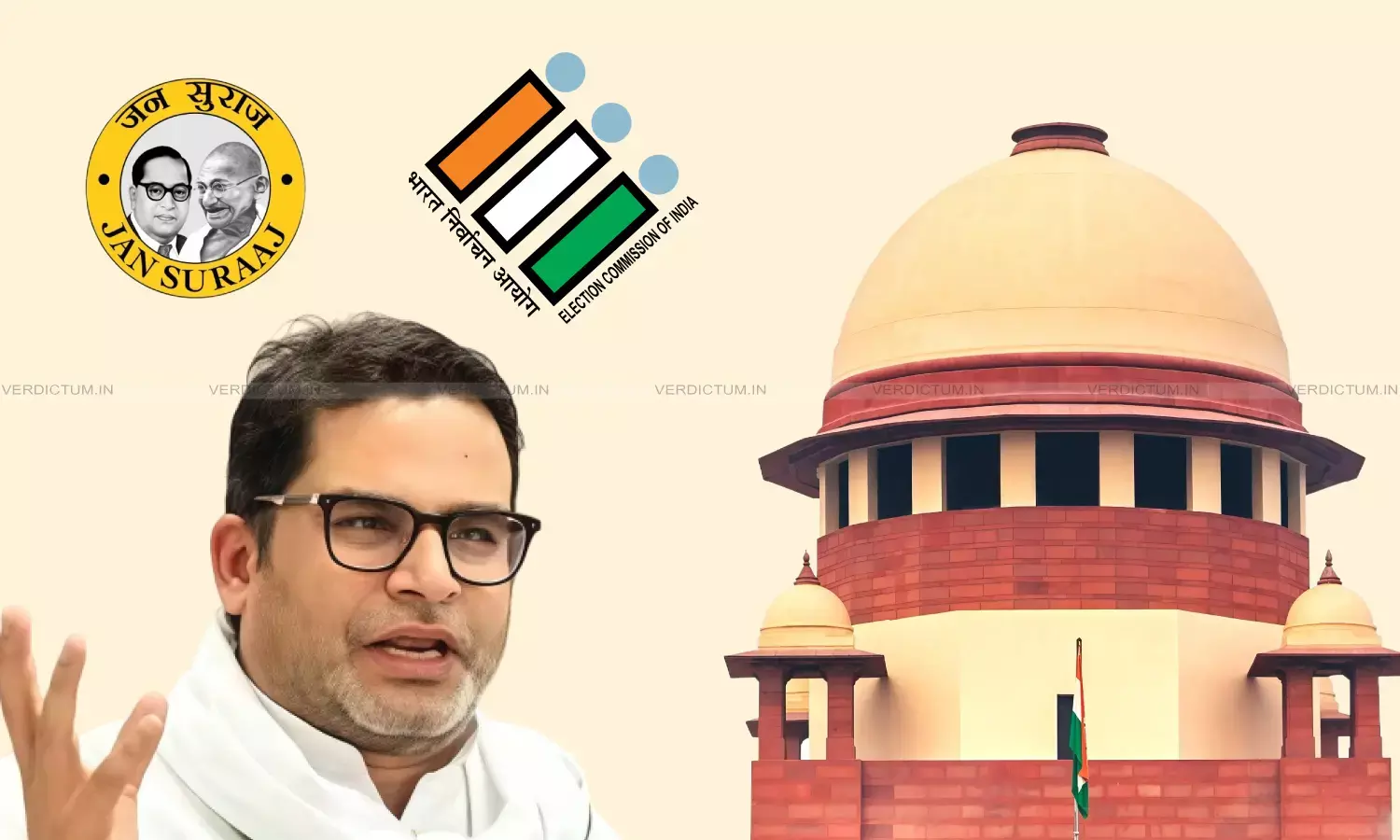
The Supreme Court, today, refused to entertain a plea filed by Prashant Kishore's Jan Suraaj challenging the state-wide scheme for women known as “Mukhyamantri Mahila Rojgar Yojana” wherein the Government of Bihar decided to provide financial help, through Direct Benefit Transfer, to one woman in every family by paying Rs.10,000/- to start self- employment.
The Bench of Chief Justice Surya Kant and Justice Joymalya Bagchi ordered, "Ld. Senior Counsel for the Petitioner seeks permission to withdraw with liberty to go to the jurisdictional High Court."
Senior Advocate CU Singh appeared for Jan Suraaj.
A writ petition is filed by the Party under Article 32 of the Constitution seeking the issuance of writ of issue writ of Mandamus, declaring the fresh addition of beneficiaries in the “Mukhyamantri Mahila Rojgar Yojana”, and payment to them in course of election as illegal, unconstitutional and contrary to Articles 14, 21, 112, 202 and 324 of the Constitution of India.
Singh argued that the State, which is among the most indebted in the country, distributed ₹15,600 crores immediately before the election without budgetary support. He stated, "We are talking about the model code of conduct being disturbed across the state by virtue of the level playing field being absolutely torn asunder."
However, the Bench expressed scepticism, questioning whether a government policy could be treated as a corrupt practice. The Court noted, "There is a difference between a legal constitutional question and the wisdom of the government in pursuing a fiscal economy policy... It’s for the people to vote out their policy."
"First of all you tell us what is the logic of not going to the High Court? High Court is the most convenient place for you to go, where they can record and verify anything and take a view", the Chief Justice said.
"How many votes did your political party get?... People reject you, and then you use judicial platforms to get popular...If such a Scheme is launched, somebody should have challenged the Scheme..." Chief Justice remarked.
The Court further said, "The freebies issue being examined by us seriously. We would like to examine the case but not at the instance of a political party that has lost everything in the election and then wants...if this political party gets power, it will do the same thing..."
Singh emphasized the gravity of the timing, noting that 25 to 35 lakh people were enrolled in the scheme after the Model Code of Conduct (MCC) came into play. He argued, "It is announced... 10,000 each today. Another 2 lakhs to be given after assessment. The first 10,000 without any assessment?"
The Court, however, remained focused on the procedural validity of the petition, calling it a "composite election petition pertaining to every election" and questioning how an entire state’s results could be set aside without proving individual benefits for every winning candidate.
Ultimately, the Supreme Court refused to issue notice on the petition, directing the party to approach the High Court first. The Bench advised, "Your matter is only for one state. There is a High Court in this state. Please avail the remedy. We will have the benefit of the viewpoint of the High Court when you will come to us."
SIngh said, "We will withdraw with liberty. We will go to the High Court."
In August 2025, the Government of Bihar, on the eve of the general assembly elections 2025, launched “Mukhayamantri Mahila Rojgar Yojana” (MMRY). The main objective was to provide financial support to one woman per family in Bihar to start a self-employment activity. The scheme stated that Rs 10,000 as the first instalment will be provided to all eligible women applicants who are members of Jeevika Self Help Groups, and further, additional assistance of Rs 2 lacs each will be provided by the government post assessment, however, after 6 months. The scheme benefits were to be given to women who were already registered with JEEVIKA; however, fresh applications for joining the self-help group were also invited.
Accordingly, the petition was withdrawn with the liberty to go to the High Court.
Cause Title: Jan Suraaj Party v. The Election Commission of India and Ors. [W.P.(C) No. 107/2026]