

Police Cannot Conduct Further Investigation Without Obtaining Permission From Court/Magistrate: Supreme Court
Holds further investigation under Section 173(8) CrPC requires prior judicial permission

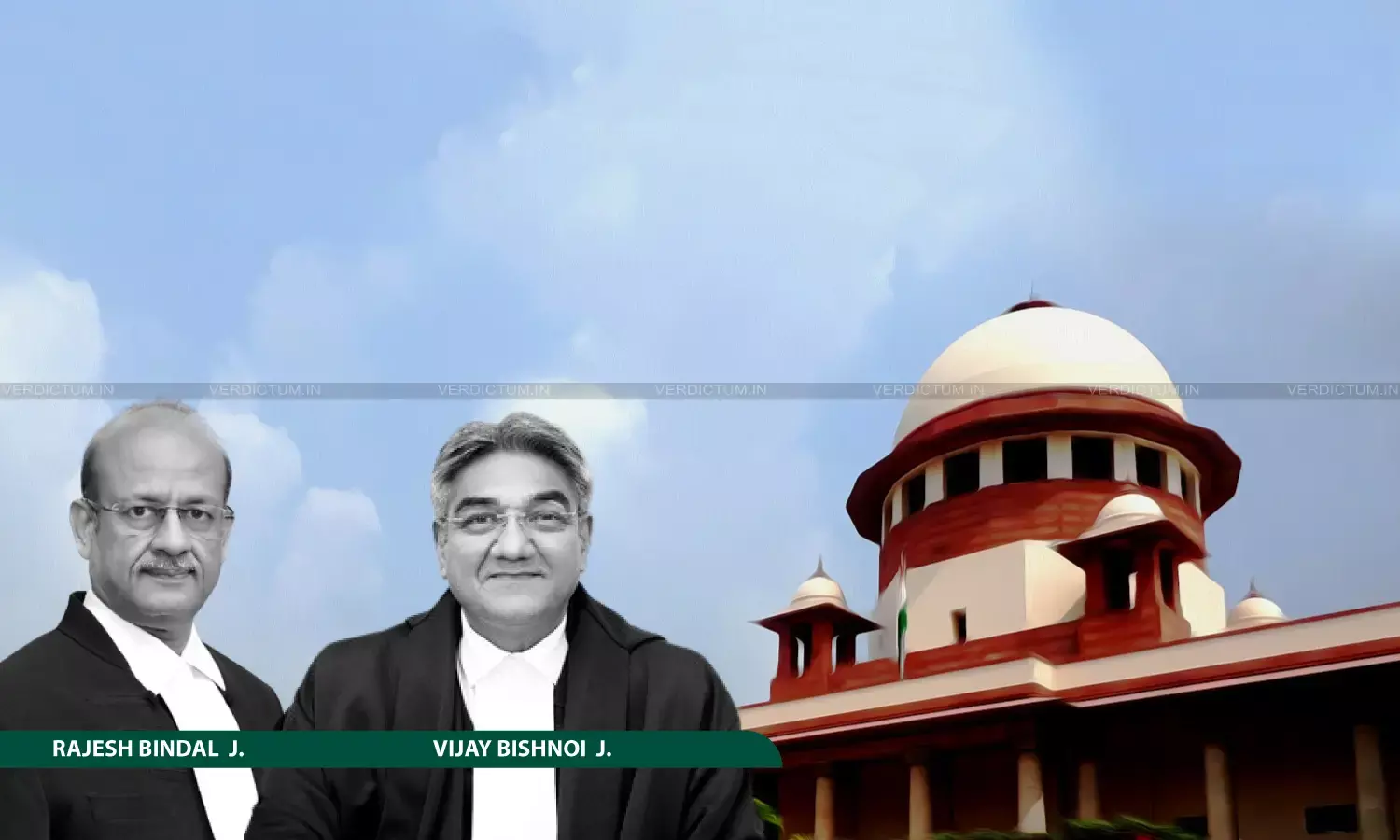
Justice Rajesh Bindal, Justice Vijay Bishnoi, Supreme Court
The Supreme Court has set aside orders of the Uttar Pradesh Government and a Superintendent of Police directing further investigation in a criminal case, holding that police authorities cannot order or conduct further investigation under Section 173(8) of the Code of Criminal Procedure, 1973 (CrPC) without first obtaining permission from the jurisdictional Magistrate.
The Court observed that the Superintendent of Police acted “in complete defiance of the procedure laid down under law” and exercised powers beyond jurisdiction, undermining judicial authority.
In the judgment, a division bench comprising Justice Rajesh Bindal and Justice Vijay Bishnoi observed, “…it is amply clear that the Superintendent of Police acted in complete defiance of the procedure laid down under the law while passing orders directing further investigation without seeking leave of the Court. It is an unbecoming conduct from the officer of such a rank to exercise unfettered powers, in excess of its jurisdiction, thereby undermining the authority vested in the Court of law”.
“…In the event, the police/ investigation agency is of the opinion that further investigation is necessary in any particular case to cull out complete facts and truth in the case, it is binding upon them to file an appropriate application before the Magistrate/Court, without directing an order for further investigation by themselves. Once such an application is filed by the investigation agency, the Magistrate/Court would apply its judicial mind, in light of the facts and circumstances of the particular case and the reasons demonstrated by the investigating agency, in order to exercise its discretion for exercise of its power to decide whether or not further investigation is to be ordered under the purview of Section 173(8) CrPC”, the bench also noted in the judgment.
Divyesh Pratap Singh, AOR appeared for the appellant and Apoorva Agrawal, A.A.G. appeared for the respondent.
In the present matter, an FIR was registered in Firozabad for offences including Section 376D IPC. After investigation, a final report (closure report) was filed in May 2014, citing contradictions in statements and lack of supporting evidence.
The Judicial Magistrate accepted the closure report on 14-09-2015 after notices to the informant went unanswered and no protest petition was filed.
However, after few years, following proceedings before the National Human Rights Commission (NHRC), the Under Secretary, Government of UP, directed that the matter be investigated by CBCID and recommended further investigation.
An Inspector of CBCID sought permission from the Magistrate on 22-04-2021, but no judicial order granting such permission was passed. Despite the order, the Superintendent of Police, Agra, issued directions on 26-04-2021 to proceed with the investigation and submit progress reports, leading to collection of DNA samples.
Therefore, the Supreme Court holding this course of action to be illegal, relying on settled principles reiterated that although Section 173(8) CrPC permits further investigation, it is an established legal requirement that investigating agencies must seek prior leave of the Court. The power to direct further investigation lies with the Magistrate or a superior court not with executive authorities or police officers, it further noted.
Allowing the appeal, the Bench quashed the impugned government and police communications dated 06-06-2019 and 26-04-2021, as well as the Allahabad High Court’s impugned order refusing to interfere dated 20-11-2023, while clarifying that its observations would not affect the pending criminal revision relating to the closure report.
Cause Title: Pramod Kumar & Ors. v. The State Of Uttar Pradesh & Ors. [Neutral Citation: 2026 INSC 120]
Appearances:
Appellant: Divyesh Pratap Singh, AOR, Shivangi Singh, Amit Sangwan, Bharat Mishra, Tiwari Prashantipriya Awadesh, Suraj Prakash Singh, Advocates.
Respondent: Apoorva Agrawal, A.A.G., Abhishek Kumar Singh, Sarvesh Singh Baghel, Advocates.