

Once Arbitral Tribunal’s View Is Found Plausible, Courts Cannot Sit In Appeal U/S 34 Or 37 Of A&C Act: Supreme Court
The Apex Court held that neither courts exercising jurisdiction under Sections 34 and 37 of the Arbitration and Conciliation Act, 1996, nor the Supreme Court under Article 136, can substitute their own interpretation merely because another view is possible.
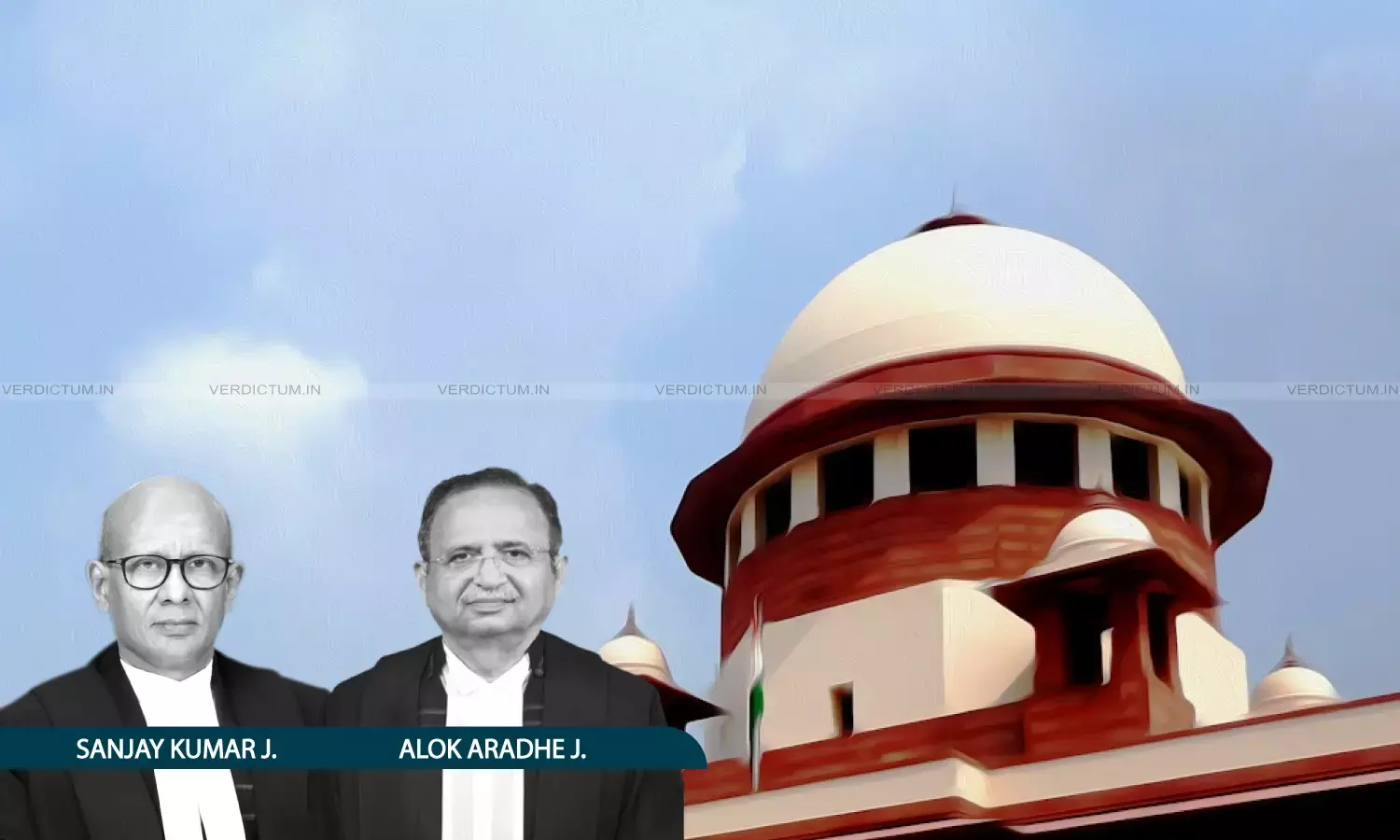
Justice Sanjay Kumar, Justice Alok Aradhe, Supreme Court
The Supreme Court has reaffirmed the limited scope of judicial review over arbitral awards, holding that once an arbitral tribunal has adopted a plausible and reasonable interpretation of facts and contractual terms, courts cannot re-appreciate evidence or sit in appeal over the award.
The Court was hearing a batch of civil appeals arising from arbitral awards passed under the Arbitration and Conciliation Act, 1996, involving disputes between the National Highways Authority of India (NHAI) and other contractors concerning reimbursement of cess levied under the Building and Other Construction Workers legislation.
A Bench comprising Justice Sanjay Kumar and Justice Alok Aradhe, upon examining the material placed on the record, observed: “Once the view taken by the arbitral tribunal is found to be a plausible and possible one on facts and not an unreasonable one, it is not for the Courts, under Sections 34 or 37 of the Arbitration Act, or for this Court to sit in appeal or substitute its view for that of the arbitral tribunal”.
Background
The disputes arose from infrastructure contracts awarded by NHAI for construction works across multiple States. Following delayed implementation of the Building and Other Construction Workers (Regulation of Employment and Conditions of Service) Act, 1996 and the Welfare Cess Act, 1996, NHAI deducted cess amounts from contractors’ bills.
The contractors invoked arbitration, contending that the levy constituted “subsequent legislation” under contractual clauses and that the financial burden could not be imposed upon them retrospectively. Arbitral tribunals, after examining contractual provisions, statutory framework, and factual timelines, allowed the contractors’ claims and directed reimbursement.
NHAI challenged the awards under Sections 34 and 37 of the Arbitration Act, contending that the tribunals had misapplied statutory provisions and contractual clauses.
Court’s Observation
The Supreme Court examined the scope of judicial interference with arbitral awards under Sections 34 and 37 of the Arbitration and Conciliation Act, 1996, and reiterated that such jurisdiction is supervisory and not appellate in nature.
The Court observed that an arbitral tribunal is the final authority on facts as well as on the interpretation of contractual clauses, and that courts are not entitled to reassess evidence or substitute their own interpretation merely because an alternative view is possible. Once an arbitral tribunal has adopted a view which is plausible, reasonable, and based on the material on record, interference is impermissible.
The Bench emphasised that the expression “patent illegality” cannot be expanded to permit a reappreciation of evidence or a re-examination of contractual terms, noting that such an approach would defeat the very purpose of arbitration as a mechanism for final and binding dispute resolution.
The Court further noted that the interpretation of clauses relating to “subsequent legislation”, allocation of financial burden, and the timing of statutory enforcement are matters that fall squarely within the tribunal’s domain. It held that where the tribunal has examined the contractual framework, statutory scheme, and surrounding factual circumstances to arrive at a reasoned conclusion, courts cannot interfere even if another interpretation is conceivable.
Addressing the argument that statutory enactment dates alone should govern liability, the Court observed that mere formal enactment of legislation does not automatically translate into enforceable obligations, particularly where implementation across States was delayed, uneven, or uncertain. The arbitral tribunals were therefore justified in examining the practical enforceability of the welfare legislation rather than treating the date of enactment as determinative.
The Court reiterated that arbitral tribunals are entitled to assess the commercial understanding of the parties, the factual context in which the contracts were executed, and the manner in which statutory obligations were imposed in practice. Such assessments, once found to be reasonable, cannot be displaced by judicial review.
Relying upon settled precedent, the Bench reaffirmed that courts exercising jurisdiction under Sections 34 and 37 cannot sit in appeal over arbitral awards, nor can they correct what may be perceived as errors of fact or reinterpret contractual provisions. Judicial intervention is warranted only where the award is vitiated by perversity, patent illegality, or contravention of a fundamental policy of Indian law.
In the present case, the Court found that the arbitral tribunals had undertaken a detailed examination of the contractual clauses, statutory framework, and factual background, and that the conclusions reached were neither arbitrary nor unreasonable. Consequently, no ground for interference was made out.
Conclusion
Holding that the arbitral tribunals had adopted plausible and reasonable views based on the contractual framework and surrounding circumstances, the Supreme Court declined to interfere with the awards.
The appeals filed by NHAI were dismissed, while the appeal filed by Prakash Atlanta (JV) was allowed.
Cause Title: Prakash Atlanta (JV) v. National Highways Authority of India (Neutral Citation: 2026 INSC 76)
Appearances
Appellants: Aishwarya Bhati, A.S.G., Advocates Neetica Sharma, Naman Saraswat, Manisha Chava, Ram Money, A.P. Singh, Vikas Soni, Tavinder Sidhu, M/s. M.V. Kini & Associates, AOR & Others
Respondents: Senior Advocate V. Giri, with Advocates Mahesh Agarwal, Victor Das, Vipul Singh, Shruti Arora, Nidhi Sri, Aishwarya Mishra, E.C. Agrawala, AOR, & Others
