RPwD Act Does Not Permit State To Arbitrarily Prescribe Upper Disability Ceiling For Reservation In Public Employment: Supreme Court
The Court held that the Act prescribes a minimum threshold of 40% disability to qualify as a “person with benchmark disability”, and does not authorise the State to impose an upper limit that excludes candidates with higher degrees of disability who are otherwise capable of performing the duties of the post.
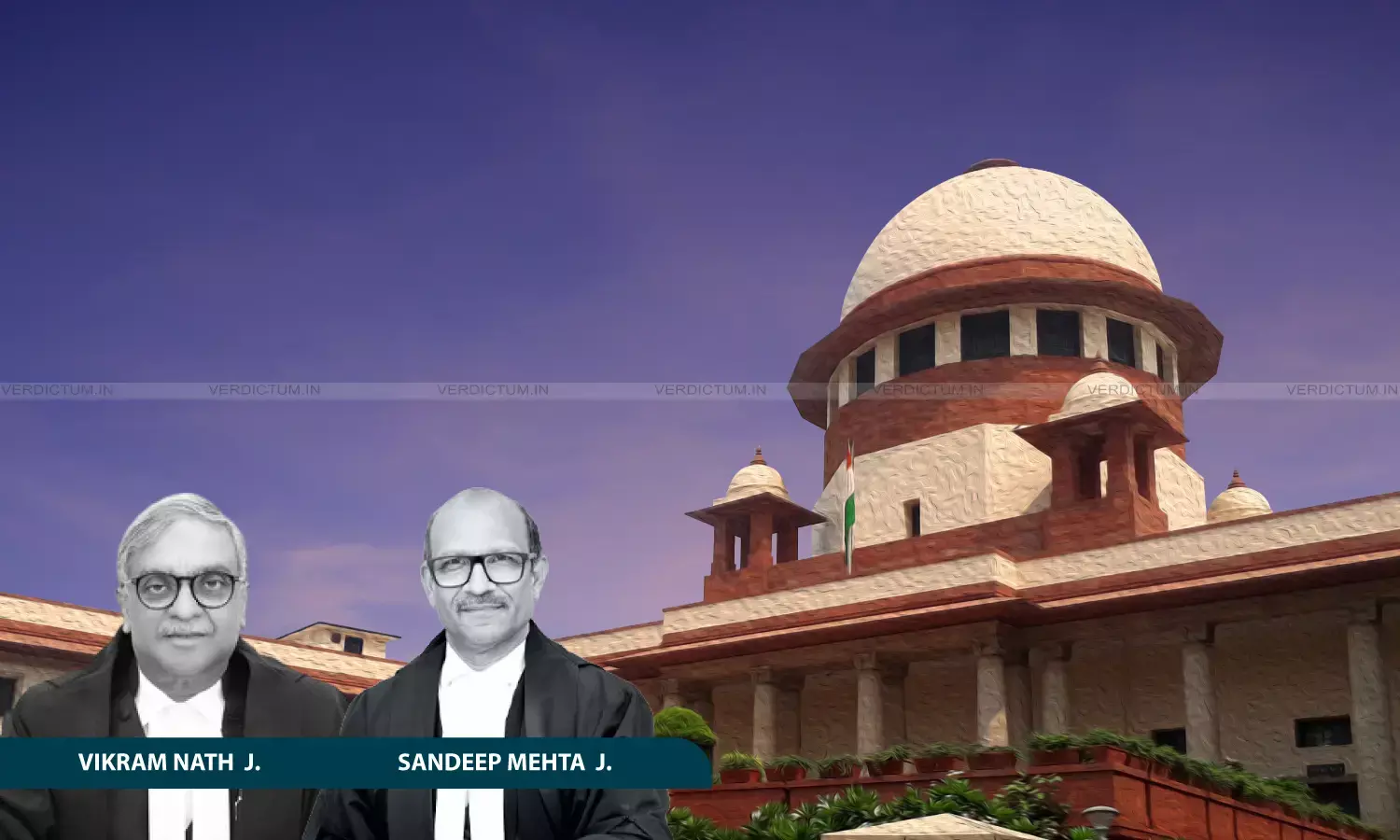
Justice Vikram Nath, Justice Sandeep Mehta, Supreme Court
The Supreme Court has held that prescribing an upper ceiling of disability for appointment under the reserved category of persons with benchmark disabilities is contrary to the scheme of the Rights of Persons with Disabilities Act, 2016.
The Court clarified that while the statute prescribes a minimum disability threshold for eligibility, it does not empower the State to exclude candidates with higher degrees of disability if they are otherwise capable of performing the functions of the post.
The Court was hearing a civil appeal challenging a judgment of the Himachal Pradesh High Court, which had upheld the denial of appointment to a candidate selected for the post of Assistant District Attorney on the ground that his disability exceeded the maximum limit prescribed in the recruitment advertisement.
A Bench of Justice Vikram Nath and Justice Sandeep Mehta, while interpreting the provisions of the Rights of Persons with Disabilities Act, 2016, observed: “…the legislature intended to create a threshold of inclusion, specifically designating 40% as the minimum requirement to qualify for ‘benchmark disability’ status, ....none of these provisions indicates that an upper limit can be prescribed in the matter of adjudging the suitability of a candidate for a particular post.”
“The RPwD Act 2016 defines the ‘floor’ for reservation eligibility, but does not empower the State to create an arbitrary ‘ceiling that excludes those with higher degrees of disability, provided they are otherwise capable of performing the functional requirements of the role through reasonable accommodation”, the Bench added.
Senior Advocate P.V. Dinesh appeared for the appellant, while Advocate Arman Roop Sharma represented the respondents.
Background
The dispute arose from a recruitment process conducted by the Himachal Pradesh Public Service Commission for the post of Assistant District Attorney, in which certain posts were reserved for persons with disabilities. The recruitment advertisement stipulated that candidates applying under the disabled category must have not less than 40% and not more than 60% disability in one arm or one leg.
The appellant, a practising advocate suffering from 90% permanent locomotor disability due to left shoulder disarticulation, applied under the reserved category. After scrutiny of his application, he was permitted to appear in the written examination, which he successfully cleared. He subsequently appeared before the interview board and was recommended for appointment under the physically handicapped quota.
However, when the final appointment notification was issued by the State Government, the appellant’s name was excluded. Upon seeking information, the appellant was informed that the recommendation had been rejected on the ground that his disability exceeded the upper limit of 60% prescribed in the advertisement.
Aggrieved by the denial of appointment despite having succeeded in the selection process, the appellant approached the High Court. The High Court dismissed the writ petition, leading to the present appeal before the Supreme Court.
Court’s Observation
The Supreme Court examined the statutory framework of the Rights of Persons with Disabilities Act, 2016, particularly the definition of “person with benchmark disability” under Section 2(r) and the provisions governing reservation in public employment.
The Court noted that the statute recognises persons with disabilities who have not less than forty per cent disability as eligible for benchmark disability status. Interpreting the statutory scheme, the Bench held that the legislative intent was to prescribe a minimum threshold for inclusion rather than to authorise exclusion through an upper disability limit.
The Court emphasised that the statute defines the floor of eligibility but does not authorise the State to impose a ceiling that excludes candidates with higher degrees of disability who are otherwise capable of performing the duties of the post through reasonable accommodation.
The Bench further observed that the High Court had relied upon the decision in V. Surendra Mohan v. State of Tamil Nadu (2019) to justify the imposition of a disability ceiling. However, the Court noted that the said decision had subsequently been overruled by a three-judge bench in Vikash Kumar v. UPSC (2021), which emphasised the principle of reasonable accommodation under the RPwD Act.
Referring to Vikash Kumar v. UPSC (2021), the Court reiterated that disability jurisprudence under the 2016 Act requires a departure from stereotypical assumptions regarding capability and instead mandates an assessment based on functional ability and reasonable accommodation.
The Court also highlighted that professional competence cannot be determined merely by the percentage of disability. It was observed that the appellant had completed the selection process and had been practising law for several years, demonstrating his functional ability to discharge the duties associated with the post.
“The percentage of disability, by itself, cannot be treated as determinative of a candidate’s capability or suitability for public employment. The statutory framework under the RPwD Act, 2016 enjoins upon the State a positive obligation to ensure equal opportunity and to provide reasonable accommodation”, the Court remarked.
In addition, the Court referred to earlier decisions, including Om Rathod v. Director General of Health Sciences (2024), Anmol v. Union of India (2025) and Kabir Pahariya v. National Medical Commission (2025), which emphasised that the eligibility of persons with disabilities must be assessed through individualised and evidence-based evaluation rather than rigid disability percentages.
The Bench further observed that “by failing to assess the appellant’s claim in the light of the doctrine of reasonable accommodation, the respondent authorities as well as the High Court have adopted an approach that is manifestly arbitrary and inconsistent with the guarantees of Articles 14 and 16 of the Constitution of India”.
The Court also questioned that, had the appellant applied under the general category and had successfully cleared the written examination as well as the interview and secured a position in the merit list, could the respondents have denied him appointment solely on account of the extent of his disability?
Stating that the answer to the above question, evidently, would be in the negative, the Bench concluded that “the principle that professional capability must be assessed on actual functional competence rather than a mere percentage of disability.”
Conclusion
The Supreme Court held that the prescription of a maximum disability limit of 60% for appointment under the reserved category was arbitrary and contrary to the Rights of Persons with Disabilities Act, 2016.
Accordingly, the Court set aside the judgment of the Himachal Pradesh High Court and directed the State Government to issue an appointment letter to the appellant for the post of Assistant District Attorney within two weeks.
The Court further directed that the appointment shall relate to the date on which appointments were originally issued and that the appellant shall be entitled to all notional benefits from that date. Considering that the appellant had been compelled to pursue prolonged litigation despite standing in merit, the Court also imposed costs of ₹5 lakhs on the State Government.
Cause Title: Prabhu Kumar v. State of Himachal Pradesh & Ors. (Neutral Citation: 2026 INSC 253)
Appearances
Appellant: Senior Advocate P.V. Dinesh with Advocates Subhash Chandran K.R., Biju P. Raman (AOR), Krishna L.R., Anna Oommen, Anirudh K.P., John Thomas Arakal
Respondents: Advocates Arman Roop Sharma, Shimpy Arman Sharma, Shivangi Goel, Priyanka Dubey, Saumya Mishra, with Dr Vinod Kumar Tewari (AOR)