

Refusal To Accommodate Each Other Amounts To Cruelty: Supreme Court Dissolves Marriage
The Supreme Court was considering an Appeal filed against the judgment of the Gauhati High Court (Shillong Bench), whereby the appeal filed by the Respondent-wife was allowed.

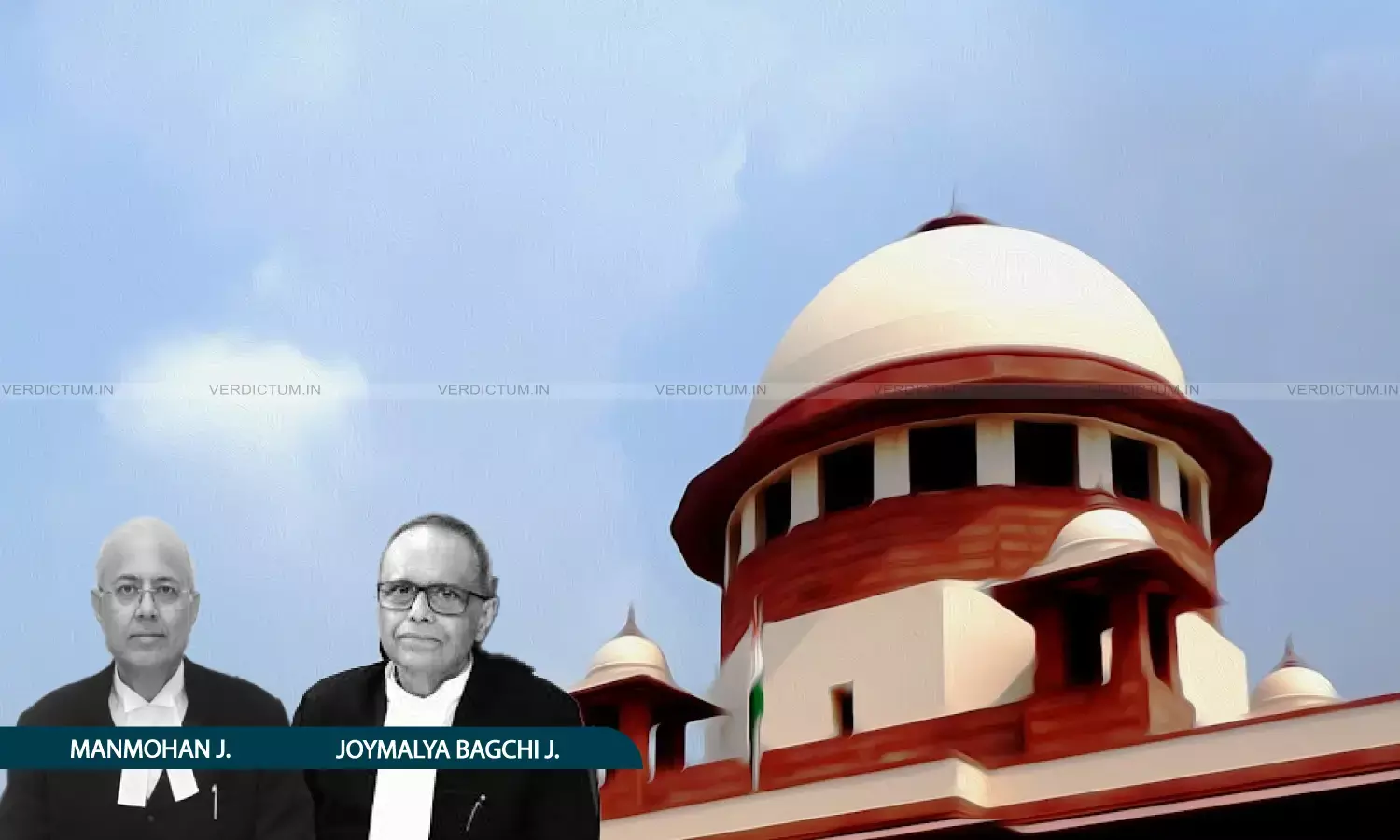
Justice Manmohan, Justice Joymalya Bagchi, Supreme Court
The Supreme Court observed that, in exercise of power to do “complete justice” under Article 142(1) of the Constitution of India, it has the discretion to dissolve the marriage on the ground of irretrievable breakdown. The Apex Court also held that the parties' refusal to accommodate each other amounted to cruelty to one another.
The Apex Court was considering an Appeal filed against the judgment of the Gauhati High Court (Shillong Bench), whereby the appeal filed by the Respondent-wife was allowed, and the judgment dissolving the marriage on the ground of desertion by the Respondent-wife was set aside.
The Division Bench of Justice Manmohan and Justice Joymalya Bagchi held, “In any event, this Court in exercise of power to do “complete justice” under Article 142(1) of the Constitution of India has the discretion to dissolve the marriage on the ground of irretrievable breakdown.”
"This Court is of the view that in matrimonial matters involving two individuals, it is not for the society or for the Court to sit in judgment over which spouses’ approach is correct or not. It is their strongly held views and their refusal to accommodate each other that amounts to cruelty to one another”, it added.
Factual Background
The marriage between the Appellant and Respondent was solemnised according to Hindu rites and rituals in 2000. The parties knew each other prior to their marriage as they had been working together since 1992 as Development Officers under Life Insurance Corporation of India Ltd. According to the Respondent-wife, the Appellant and his family members demanded that the Respondent give up her job, ignoring the fact that she had to financially look after her old and ailing mother, her brother and other dependents. It was the Respondent-wife’s case that due to the continuous ill-treatment meted out by the Appellant and his family, the Respondent-wife was compelled to leave her matrimonial home in 2001.
In 2003, the Appellant-husband instituted a suit for divorce before the Additional Deputy Commissioner (Judicial), Shillong, for dissolution of the marriage under Section 13(1)(i-b) of the Hindu Marriage Act, 1955. However, the suit was dismissed by the Additional Deputy Commissioner as premature. The Additional Dy. Commissioner dissolved the marriage, observing that Appellant-husband had been able to prove his case under Section 13(1)(i-b) of the Act, namely desertion. The Respondent-wife, feeling aggrieved by the judgment, filed a First Appeal before the High Court. The High Court allowed the appeal. It was in such circumstances that the appeal was filed before the Apex Court.
Reasoning
The Bench noted that the matrimonial litigation between the parties commenced within 2 years of marriage and had been pending for the last 22 years. It was further noticed that the parties had been living separately for 24 years and there was no child from the wedlock. Despite repeated efforts by the Courts, there had been no reconciliation between the parties. The Bench took note of the fact that no efforts had been made since then, by either of the parties, to reconcile their matrimonial differences.
The Bench noticed that the spouses had strongly held views with regard to the approach towards matrimonial life, and they refused to accommodate each other for a long period of time. Consequently, their conduct amounted to cruelty to each other. The Bench further explained, “In any event, this Court in exercise of power to do “complete justice” under Article 142(1) of the Constitution of India has the discretion to dissolve the marriage on the ground of irretrievable breakdown.”
Noting that grant of divorce in the present proceedings would not have a devastating effect on any third party, as there are no children from the wedlock, the Bench held, “ Consequently, this Court is of the view that marriage between the parties has irretrievably broken down and, therefore, in exercise of its power under Article 142 of the Constitution of India dissolves the marriage between the parties. Accordingly, the order of the Additional Deputy Commissioner (Judicial) Shillong, insofar as, it grants a decree of divorce to the parties is upheld…”
Thus, allowing the appeal, the Bench set aside the order of the High Court.
Cause Title: PQ v. YZ (Neutral Citation: 2025 INSC 1436)