

Any Embroidery Found On Witness Testimony Can’t Be A Ground For Throwing Prosecution Case Overboard: Supreme Court Upholds Murder Conviction
The Supreme Court agreed with the argument that premeditated murder with common intention has been irrefutably established by the prosecution.
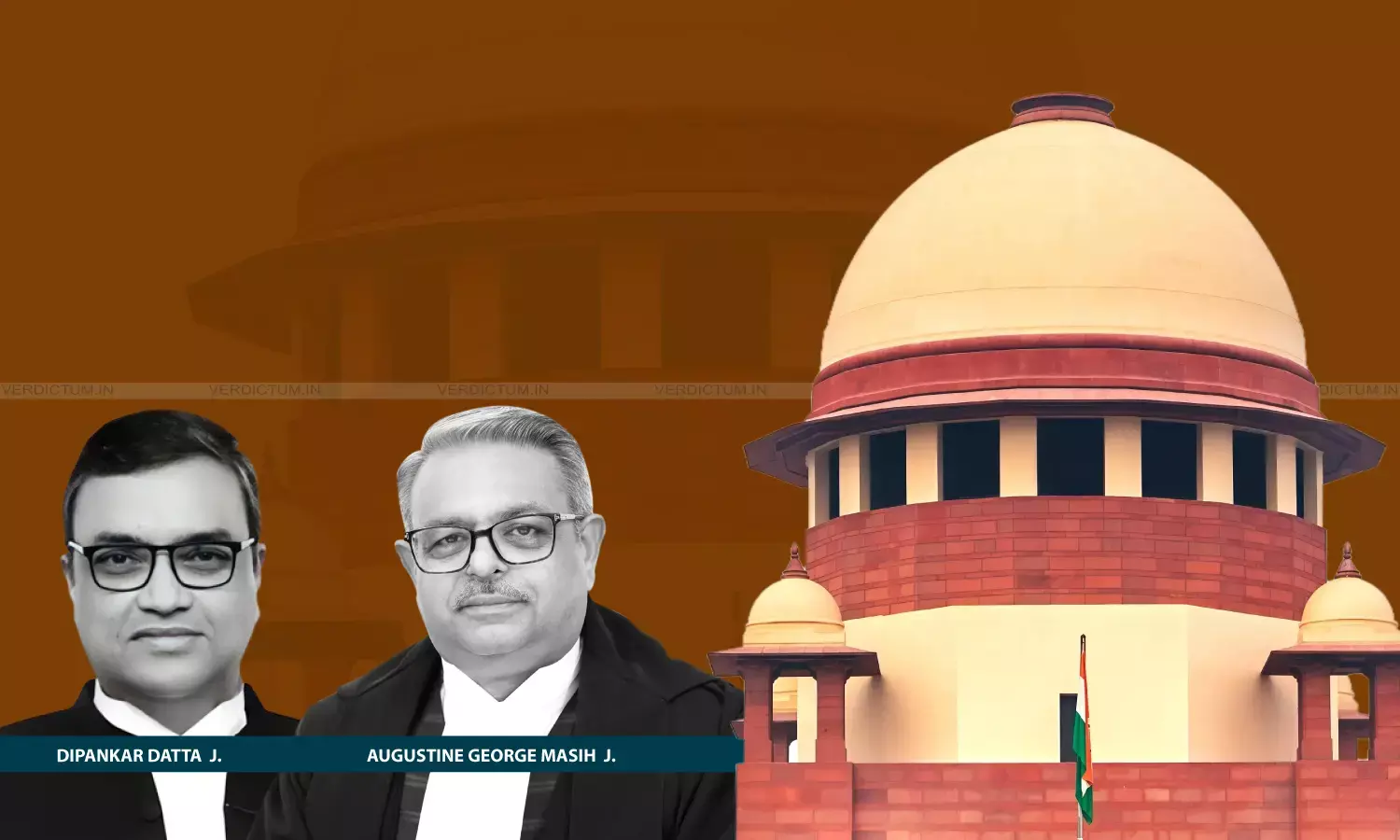
Justice Dipankar Datta, Justice Augustine George Masih, Supreme Court
While upholding the conviction in 2007 murder case, the Supreme Court reiterated that any embroidery found cannot per se be a ground for throwing the prosecution case overboard, if there is a ring of truth in the main.
The Court was hearing a batch of Criminal Appeals challenging the Judgment of the Madras High Court, by which the accused persons were convicted under Section 302 read with Sections 34, 148, and 341 of the Indian Penal Code, 1860 (IPC).
The two-Judge Bench of Justice Dipankar Datta and Justice Augustine George Masih observed, “As warned by this Court, any embroidery found cannot per se be a ground for throwing the prosecution case overboard, if there is a ring of truth in the main. It is the duty of the court to sift the grain from the chaff unless there is reason to believe that the inconsistencies or falsehood are so glaring as utterly to destroy confidence in the witnesses.”
The Bench agreed with the argument that premeditated murder with common intention has been irrefutably established by the prosecution based on the evidence on record and the findings returned by the High Court.
Senior Advocate Navin Pahwa, AOR Deepak Prakash, R. Prabhakaran, and Sowmya appeared for the Appellants, while Senior Advocates V. Krishnamoorthy and N.S. Nappinai appeared for the Respondents.
Facts of the Case
As per the prosecution case, at a gathering in the house of A-9 in July, 2007, all the accused persons had planned the murder of the victim. FIRs in cases pertaining to prior feuds between the families of the victim on the one hand and those of A-4 and A-9 on the other provided the motive. At about 1:00 p.m., the victim left the school (where he was a teacher) on his motorcycle and was heading home for lunch. PWs 1 (brother-in-law of the victim) and 2 (brother of the victim) were following the victim on a separate motorcycle. It was alleged that the victim was initially waylaid by A-3 and A 4 and striking a ninja chain against the motorcycle which the victim was riding, A-3 ensured that the victim was compelled to stop. Allegedly, A-1, A-2, and A-4 then attacked the victim with sickles and A-5, A-6, and A-8 to A 11 were also attributed the role of attacking the victim with sickles.
While PWs 1 and 2 tried to intervene, they were allegedly threatened by the multiple accused of dire consequences. To save their lives, PWs 1 and 2 hid behind a tree and witnessed the ghastly attack on the victim. The victim died on the spot as a result of the injuries inflicted on him. It was further alleged that the victim was then pushed into a field by the accused, whereafter some of them left in a car driven by A-7 while the rest ran away from the scene of crime. Resultantly, a complaint was lodged and the Trial Court acquitted the accused persons. The High Court convicted A-1 to A-4 and A-10 and sentenced them to undergo life imprisonment. However, it did not disturb the acquittal of the co-accused (A-5 to A-9 and A-11). Being aggrieved by their conviction, the accused persons approached the Apex Court.
Reasoning
The Supreme Court in view of the facts and circumstances of the case, noted, “Insofar as the question of delay in forwarding the FIR to the Judicial Magistrate on 13th July, 2007 at 05.30 hours is concerned, i.e., about 14 hours after the registration thereof and the inference drawn by the trial court of manipulation of the FIR, we agree with the High Court that the delay is not fatal to the case of the prosecution. There is justification provided through the evidence of PW-26 (Head Constable). He stayed overnight to ensure that the FIR reaches the magistrate, which stands proved by reason of the document, being Ext. P-19, containing the signature of the Magistrate with date and time, acknowledging receipt of the FIR.”
The Court said that there is no reason to hold that the evidence of PWs 1 and 2 was not creditworthy and merely because they were related to the victim, it can afford no ground to discredit their evidence.
“In fact, we agree with the High Court that the conduct of PWs 1 and 2 was natural, faced with the threat of being physically harmed by the appellants and the others who were armed with sickles. We also agree with the High Court that the trial court based its conclusions on imaginary and illusionary reasons and that it was right in rejecting the trial court’s finding on alleged contradictions in respect of the injuries to the victim between the evidence of PWs 1 and 2, as being contrary to settled law”, it added.
The Court held that the evidence of the eye witnesses as also circumstantial evidence including medical evidence, the charges against A-1 to A-4 and A-10 are duly proved.
“There is merit in the argument of Ms. Nappinai that premeditated murder with common intention has been irrefutably established by the prosecution based on the evidence on record and the findings returned by the High Court, on a fair and proper appreciation and analysis of the evidence on record, point unerringly towards the guilt of the appellants and that there is no perversity in the decision of the High Court”, it concluded.
Accordingly, the Apex Court dismissed all the Appeals and upheld the conviction.
Cause Title- Patchaiperumal @ Patchikutti & Anr. v. State Rep. by Inspector of Police & Anr. (Neutral Citation: 2025 INSC 1478)
Appearance:
Appellants: Senior Advocate Navin Pahwa, AORs Deepak Prakash, G. Sivabalamurugan, Binisa Mohanty, Shyam Gopal, Advocates R. Prabhakaran, Sowmya, Rajesh Sen, Shibani Bhattacharjee, Kamal Pundir, Abdullah, Shailendra Singh, Abhyuday Dhasmana, Rajul Shrivastava, K. Krishna Kumar, and P. Krishnadevan.
Respondents: Senior Advocates V. Krishnamoorthy, N.S. Nappinai, AORs Rakesh K. Sharma, Sabarish Subramanian, Advocates Vishnu Unnikrishnan, Azka Sheikh Kalia, Jahnavi Taneja, Veshal Tyagi, K.S. Badhrinathan, and Danish Saifi.
