

Compensation Cannot Become “Blood Money” In Heinous Offences: Supreme Court Restores 3-Year Sentence Of Convict In Attempt To Murder Case
Trend amongst various High Courts where awarded sentences are reduced without application of mind

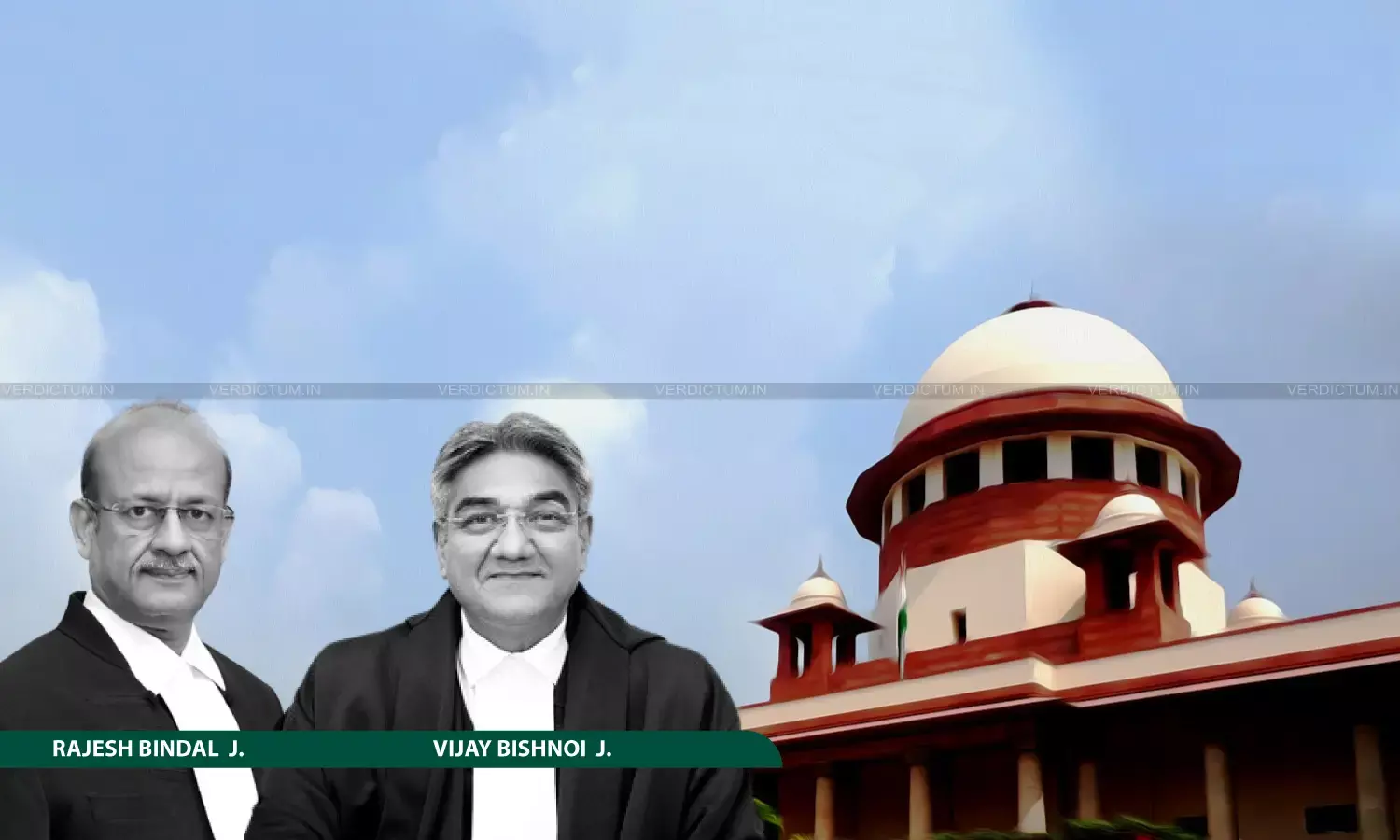
Justice Rajesh Bindal, Justice Vijay Bishnoi, Supreme Court
The Supreme Court has set aside a Madras High Court order holding that monetary compensation cannot be treated as a substitute for punishment in serious offences. The impugned order had reduced the sentence of two convicts in an attempt to murder case to the period already undergone upon payment of enhanced compensation.
The bench referred to its previous judgment where it termed such payment of compensation by the High Court as “blood money”. It further observed that there is a trend amongst various High Courts wherein the sentences awarded to the accused persons by the Trial Court are reduced mechanically, "without any visible application of judicial mind".
The Bench was of the opinion that the undue sympathy shown by the High Court in sentencing was unwarranted, particularly in cases involving life-threatening injuries, as it undermines public confidence in the criminal justice system.
A Division Bench of Justice Rajesh Bindal and Justice Ajay Bishnoi, while referring to Shivani Tyagi v. State of U.P. & Anr. 2024 SCC OnLine SC 842, where a bench comprising Justice Bindal was dealing with a horrendous situation where in an offence related to acid attack, observed, “…the High Court suspended the sentence of the accused in lieu of payment of ₹ 25 lakhs to the victim for medical treatment. The High Court went to the extent of directing the payment to be deposited with the court when the victim refused to accept the said amount. This Court while setting aside the judgment of the High Court termed that such payment was kind of “Blood Money” to the victim by the offenders”.
“The misplaced understanding of various courts in treating compensation as a substitute of sentence is both a matter of concern and a practice which should be condemned. We have observed a trend amongst various High Courts wherein the sentences awarded to the accused persons by the Trial Court are reduced capriciously and mechanically, without any visible application of judicial mind. Considering the gravity of the situation as thus, we have culled out certain basic factors, which are to be kept in mind by the courts while dealing with imposition of sentence, in line with the view taken by this Court in the aforementioned cases”, the bench further noted.
Advocate Navpreet Kaur appeared for the appellant and V. Krishnamurthy, Senior A.A.G. appeared for the respondent.
As per the facts, on 06-06-2009 in Tamil Nadu, the private respondents, armed with knives, assaulted the victim due to prior enmity and inflicted multiple stab injuries on his chest, abdomen and hand. The medical evidence established that the victim suffered four grievous stab injuries which, if left untreated, could have proved life-threatening.
The trial court convicted the accused under Sections 307, 326 and 324 of the IPC and sentenced them to three years’ rigorous imprisonment with a fine of ₹5,000 each.
Subsequent to which, the conviction and sentence were affirmed by the appellate court. In revision, however, the High Court upheld the conviction but reduced the sentence to the two months already undergone, while enhancing the fine to ₹50,000 each to be paid as compensation to the victim’s wife.
Now, before the Supreme Court, it was contended that the High Court had reduced the sentence without cogent reasons and had exceeded its revisional jurisdiction by showing undue leniency. It was argued that compensation cannot replace punishment and that sentencing must reflect the gravity of the crime.
Therefore, allowing the appeal, the Court held that the High Court acted in “complete defiance” of settled sentencing principles. The Bench reiterated that proportionality between crime and punishment is central to criminal jurisprudence and that sentencing must balance aggravating and mitigating factors, the rights of the victim, and societal interest.
“…the High Court, while exercising its revisionary powers, very ignominiously reduced the sentence of the Private Respondents to the period already undergone. The High Court was so undesirous to even glance through the fact that the Trial Court had already taken into consideration all the relevant factors while imposing the sentence and showed adequate leniency while awarding sentence of rigorous imprisonment for three years only, whereas the maximum punishment permissible for the offence under Section 307 of the IPC is ten years. Additionally, the undue sympathy shown by the High Court herein was totally unwarranted, and such displays of overt sentiments risk undermining the administration of justice, as it is imperative that justice is not merely done but also seen to be done, it noted in the judgment.
The Bench said that victim compensation under statutory provisions is restitutory in nature and cannot exonerate the offender or dilute punitive consequences. In serious offences, reducing custodial sentences solely on account of lapse of time or payment of money sends a dangerous message that criminal liability can be purchased.
Accordingly, the respondents were directed to surrender before the trial court within four weeks to serve the remaining sentence, failing which coercive steps were to be taken.
Cause Title: Parameshwari v. State of Tamil Nadu & Ors. [Neutral Citation: 2026 INSC 164]
Appearances:
Appellant: A Velan, AOR, Navpreet Kaur, Mritunjay Pathak, Prince Singh, Nilay Rai, Kanika Sharma, M. Rashik Hameed Mukilan, Advocates.
Respondent: V. Krishnamurthy, Sr. A.A.G., Sabarish Subramanian, AOR, M.P. Parthiban, AOR, Priyaranjani Nagamuthu, Bilal Mansoor, Shreyas Kaushal, S. Geyolin Selvam, Alagiri K, Shivansh Sharma, Abhishek S, Advocates.