

Compromise Or Arrangement U/S. 230 Companies Act 2013 Permissible During IBC Proceedings At Appropriate Stage: Supreme Court
The Apex Court held that a compromise or arrangement under Section 230 of the Companies Act, 2013, can also be entered into during proceedings under the Insolvency and Bankruptcy Code, 2016, at an appropriate stage.
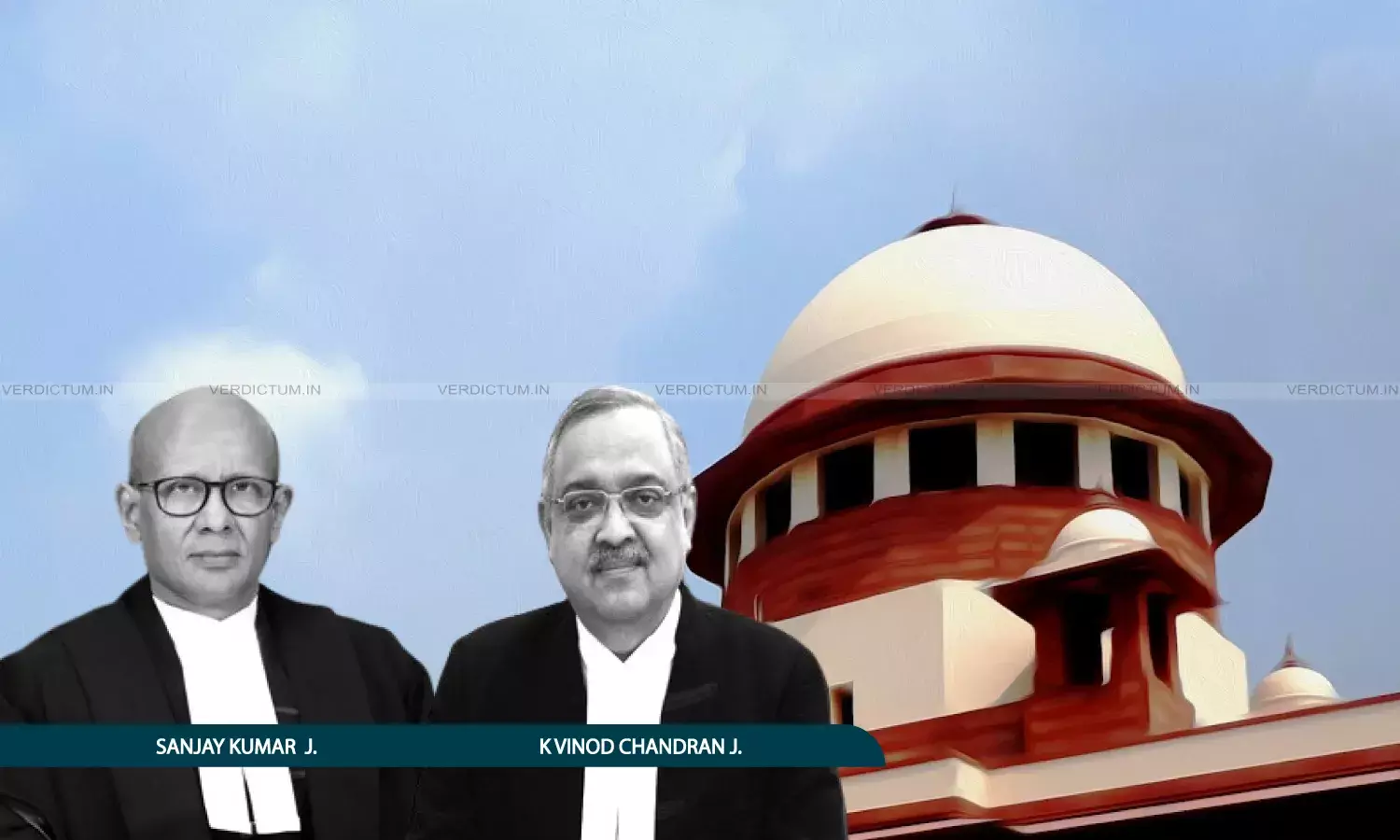
The Supreme Court has held that a compromise or arrangement under Section 230 of the Companies Act, 2013, can also be entered into during insolvency proceedings under the Insolvency and Bankruptcy Code, 2016, at an appropriate stage.
The Court clarified that the statutory framework of the IBC does not preclude such arrangements during the insolvency process.
The Court was hearing a civil appeal challenging the order of the National Company Law Appellate Tribunal (NCLAT), which had kept proceedings under Section 7 of the IBC in abeyance on account of pending proceedings relating to a Scheme of Arrangement under Sections 391–394 of the Companies Act, 1956, before the High Court.
A Bench comprising Justice Sanjay Kumar and Justice K. Vinod Chandran examined the interplay between the Companies Act regime and the IBC, including the effect of the Companies (Transfer of Pending Proceedings) Rules, 2016, and observed: “a compromise or an arrangement under Section 230 of the Companies Act, 2013 can also be entered into in an IBC proceeding at the appropriate stage.”
Background
The financial creditor had initiated proceedings under Section 7 of the IBC seeking commencement of the Corporate Insolvency Resolution Process (CIRP) against the corporate debtor in respect of substantial outstanding dues arising from earlier financial transactions.
The corporate debtor resisted the insolvency proceedings on the ground that a Scheme of Arrangement under Sections 391–394 of the Companies Act, 1956, had been sanctioned by the High Court and that related proceedings were pending.
The Adjudicating Authority admitted the Section 7 application, declared a moratorium and appointed an Interim Resolution Professional. However, on appeal, the NCLAT kept the insolvency proceedings in abeyance pending the outcome of the Scheme of Arrangement proceedings.
Court’s Observation
The Supreme Court examined the statutory procedure under Section 391 of the Companies Act, 1956, noting that it required two distinct stages: first, the convening of meetings of creditors; and second, the sanction of the scheme upon approval by the requisite majority. It also referred to the Companies (Court) Rules, 1959, which prescribed timelines for filing the second motion and for completing procedural formalities.
The Court found that in the present case, the second motion had not been filed within the prescribed time and that when the Companies (Transfer of Pending Proceedings) Rules, 2016 came into force, the second motion that had been filed belatedly was pending and had not been reserved for orders. In such circumstances, the proceeding was required to be transferred to the National Company Law Tribunal.
The Bench observed that there was no basis to keep the IBC proceedings in abeyance on the ground of judicial discipline. It held that proceedings under Section 7 of the IBC are independent and must be tested on their own merits.
The Court noted that even under the Companies Act, 2013, a compromise or arrangement under Section 230 can be entered into during insolvency proceedings at an appropriate stage, including in liquidation. The Court reproduced its earlier observations to the effect that such arrangements are not alien to the IBC framework.
The Court reiterated that the IBC has an overriding effect by virtue of Section 238 and that insolvency proceedings cannot be made subservient to pending company law proceedings which are not reserved for orders and are liable to statutory transfer.
Conclusion
Setting aside the order of the NCLAT, the Supreme Court restored the order of the Adjudicating Authority admitting the Section 7 application and initiating CIRP. The Interim Resolution Professional was directed to proceed in accordance with the law.
The Civil Appeal was accordingly allowed.
Cause Title: Omkara Assets Reconstruction Private Limited v. Amit Chaturvedi & Ors., (Neutral Citation: 2026 INSC 189)
Appearances
Appellant: Neeraj Kishan Kaul, Sr. Adv.; Abhijeet Sinha, Sr. Adv.; Mandeep Kalra, AOR and others
Respondents: Purti Gupta, AOR; Ravi Sehgal, Adv.; Siddhartha Jha, AOR and others
