

Party Setting Up Competing Claim To Hereditary Pujari Rights Has To Plead Specifically When They Came Into Possession Of Suit Temple: Supreme Court
The Supreme Court was considering a matter where there was a protracted dispute over claims to the ancestral pujari rights and the right to perform puja of the deity Amogasidda.

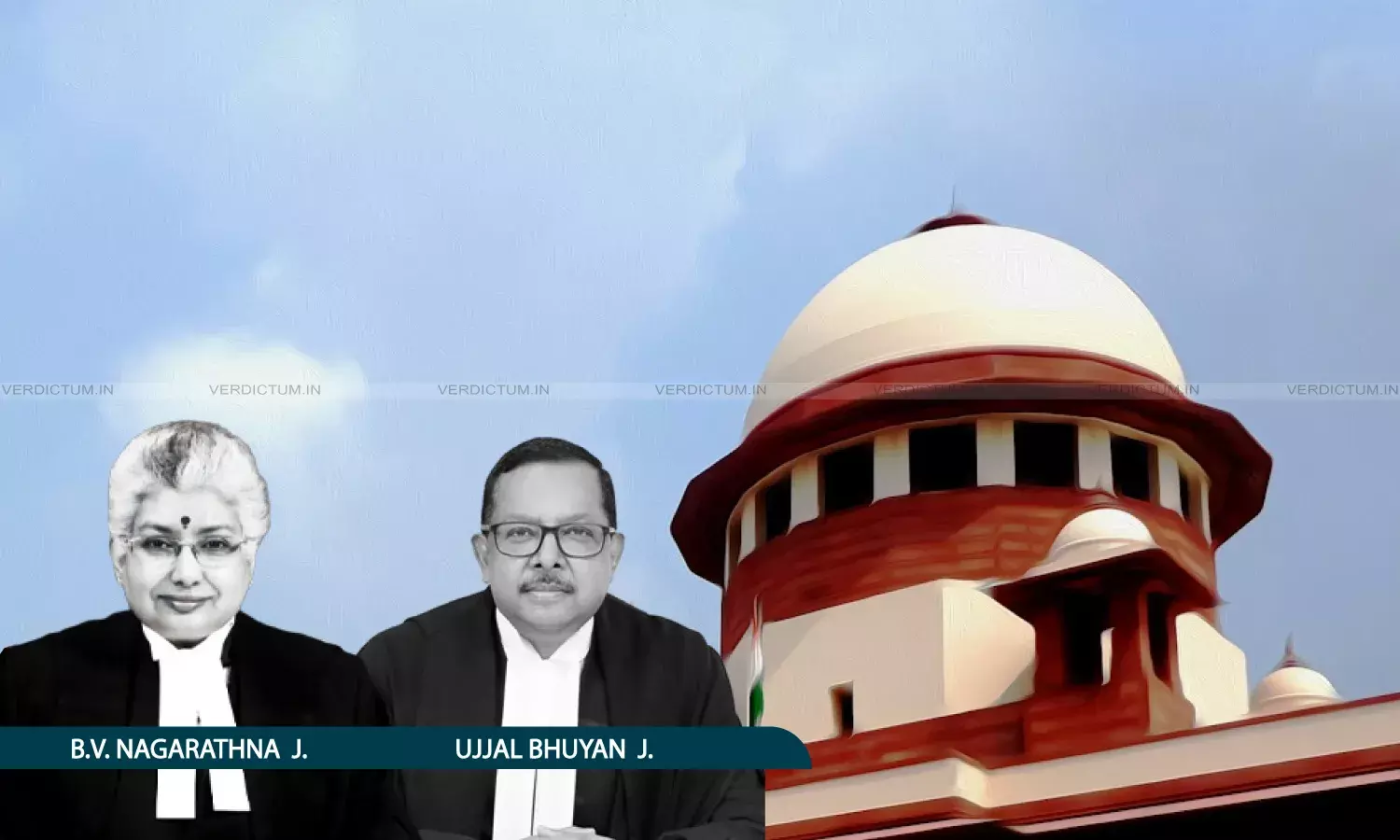
Justice B.V. Nagarathna, Justice Ujjal Bhuyan, Supreme Court
While dealing with a case of competing claims to the ancestral pujari rights of the deity Amogasidda, the Supreme Court has held that a party setting up a competing claim to hereditary pujari rights is obligated to plead specifically when they came into possession of the suit temple, when they commenced performing puja and when and how the opposite parties began obstructing them.
The Apex Court was considering a matter where there was a protracted dispute spanning over a century, wherein the respondents/plaintiffs and the appellants/defendants lay competing claims to the ancestral pujari rights and the right to perform puja of the deity Amogasidda – a saint who passed away 600 years ago and his Samadhi was built as a reverence at the temple situated in Mamatti Gudda, Jalgeri, Arkeri, Karnataka.
The Division Bench of Justice B.V. Nagarathna and Justice Ujjal Bhuyan held, “A party setting up a competing claim to hereditary pujari rights is obligated to plead specifically—when they came into possession of the suit temple; when they commenced performing puja; when and how the respondents/plaintiffs began obstructing them; and what steps, if any, they took to vindicate their rights during the long intervening period. The written statement of the appellants/defendants is reticent on each of these material particulars. They contend themselves with a bare denial and a reference to the 1901 decree. This is wholly insufficient. In the absence of any foundational plea, the oral evidence of D.W.1 attempting to fill these gaps must necessarily be disregarded. Oral evidence cannot be a substitute for pleading, and a case not made out in the pleadings cannot be erected on evidence alone.”
Senior Advocate Basava Prabhu S. Patil represented the Appellant, while AOR T. V. Ratnam represented the Respondent.
Factual Background
The genesis of this longstanding dispute dates back to 1944, when the deceased Ogeppa Biradar/predecessor-in-interest of the appellants/defendants, along with others, filed an Original Suit for possession of the suit temple and other properties, contending that the plaintiffs had entered into possession of the temple property by force and had asserted the right to perform puja. The Trial Court dismissed the suit. The appellants/defendants preferred First Appeal, but during its pendency, they filed an application to withdraw the said suit with liberty to file a fresh suit, to which the plaintiffs/respondents’ counsel consented. The Appellate Court accordingly set aside the judgments of the Trial Court and permitted the withdrawal.
In 1967, it was alleged by the respondents/plaintiffs that the appellants/defendants started obstructing the puja in the suit temple, and consequently, the respondents/plaintiffs filed a suit for permanent injunction. An ex parte decree was granted in favour of the respondents/plaintiffs, but the said suit was later dismissed for non-prosecution. Later, the present respondents/plaintiffs filed a suit before the Court of the Principal Munsiff at Bijapur for a declaration that they are the ancestral wahiwatdar pujargi possessing puja rights at the suit temple, along with consequential prayers for permanent injunction.The Trial Court partly decreed the suit and declared that both the Civil Appeals respondents/plaintiffs and the appellants/defendants are pujargies of the suit temple and shall perform puja and jatra in a certain proportion, whilst rejecting the prayer for injunction.
The appellants/defendants, being aggrieved by the judgment passed by the First Appellate Court, preferred a Regular Second Appeal before the High Court, which was allowed. Against the High Court's judgment, the respondents/plaintiffs preferred special leave petitions before the Apex Court, which were later converted into Civil Appeals. The Court, while allowing the said Civil Appeals, remanded the matter back to the High Court and held that the bar of Section 80 of the Bombay Public Trust Act did not apply and the matter required a decision on merits. After remand, the appeals were dismissed, thereby decreeing in favour of the respondents/plaintiffs. This judgment, thus, came to be challenged before the Apex Court.
Reasoning
The Bench, at the outset, reaffirmed that the jurisdiction under Article 136 of the Constitution of India should be used sparingly more particularly when dealing with concurrent findings of fact. “Unless and until the findings rendered by the courts below are manifestly perverse, this Court should be reluctant to intervene in the same”, it added.
On a perusal of the facts of the case, the Bench held that the First Appellate Court rightly noticed that if the appellants/defendants were indeed in continuous and uninterrupted possession of the suit temple and had been discharging their duties as wahiwatdar pujaries thereunder, there was no conceivable reason for their predecessor to have instituted the suit seeking possession and injunction. “A party in settled possession does not sue for possession. The very institution of that suit is a categorical admission by the appellants/defendants' predecessor that possession of the suit temple was not with them at the relevant point in time. This inference drawn by both, the First Appellate Court and the High Court, is legally sound”, it stated.
The Bench further noticed that the predecessor of the appellants/defendants, having lost the said suit on merits before the Trial Court, and instead of pursuing the appeal, moved an application seeking withdrawal of the suit with liberty to file a fresh suit. Thereafter, for over three and a half decades, no fresh suit was instituted, and the appellants/defendants had offered no explanation, either in their pleadings or in their evidence, as to what transpired during this long interregnum.
The Bench further mentioned, “As the High Court correctly observed, when a party obtains liberty to file a fresh suit and consciously refrains from doing so for thirty-six years, the inevitable inference is that the said party had reconciled itself to the factual reality on the ground. This conduct speaks louder than any decree of 1901 that the appellants/defendants seek to wave before this Court.”
As per the Bench, the respondents/plaintiffs had established their claim throughout, through consistent documentary evidence, revenue records, the admission of the appellants/defendants' own witness, and the testimony of independent witnesses, including the devotees of the temple, that they had been performing puja at the Amogasidda temple as hereditary wahiwatdar pujaries. “The appellants/defendants, on the other hand, rest their claim almost entirely on a century-old decree, the effect of which was demonstrably undone by their own predecessor's subsequent conduct in instituting a suit for possession in 1944”, it added.
Thus, finding no perversity in the impugned judgment, the Bench dismissed the appeal.
Cause Title: Ogeppa (D) Through Lrs. v. Sahebgouda (D) (Neutral Citation: 2026 INSC 191)
Appearance
Appellant: Senior Advocate Basava Prabhu S. Patil, Advocates S. K. Kulkarni, M. Gireesh Kumar, AOR Ankur S. Kulkarni, Advocates Uditha Chakravarthy, Arijeet Shukla, Tarun, B.K. Prasad, Rajini. K. Prasad, AOR N. Annapoorani
Respondent: AOR T. V. Ratnam, Advocates Akhil Ranganathan S., Rajendra Prasad Maurya