

Site Not Identified On The Ground & Title Not Proved: Supreme Court Upholds Dismissal Of Injunction Suit
The Supreme Court was considering a civil matter in which the High Court had reversed the order dismissing a suit for a permanent injunction filed by the respondent plaintiffs.

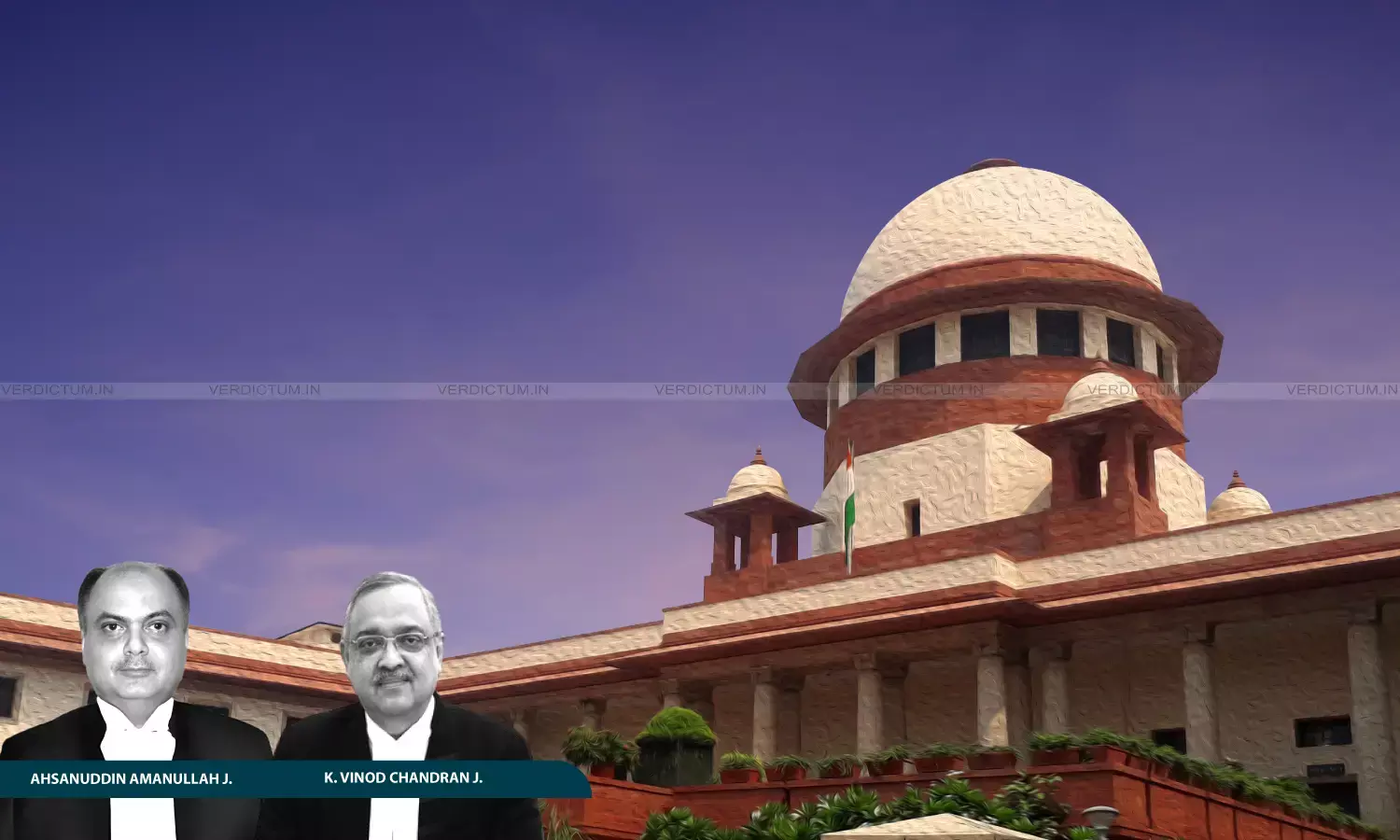
Justice Ahsanuddin Amanullah, Justice K. Vinod Chandran, Supreme Court
The Supreme Court has restored an order of the Trial Court dismissing a suit for injunction after finding that there was no seal or a clear signature on the letter purportedly written by the Land Acquisition Officer of the BDA, and the plaintiff failed to prove the title.
A suit for permanent injunction filed by the respondent plaintiffs was dismissed. This order was reversed by the High Court and decreed in First Appeal, against which the appellants/defendants filed an appeal before the Apex Court.
The Division Bench of Justice Ahsanuddin Amanullah and Justice K. Vinod Chandran held, “The trial court, according to us, rightly refused to rely on Exhibit P-24, a letter purportedly written by the Land Acquisition Officer of the BDA, wherein there was no seal or a clear signature, the latter being not legible. It was categorically found that the building licence produced as Annexure P-22 by the respondents also referred to a different property from that described in the schedule to the suit.”
“The properties in the survey numbers as shown in the rectification having not been identified, there can be no injunction granted. The plaintiff has not proved the title, nor was Site No.66 properly identified on the ground, based on survey numbers”, it further added.
Senior Advocate Shailesh Madiyal represented the Appellant, while AOR Vagisha Kochar represented the Respondent.
Factual Background
The facts as presented by the appellants were that their property was acquired by the Bangalore Development Authority. Though possession was not taken, an agreement was executed, allotting the property to the father of the respondents/plaintiffs. Later, a sale deed was executed. Subsequently, on a writ petition filed by the appellants, the acquisition itself was set aside. The respondents filed a suit for a permanent injunction. While the matter was pending, a rectification deed was executed by the BDA in favour of the children of the original allottee, the respondents, alleging that there was a mistake in the survey numbers shown in the original deed and replacing it with Survey Nos. 350/9, 350/10 and 350/11.
A further suit was filed in which the trial court found the claim of title to be not established, and even going by the documents produced, the identification of the property was not possible. The trial court rejected the claim for a permanent injunction. The High Court reversed the judgment on the ground that there was a survey conducted by the BDA on a request made by the respondents’ advocate to the Police, in which Site No.66 was found existing in the survey numbers as mentioned in the rectified deed. Aggrieved thereby, the appellants approached the Apex Court.
Reasoning
On a perusal of the facts of the case, the Bench noted that the allotment was made to the predecessor of the plaintiffs on the basis of the acquisition of the properties in Survey Nos.349/1 and 350/12, and the same was evident from the sale agreement and the sale deed which were far apart in time, the former in the year 1993 and the latter after a decade in the year 2003. It was noticed by the trial court that the sale agreement clearly insisted on the construction of a residential house in the allotted plot, which also had to be completed within a period of two years from allotment.
Noting that there was no building constructed by the father of the respondents or the respondents themselves, even when the suit was filed, the Bench affirmed the finding that the title of the respondents/ plaintiffs was not established. The Bench also noticed that Site No.66 as allotted couldnot be found to be existing in Survey Nos.349/1 or 350/12, and it was also not identified in Survey Nos.350/9, 350/10 and 350/11. The rectification deed also did not speak of the specific grounds on which the alleged errors were rectified.
The Bench also stated, “The High Court in our opinion seriously erred in having relied on the alleged survey carried out by the BDA. The letter produced is silent insofar as it does not refer to any clear boundaries or the measurements by metes and bounds. Moreover, the said survey, if at all carried out was behind the back of the appellants which could not have been relied upon by the High Court. The document, though produced by the plaintiff who deposed before Court, production is not proof and the author of the said document, the Surveyor/Land Acquisition Officer was not examined before Court.”
The Bench was of the view that the original allotment was made of the property acquired from the mother of the appellants who succeeded to it on her father’s death, existing in Survey Nos.349 and 352, which acquisition proceedings were challenged successfully. “Hence, the respondents cannot claim any right over the property acquired by the BDA, which was allotted to the father of the respondents, which acquisition was later set at naught”, it added.
Thus, allowing the appeal, the Bench restored the order of dismissal of the suit, as passed by the trial.
Cause Title: Obalappa v. Pawan Kumar Bhihani (Neutral Citation: 2025 INSC 1450)
Appearance
Appellant: Senior Advocate Shailesh Madiyal, Advocates Chandrashekhar A. Chakalabbi, S.K Pandey, Awanish Kumar, Anshul Rai, Mallika Ranjan, Rahul Singh Latwal, AOR M/s Dharmaprabhas Law Associates
Respondent: AOR Vagisha Kochar