

Dying Declaration Cannot Be Discarded Merely Due To Lapse Of Time Between Its Recording And Death: Supreme Court
The Apex Court held that a statement made by a deceased person under Section 161 CrPC becomes admissible as a dying declaration under Section 32(1) of the Evidence Act, regardless of the absence of a Magistrate or contemporaneous medical endorsement of mental fitness.
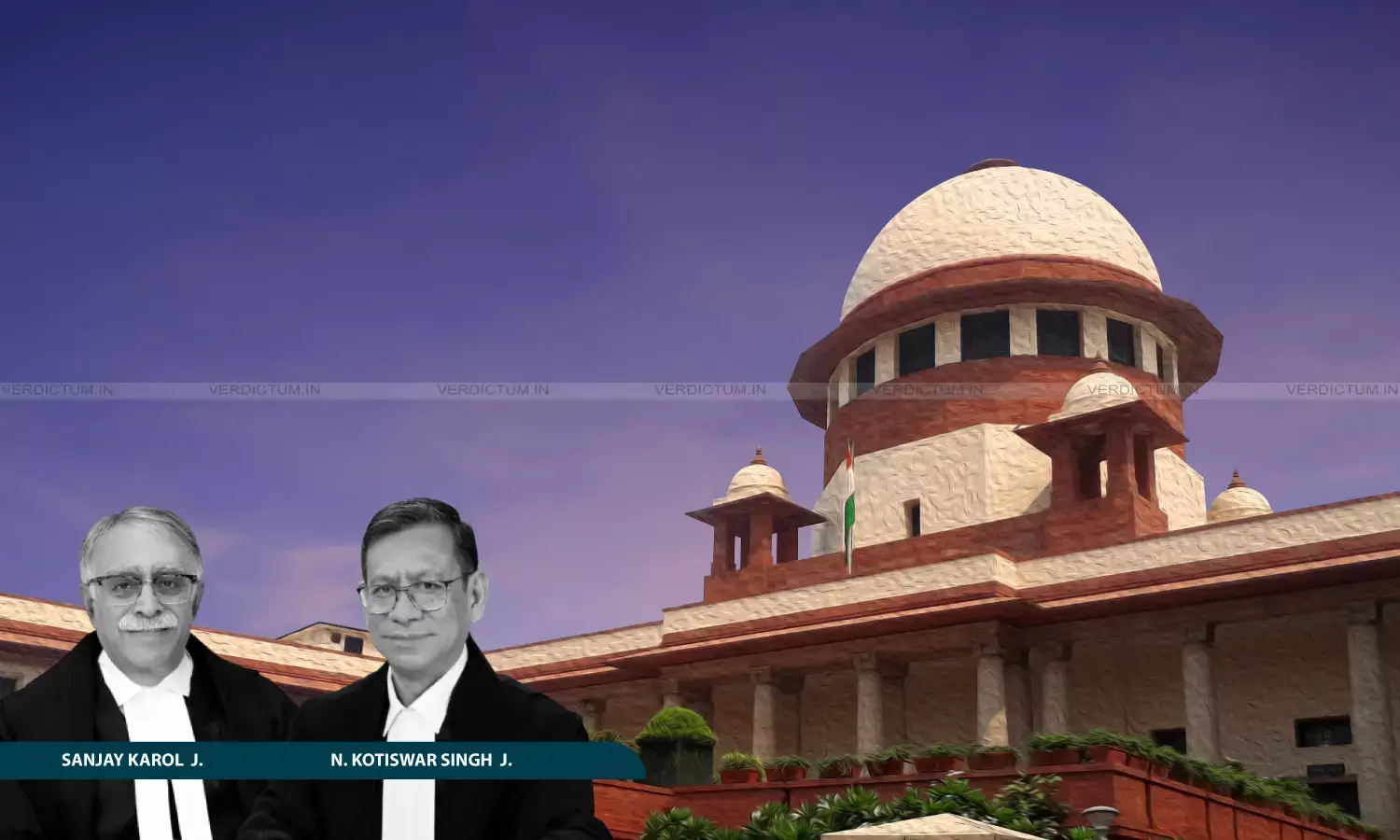
Justice Sanjay Karol, Justice Nongmeikapam Kotiswar Singh, Supreme Court
The Supreme Court has held that a dying declaration does not lose its evidentiary value merely because the declarant’s death occurs after a considerable time has elapsed from the recording of the statement, so long as the statement relates to the cause of death or the circumstances of the transaction resulting in death.
The Apex Court clarified that Section 32(1) of the Indian Evidence Act contains no limitation mandating temporal proximity between the declaration and the death.
The Court was hearing a criminal appeal arising from an order of the Allahabad High Court affirming dismissal of a prosecution application under Section 319 CrPC seeking the summoning of additional accused in a murder case.
A Division Bench comprising Justice Sanjay Karol and Justice N Kotiswar Singh, upon hearing the matter, while observing that “a dying declaration need not necessarily be recorded in the presence of a Magistrate", held that “the High Court erred in holding that these statements cannot be treated as dying declaration(s) merely because the death of the deceased occurred after a substantial lapse of time from their recordings”, while clarifying that “what is pertinent is that the statement relates either to the cause of death or the circumstances leading to it”.
Advocates Shivam Sharma and Vijendra Singh appeared on behalf of the appellant and respondents, respectively.
Background
The deceased had suffered firearm injuries allegedly caused by her husband. Her statements were recorded by the police under Section 161 CrPC on the same day and again after some days, both through video recording. She implicated her husband in the first statement and later alleged instigation by other family members. She subsequently succumbed to her injuries 2 months later.
Upon commencement of the trial, the prosecution sought to summon the husband’s relatives as additional accused under Section 319 CrPC based on the depositions of PW-1 and PW-2 and the statements of the deceased. Both the Trial Court and the High Court rejected the application, finding the evidence insufficient to invoke the extraordinary power under Section 319.
Aggrieved, the appellant approached the Supreme Court seeking reversal of the orders and summoning of the private respondents to face trial together with the principal accused.
Court’s Observation
The Supreme Court, upon examining the relevant records, reiterated that Section 319 CrPC confers extraordinary but essential authority to ensure that no real offender escapes trial. The standard of satisfaction is higher than that required at the stage of framing charges but below the threshold for conviction.
The Bench held that the testimony of PW-2, the minor daughter and purported eyewitness, specifically attributed the instigation to the private respondents. Evaluating credibility of the testimony at this stage, the Bench stated, would amount to a mini-trial, which is impermissible while considering a Section 319 application.
Addressing the admissibility of the deceased’s statements, the Court held that once the declarant dies, such statements fall within Section 32(1) of the Evidence Act and acquire the status of dying declarations. The absence of a Magistrate’s presence or a doctor’s certification does not nullify their admissibility, though caution is required in appreciation.
The Bench rejected the view of the Courts below that the delay between the incident and death rendered the statements inadmissible. The Bench clarified that “such an approach is clearly untenable since the law does not require that a declarant, at the time of making the statement, be under the shadow of death or the expectation that death is imminent”.
It also referred to precedents including Dharmendra Kumar v. State of M.P., Laxman v. State of Maharashtra, Bhagwan v. State of U.P., Jagbir Singh v. State (NCT of Delhi) and others, reaffirming that dying declarations recorded by police can be relied upon with caution and legal safeguards.
The Court found that the High Court erred in discarding material constituting prima facie evidence indicating the respondents’ involvement, including harassment over repeated female childbirths, alleged sex determination, and instigation during the incident.
Conclusion
The Supreme Court held that the material on record sufficiently disclosed the private respondents' complicity and satisfied the threshold for summoning them as additional accused. The impugned orders of the High Court and Trial Court were set aside.
The respondents were directed to appear before the Trial Court, and the trial was ordered to be expedited. All pending applications were disposed of.
Cause Title: Neeraj Kumar @ Neeraj Yadav v. State of U.P. & Others (Neutral Citation: 2025 INSC 1386)
Appearances
Appellant: Advocates Shivam Sharma, Utkarsh Bhushan, Abhishek Vikas, AOR
Respondents: Advocates Vijendra Singh, AOR, Apurva Singh, Aniket Tiwari, Dhruv Joshi, AOR
