State Anti-Corruption Bureau Has Jurisdiction To Investigate Corruption Cases Against Central Government Employees: Supreme Court
The Apex Court held that the Prevention of Corruption Act, 1988, does not mandate a separate or exclusive investigative mechanism for offences committed by Central Government employees, and that State Anti-Corruption agencies are competent to register and investigate such offences, subject to the rank requirements prescribed under the statute.
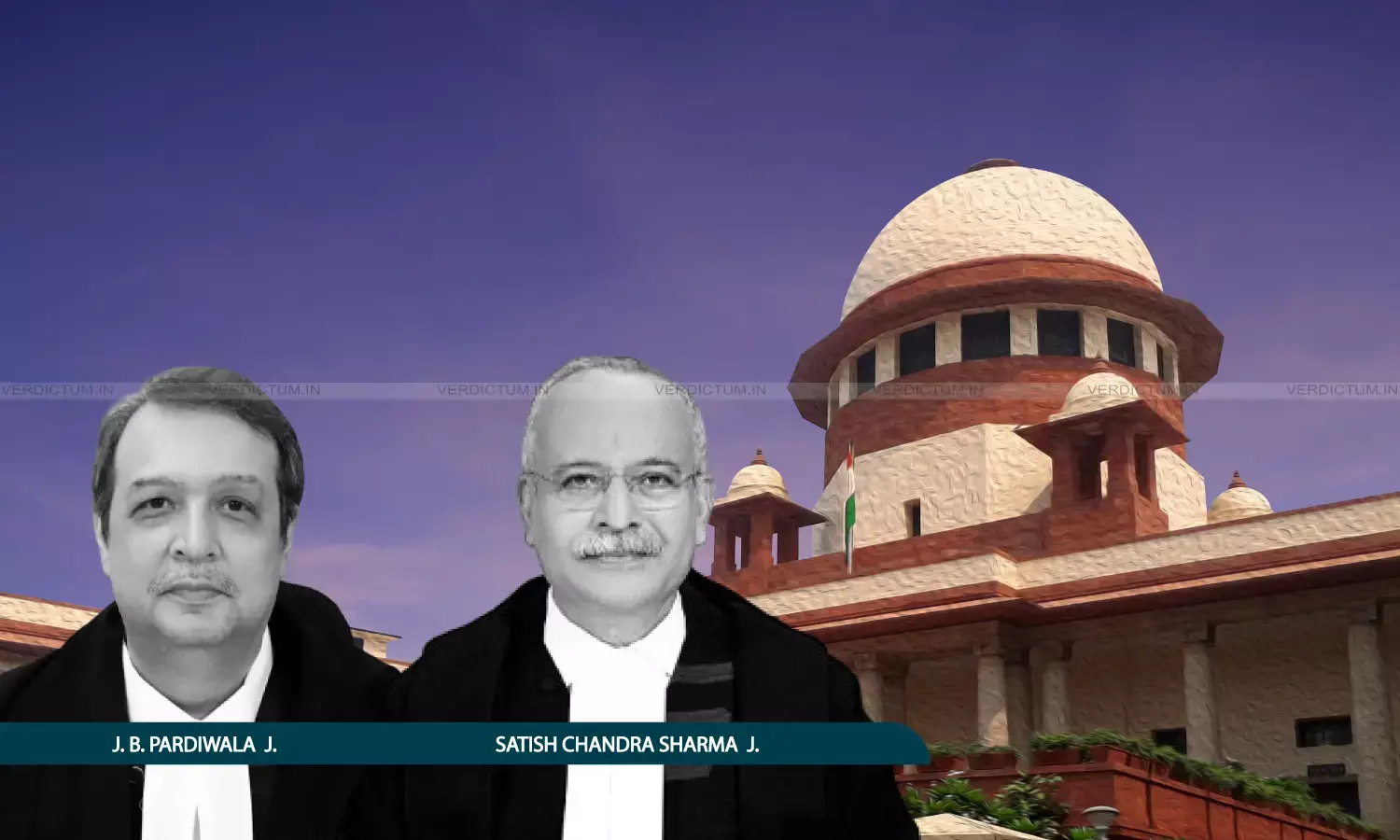
Justice J.B. Pardiwala, Justice Satish Chandra Sharma, Supreme Court
The Supreme Court has held that offences under the Prevention of Corruption Act, 1988, committed by employees of the Central Government within the territorial jurisdiction of a State, can validly be investigated by the State Anti-Corruption Bureau, and that such jurisdiction is not vested exclusively in the Central Bureau of Investigation.
The Court was hearing a challenge to a judgment of the Rajasthan High Court, which had upheld the authority of the State Anti-Corruption Bureau to register a case, investigate, and file a charge-sheet against a Central Government employee under the Prevention of Corruption Act, 1988.
A Bench comprising Justice J.B. Pardiwala and Justice Satish Chandra Sharma, while dismissing the Special Leave Petition, finding no error in the High Court’s conclusion, held: “The PC Act does not specifically envisage a separate procedure for conducting investigation. The offences under the PC Act can be investigated by the State agency, by the Central agency or by any police agency, as can be seen from Section 17 of the said Act, with the qualification that the police officer shall be of a particular rank. Section 17 does not exclude or prevent the State Police or a Special Agency of the State from registering a crime or investigating cases relating to bribery, corruption and misconduct against Central Government employees”.
Advocate Manish Aggarwal represented the petitioner, while Shivmangal Sharma, AAG, represented the respondents.
Background
The petitioner, a Central Government employee, had assailed criminal proceedings initiated by the Anti-Corruption Bureau of the State of Rajasthan under the Prevention of Corruption Act, 1988. It was contended that offences involving Central Government employees could be investigated only by the Central Bureau of Investigation under the Delhi Special Police Establishment Act, 1946, and that the State agency lacked jurisdiction.
Two specific questions arose for consideration before the High Court: (i) whether the State Anti-Corruption Bureau had authority to investigate offences under the PC Act against Central Government employees; and (ii) whether a charge-sheet filed without obtaining consent or approval from the CBI was legally sustainable.
The Rajasthan High Court answered both questions against the petitioner, leading to the present challenge before the Supreme Court.
Court’s Observations
The Supreme Court examined the statutory scheme governing the investigation of offences under the Prevention of Corruption Act, 1988, read with the Code of Criminal Procedure, 1973.
The Court noted that the CrPC is the parent statute governing investigation, inquiry, and trial of offences, and that under Sections 4 and 156 of the Code, cognizable offences can be investigated by the police unless a special statute expressly or impliedly provides otherwise.
It was observed that while the PC Act is a special enactment, Section 17 of the Act only prescribes the rank of the police officer competent to investigate offences under the Act, and does not create an exclusive investigative domain for any particular agency.
The Court held that Section 17 does not exclude the State Police or a specialised State agency from registering or investigating corruption cases against Central Government employees, provided the investigation is conducted by an officer of the prescribed rank.
The Bench explained that “It is for convenience and to avoid duplication of work that the Central Bureau of Investigation a specialised investigating agency under the Special Police Establishment - is entrusted with the task of investigation of the cases of corruption and bribery against the employees of Central Government and its Undertakings and the Anti Corruption Bureau - a specialised investigating agency of the State - is entrusted with the task of investigation of the cases of corruption and bribery against the employees of State Government and its Undertakings.”
Referring to the Delhi Special Police Establishment Act, 1946, the Court held that the statute is permissive in nature and does not divest State police authorities of their inherent powers to investigate offences under other competent laws.
The Court relied on earlier precedents, including A.C. Sharma v. Delhi Administration (1973), wherein it was held that the DSPE Act does not implicitly bar investigation by State agencies. The Bench also noted consistent views taken by the High Courts of Madhya Pradesh and Andhra Pradesh on the same issue.
The Court further observed that offences under the PC Act are cognizable, and that Vigilance and Anti-Corruption Bureaus functioning as wings of State Police fall within the definition of “police station” under the CrPC.
Finding the reasoning of the Rajasthan High Court to be legally sound, the Supreme Court held that there was no jurisdictional infirmity in the investigation or the charge-sheet filed by the State Anti-Corruption Bureau.
Conclusion
Holding that the Prevention of Corruption Act, 1988, does not envisage an exclusive investigative procedure or agency for offences involving Central Government employees, the Supreme Court affirmed that State Anti-Corruption agencies are competent to register and investigate such offences in accordance with Section 17 of the Act.
Finding no error of law in the impugned judgment, the Court dismissed the Special Leave Petition. Pending applications, if any, were disposed of accordingly.
Cause Title: Nawal Kishore Meena @ N.K. Meena v. State of Rajasthan (Neutral Citation: 2026 INSC 71)
Appearances
Petitioner: Advocates Manish Aggarwal, Amit Ambawat, Sruthi Iyer, Shilpa Sharma, Riya Sharma, Rupali Panwar, Vishal Arun Mishra, AOR
Respondent: Shivmangal Sharma, Additional Advocate General, Puneet Parihar, Advocate