High Court Cannot Dismiss First Appeal Against MACT Award Merely Because Insurer Undertook To Satisfy Decree; Appeal Must Be Decided On Merits: Supreme Court
Holding that a statutory first appeal against a motor accident compensation award must be examined on facts and law, the Apex Court ruled that dismissal of such an appeal solely because the insurer undertook to satisfy the decree amounts to failure to exercise appellate jurisdiction.
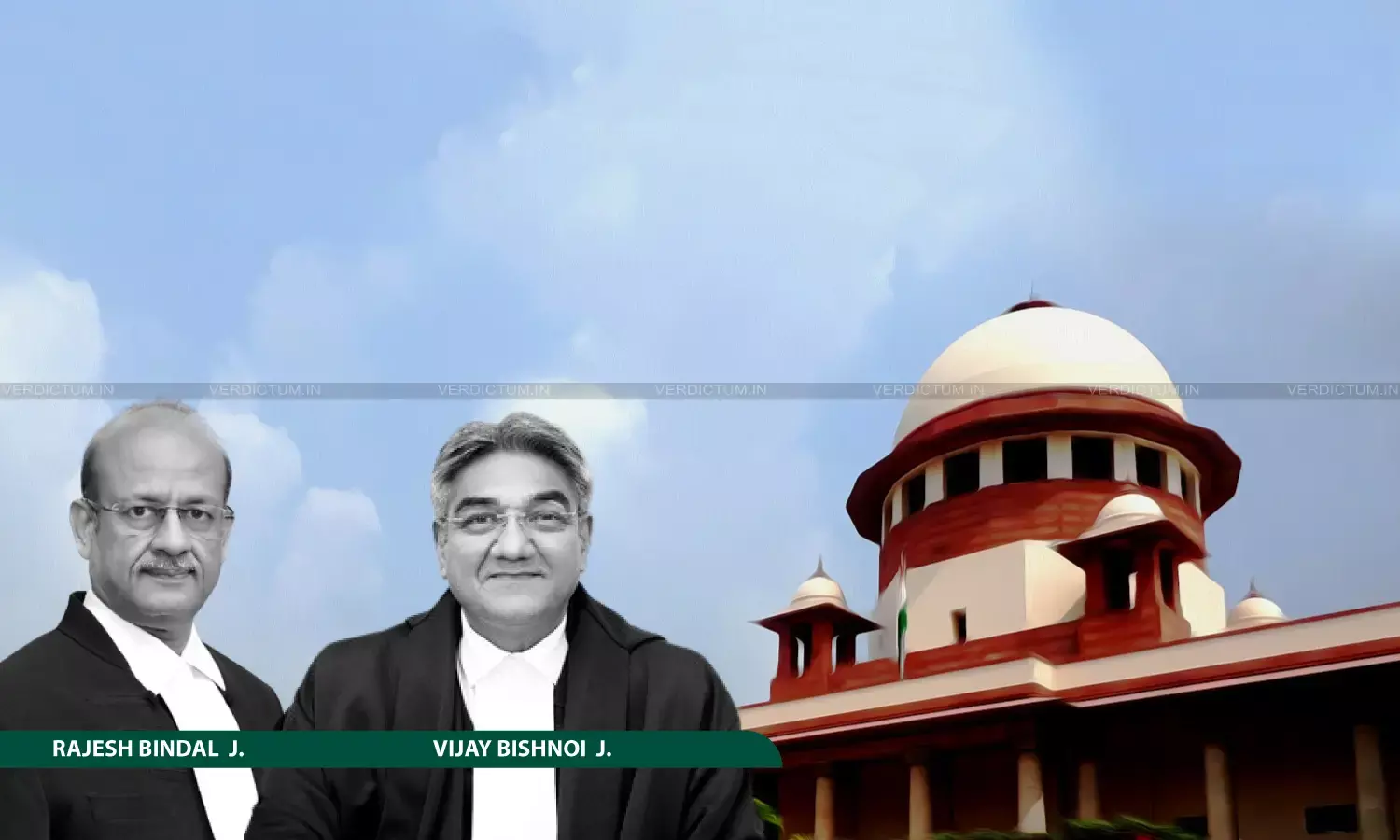
Justice Rajesh Bindal, Justice Vijay Bishnoi, Supreme Court
The Supreme Court has held that a High Court hearing a first appeal against a Motor Accident Claims Tribunal (MACT) award cannot dismiss the appeal merely because the insurance company undertook before the executing court to satisfy the award.
The Court clarified that even where the award is complied with in the absence of an interim stay, the appellate court remains duty-bound to adjudicate the appeal on the merits.
The Court was considering civil appeals filed by an insurance company challenging orders of the High Court that dismissed its appeal and review petition solely on the ground that an undertaking had been furnished to satisfy the award. The Tribunal had awarded compensation exceeding ₹2.7 crore to an injured claimant.
A Bench of Justice Rajesh Bindal and Justice Vijay Bishnoi observed: “We cannot lose sight of the fact that it was the first appeal against the award of the Tribunal, which is open for consideration before the High Court on law as well as on facts. But the High Court, having failed to exercise its jurisdiction, had merely been swayed by the fact that the undertaking had been given by the Insurance Company to satisfy the award”.
The Bench further stressed that “this, at most, can be considered a case where in appeal filed by the Insurance Company, no stay is granted and as a result the judgment-debtor is to satisfy the award, …even in that eventuality, the appeal could not have been dismissed merely on that ground and had to be considered on merits by the High Court”.
Background
A claimant who suffered severe injuries in a road accident approached the Tribunal seeking compensation. The Tribunal assessed functional disability at 100% and awarded compensation significantly higher than the amount claimed, together with interest.
The insurer filed an appeal before the High Court challenging the quantum and methodology of compensation. While the appeal was pending, the claimant then initiated execution proceedings. The executing court issued warrants for the attachment of office furniture, fixtures, and computers of the insurer’s local office. Under those circumstances, an undertaking was furnished by a local officer of the insurer to satisfy the award.
Relying solely on that undertaking, the High Court dismissed the insurer’s appeal without examining the grounds raised. A subsequent review petition explaining the circumstances under which the undertaking was given was also dismissed.
Court’s Observation
The Supreme Court examined the sequence of execution proceedings and the High Court’s handling of the appeal. It noted that the appeal was dismissed purely based on the undertaking furnished before the executing court, without any consideration of the insurer’s challenge to the award. Such an approach, the Court held, amounts to abdication of appellate jurisdiction.
The Bench emphasised that a first appeal against a Tribunal award is a substantive statutory remedy permitting full reconsideration on law and facts. Compliance with an award in the absence of a stay cannot extinguish or dilute the right of appeal. At best, such compliance affects execution; it does not justify dismissal of the appeal.
The Court also scrutinised the manner in which execution was pursued. It was observed that the attachment of office furniture and essential equipment of a public sector insurer, without exploring alternative recovery mechanism demonstrated undue haste. While execution of a decree is permissible, coercive steps must reflect judicial application of mind and procedural fairness.
Addressing the High Court’s reasoning, the Bench clarified that the undertaking did not amount to a waiver of the appeal nor a concession on merits. Even if the insurer was required to satisfy the award pending appeal, the appellate court remained obligated to independently assess whether the Tribunal’s calculation complied with settled principles.
The Court further noted that the insurer had alleged serious errors in the assessment of income, disability, and heads of compensation. Whether those grounds were sustainable was a matter for appellate determination, which the High Court failed to undertake.
The Supreme Court underscored that dismissal of a statutory appeal without adjudication undermines the appellate framework and risks perpetuating potentially erroneous awards. The proper course was to hear the appeal on the merits rather than treating execution compliance as dispositive.
Conclusion
Holding that the High Court failed to exercise its appellate jurisdiction, the Supreme Court set aside the orders dismissing the appeal and review petition. The matter was remitted to the High Court for fresh consideration on the merits, with a request to dispose of the appeal expeditiously.
Pending adjudication, the Court directed the insurer to release ₹1 crore to the claimant, clarifying that such payment would not prejudice consideration of the appeal.
Cause Title: National Insurance Co. Ltd. v. Rathlavath Chandulal & Ors. (Neutral Citation: 2026 INSC 146)
Appearances
Appellant: Meenakshi Arora, Senior Advocate, with Hetu Arora Sethi, AOR, Rahul Jain, Sanidhya Kumar, and Kanak Bathwal, Advocates.