

Plaintiffs Are Dominus Litis; Can’t Be Compelled To Add Party To Defend Suit Against Their Wishes: Supreme Court
The Supreme Court was considering an appeal challenging a judgment setting aside the order of the court of first instance permitting the appellant's impleadment as one of the defendants to the suit.

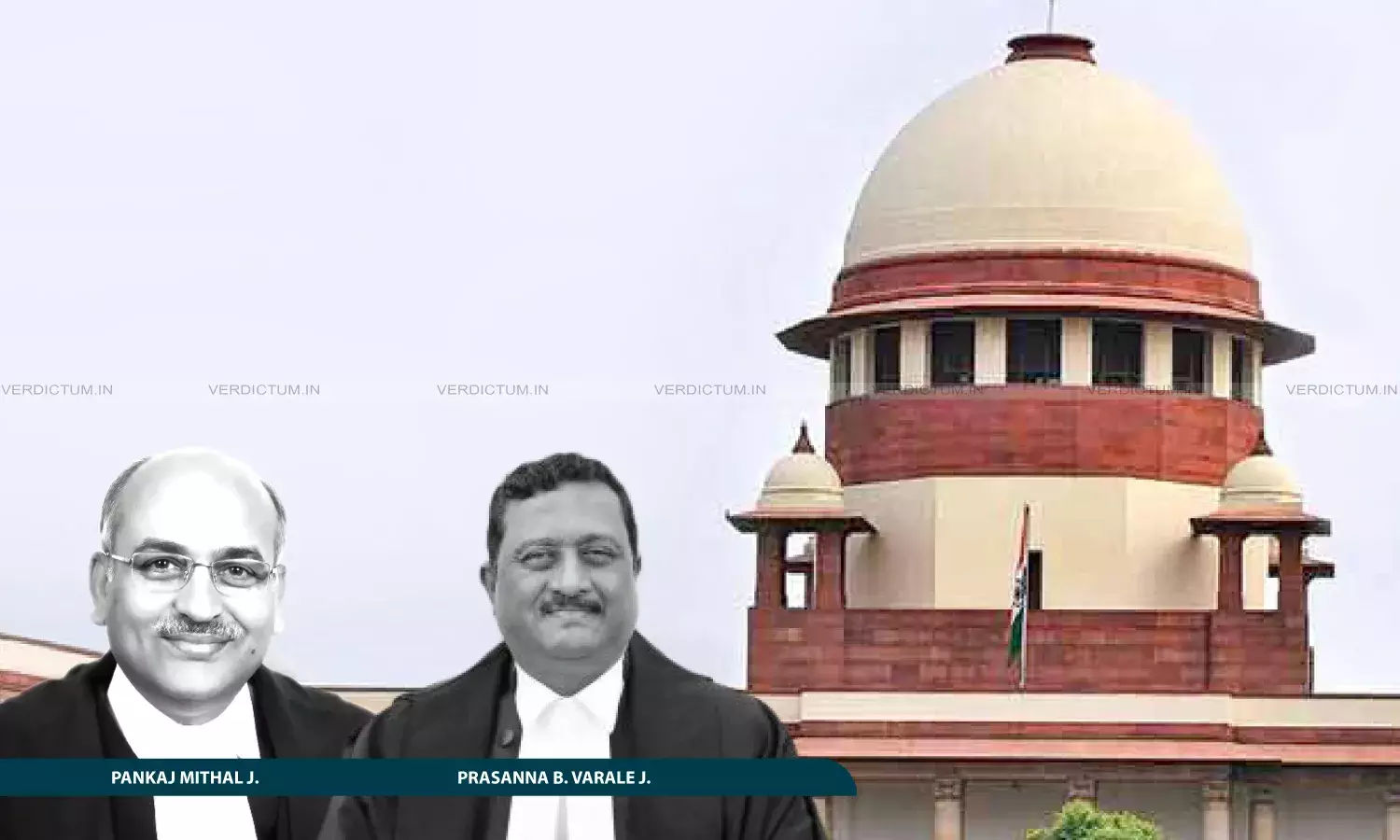
Justice Pankaj Mithal, Justice Prasanna B. Varale, Supreme Court
The Supreme Court has reiterated that the litigants who have instituted the suit are dominus litis and it is for them to choose their adversaries. The Apex Court further held that they cannot be compelled to add a party to defend a suit against their wishes.
The Apex Court was considering an appeal challenging a judgment setting aside the order of the court of first instance permitting the appellant's impleadment as one of the defendants to the suit.
The Division Bench of Justice Pankaj Mithal and Justice Prasanna B. Varale held, “This apart, the respondent Nos.1 and 2 who have instituted the suit are dominus litis and it is for them to choose their adversaries. If they do not array the proper and necessary parties to the suit, they do it at their own risk. However, they cannot be compelled to add a party to defend a suit against their wishes. The decree, if any, passed in the suit would be binding only between the parties to the suit and 18 would not infringe upon any right of a third party, much less of the appellant that is not a party to the suit.”
Factual Background
One Keshrichand Shah was the original owner of the commercial premises existing on the third floor of the Churchgate House, Mumbai. He was the sole proprietor of M/s Union Commercial Corporation. The aforesaid Keshrichand through its proprietorship firm, let out an area of 525 square feet of the above premises to one M/s Modern Products Pvt. Ltd. The said firm was licensed or sublet to the third respondent. In addition to the rent of Rs 400 per month payable to the firm, the third respondent also used to pay service charges at the rate of Rs 2,100 per month for the use of furniture and fixtures therein to the owner. On the death of Shah, the said service charges were realised by his heirs, i.e., respondents.
The first two respondents instituted a Suit against the third respondent for the recovery of service charges amounting to Rs 75,600 for the period November 2004 to October 2007. In the aforesaid suit, notice was served upon the sole defendant i.e., third respondent, but no one appeared on its behalf. Thus, the court proceeded ex parte. The appellant then filed an application for being impleaded as the defendant in this suit, contending that it is a successor of the third respondent under Part IX of the Companies Act, 1956. The court of first instance allowed the motion. The aforesaid order of the court of first instance, on being taken up before the High Court, was reversed, and the impleadment of the appellant was revoked on the ground that it was not a proper or a necessary party to the suit.
Reasoning
The Bench explained that a company comes into existence as a body corporate from the date of its incorporation, having perpetual succession and a common seal. However, its incorporation or its Certificate of Incorporation does not conclusively prove that it has come into existence as a successor of the third respondent. “In such circumstances, appellant cannot be accepted to be the successor of respondent No.3 so as to permit it to be impleaded and to defend the suit for the recovery of service charges,” it added.
The Bench noticed that the appellant had nowhere established its independent right to be impleaded to defend the suit except for claiming to be the successor of the third respondent, which had no legs to stand. “In the case at hand, the respondent Nos.1 and 2 are not claiming any relief against the appellant. There is no iota of material to indicate that the relief, as claimed in the suit against respondent No.3, if granted, would be implemented against the appellant. Therefore, the appellant is not a necessary party to the suit”, it added.
In the absence of any evidence to prove that the third respondent ceased to exist or could not be represented in the suit on its own to contest it on merits, the Bench held that the appellant was not even a proper party to provide any assistance to the court in the suit. Considering that the impleadment application was filed almost nine years after the knowledge of the pendency of the suit, the Bench held that the impleadment was rightly refused to the appellant by the High Court.
Cause Title: Nak Engineering Company Pvt. Ltd. v. Tarun Keshrichand Shah (Neutral Citation: 2026 INSC 8)