

Retired Employees Of Tuticorin Heavy Water Plant Under Department Of Atomic Energy Not Covered Under Section 2(e) Of Payment Of Gratuity Act: Supreme Court
The Supreme Court was considering an appeal filed at the instance of the retired employees of Heavy Water Plant, Department of Atomic Energy, Government of India, Tuticorin (HWP).

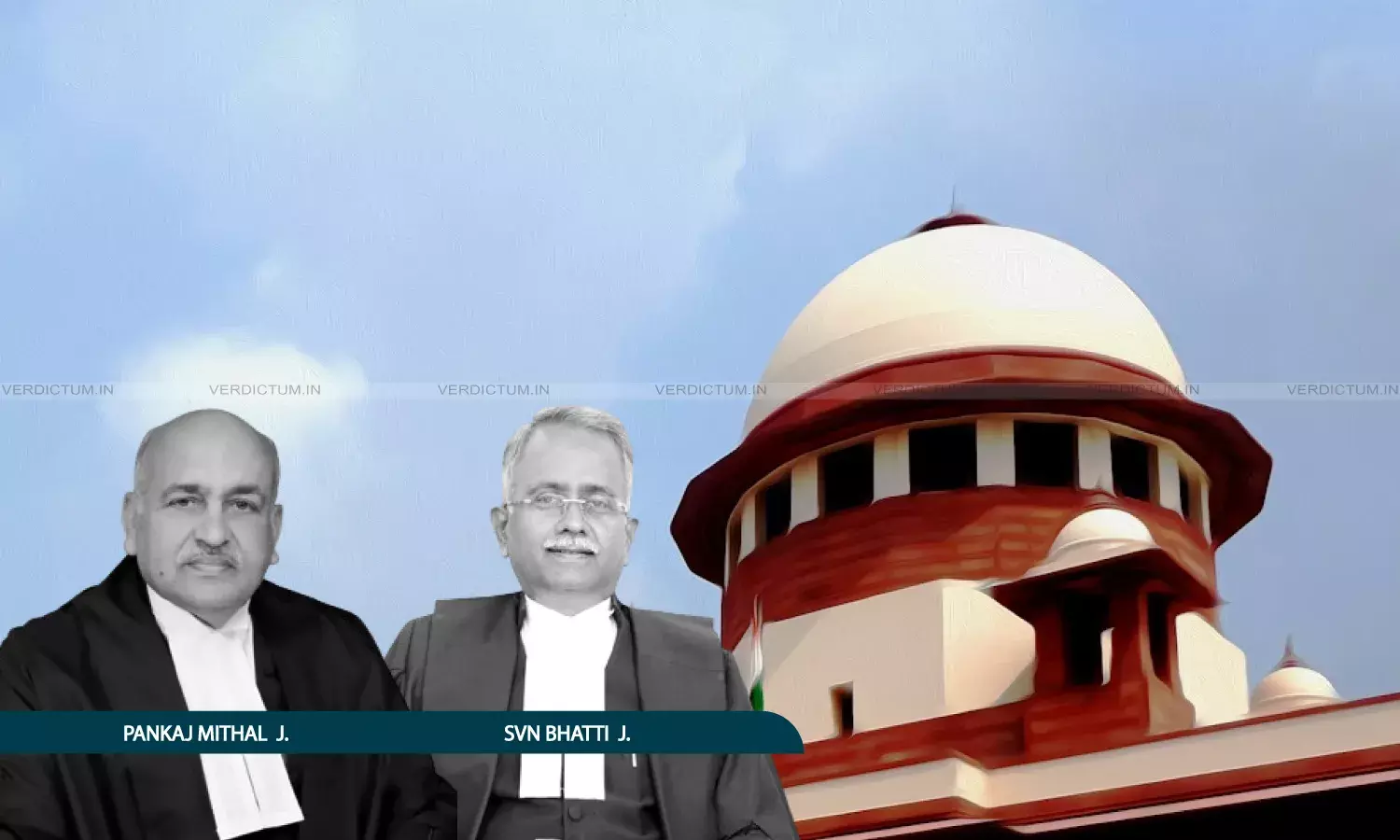
The Supreme Court has held that the retired employees of Heavy Water Plant, Department of Atomic Energy, Government of India, Tuticorin, are not covered by the definition of Section 2(e) of the Payment of Gratuity Act, 1972.
The Apex Court was considering an appeal filed at the instance of the retired employees of Heavy Water Plant, Department of Atomic Energy, Government of India, Tuticorin (HWP), against a judgment declaring that such employees are not covered by the definition of Section 2(e) of the Payment of Gratuity Act, 1972 (PG Act).
The Division Bench of Justice Pankaj Mithal and Justice S.V.N. Bhatti held, “The jurisdictional fact, on appreciation, leads us to the conclusion that HWP is an adjunct or ancillary operating through the Heavy Water Projects Board of the DAE. On examination of constitution, establishment, and continuation, we notice the character of HWP as an adjunct of the Department of Atomic Energy, and by choice, we are not adverting to the appointment orders or any other circulars for deciding the jurisdictional fact of “employees”. Therefore, the employees fall within the exclusionary clause of Section 2(e) of the PG Act. The result of such exclusion is that Sections 5 and 14 are not attracted in deciding on the applicability of the PG Act to the employees of HWP.”
Senior Advocate Haripriya Padmanabhan represented the Appellant while ASG S.D Sanjay represented the Respondent.
Factual Background
In the year 1969, the Government of India/DAE issued Office Memorandum No. 12/7/69-(P) for the constitution of a Board to administer the Heavy Water Production Projects of the DAE. The HWP in Tuticorin is one of the Heavy Water Boards established by the DAE. A pension payment order in favour of one of the retired employees was issued under the CCS (Pension) Rules, 1972. The CCS (Pension) Rules, 1972, deal with the retirement benefits to which a retired employee is entitled, including gratuity. The sum payable as gratuity under the PG Act and CCS (Pension) Rules, 1972, is less than the sum payable under the PG Act. This led to an employee of HWP filing an application before the Controlling Authority under the PG Act. The Controlling Authority held that the provisions of the PG Act are applicable to the employees of HWP, and a direction was ordered to pay the difference between the PG Act and CCS (Pensions) Rules, 1972.
The Authority held that HWP constitutes an industry under the Industrial Disputes Act, 1947, making the applicant-employee eligible for coverage under Section 1(3)(b) of the PG Act. HWP, Tuticorin, challenging the Order of the Controlling Authority, filed an appeal before the Deputy Chief Labour Commissioner, and the appeal filed was dismissed. HWP filed a Writ Petition challenging the subsequent orders of the Controlling Authority directing payment of the difference of gratuity to the retired employees of HWP. The Division Bench of the Madras High Court allowed the Writ Appeals as well as Writ Petitions filed by HWP.
Reasoning
Referring to the provisions of the Act, the Bench held that the amended definition deals with the first limb of Section 2(e), and the second exclusionary limb is the same in the pre and post-amendment provisions. Construing Section 2(e), the Bench noted that the second limb begins with the words “but does not include” any such person (i) who holds a post under the Central Government, (ii) a State Government, (iii) is governed by any other Act or (iv) by any Rules providing payment of gratuity. “The exclusionary clause, if read by applying the golden rule without a further test,excludes employees of the Central and State Governments from the meaning of “employee” under the PG Act. Secondly, it also excludes a person who is governed by any other act. Thirdly, even if it is used as “or” but not as “and”, it excludes any such person who is governed by any other Act or by any rules providing for payment of gratuity”, it added.
“Consequently, a person who is governed by any other Act, or governed by any Rules providing for payment of gratuity, does not come within the ambit of the definition of “employee” under the PG Act”, it added.
Coming to the facts of the case, the Bench noted that the HWP is created to manage the projects of the DAE for the production of heavy water. HWP at Tuticorin is a project under the management of the Heavy Water Projects Board of the DAE, and cannot, by sieving, separate itself from being an ancillary or adjunct of the DAE. As per the Bench, for the limited purpose of gratuity, the larger and comprehensive establishment of atomic energy facilities by the Central Government is not replaced with a very narrow construction of the functional freedom given to the Heavy Water Projects Board or individual Heavy Water Plants.
Thus, the Bench concluded that Sections 5 and 14 are not attracted in deciding on the applicability of the PG Act to the employees of HWP. Agreeing with the order impugned, the Bench dismissed the Civil Appeals.
Cause Title: N. Manoharan v. The Administrative Officer (Neutral Citation: 2026 INSC 143)
Appearance
Appellant: Senior Advocate Haripriya Padmanabhan, Advocate Shrutanjay Bhardwaj, AOR Raghunatha Sethupathy B, Advocate Siddhi Nagwekar, AOR K. Paari Vendhan, Advocate Aayushman Aggarwal
Respondent: ASG S.D Sanjay, Advocates Aurnima Diwedi, Rajeev Ranjan, Dharmendra Kumar Pandey, Raman Yadav, Saurabh Kumar Kaushik, AOR Amrish Kumar, AOR Raj Bahadur Yadav, AOR Gurmeet Singh Makker