"FR Does Not Provide Extension Merely For Pay & Allowances": Supreme Court Relief To Ex-Employees Of Assam Electricity Board In Pay Revision Dispute
The Apex Court held that continuation in service until the afternoon of the last day of the month under Fundamental Rule 56(a) is not a limited extension for salary computation, and employees attaining the age of superannuation during March 2016 are deemed to have remained in service on 31 March 2016, making them eligible for pay revision under the 2017 Rules.
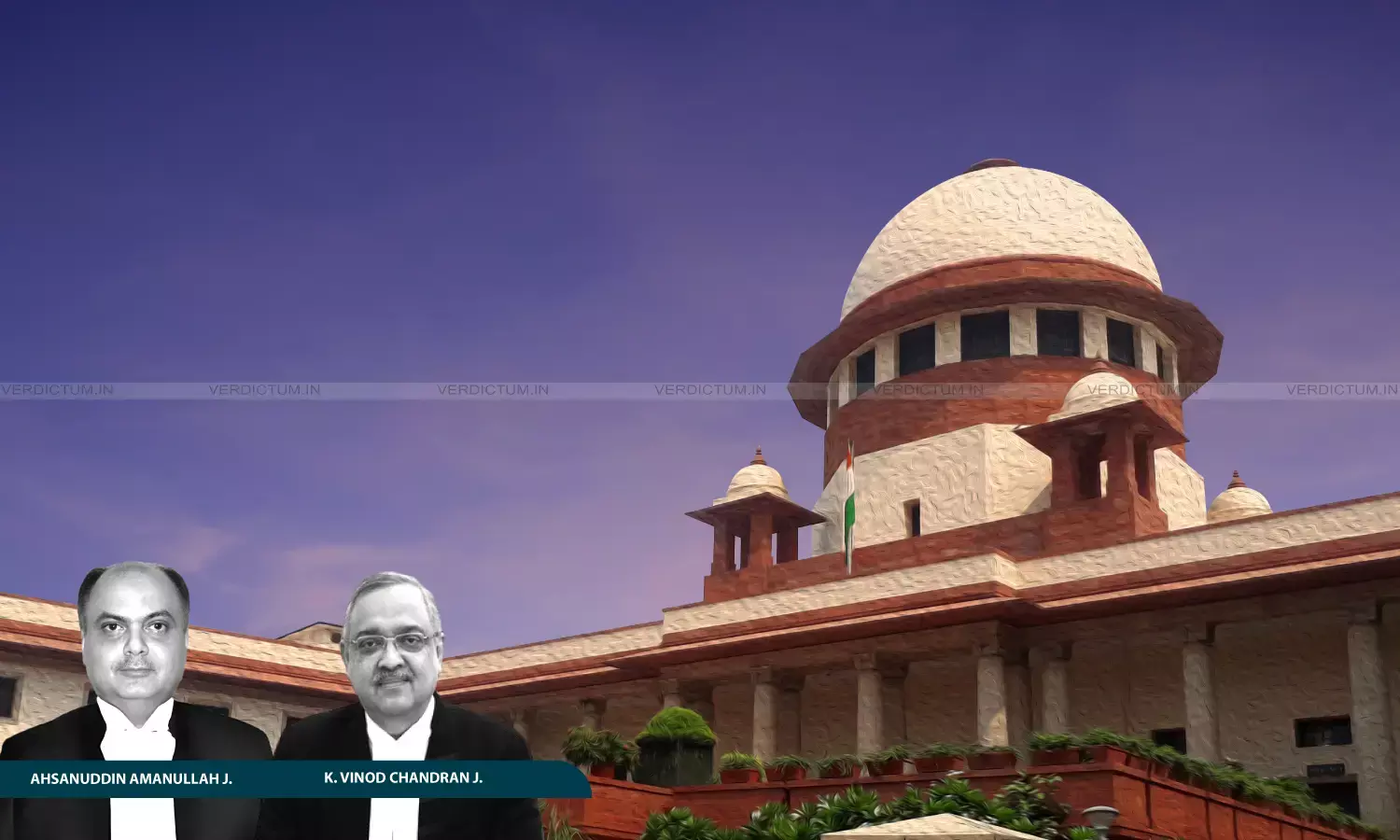
Justice Ahsanuddin Amanullah, Justice K. Vinod Chandran, Supreme Court
The Supreme Court has ruled that employees of the Assam State Electricity Board who attained the age of superannuation in March 2016 are entitled to the revised pay benefits introduced under the Assam Electricity Board and its Successor Companies Revised Pay Rules, 2017.
The Court clarified that Fundamental Rule 56(a) of the Assam State Electricity Board and its Successor Companies Revised Pay Rules, 2017, ensures continuation of the employer-employee relationship until the last day of the month in which retirement age is attained, and such service cannot be treated as a mere extension only for pay and allowances.
The Court was hearing civil appeals filed by retired employees whose claims for pay revision were rejected on the ground that they had technically retired before the cut-off date of 31 March 2016. A Division Bench of the Gauhati High Court had treated their retirement as having taken effect upon turning 60 years of age during the month and therefore held that they were not “in service” on the relevant date.
A Division Bench of Justice Ahsanuddin Amanullah and Justice K. Vinod Chandran relied upon the express wording of FR 56(a) to hold that the law does not contemplate a deemed cessation of employment on the exact date an employee turns 60.
While making these observations, the Bench remarked: “The FR does not provide for such extension to be merely for the purpose of pay and allowances nor can there be a deemed legal termination of employer-employee relationship be found on the date of attaining the age of 60 years. The rule of superannuation is clear and unambiguous that any person who attained the age of superannuation in a month will retire only on the last day of that month”.
Senior Advocate K N Choudhury represented the petitioners, while Senior Advocate B K Sharma represented the respondents.
Background
The appellants, employees of the Assam Power Generation Corporation, attained the age of superannuation in March 2016. By operation of Fundamental Rule 56(a), their retirement took effect on 31 March 2016. The 2017 Pay Rules extended revised pay benefits to “all employees in service on 31.03.2016 or appointed on or after 01.04.2016.”
The Single Judge held that the appellants were entitled to revised pay. However, the Division Bench reversed that interpretation, holding that the employees had technically retired before the cut-off. Aggrieved, the appellants approached the Supreme Court.
Court’s Observation
The Supreme Court examined the distinction between revision under Central Pay Commission recommendations and the specific wording of the 2017 Assam Rules, noting that the latter explicitly covered all employees in service on 31 March 2016.
The Court held that FR 56(a) deems retirement to occur on the afternoon of the last day of the month, and such continuance cannot be treated as only for pay and allowances. It rejected any concept of a deemed severance of the employer-employee relationship at the moment an employee turns 60.
The Bench distinguished K.J. George v. BSNL and the Delhi High Court’s decision in G.C. Yadav on the ground that those cases involved employees retiring a day prior to the pay revision taking effect. In contrast, here, the appellants retired on the effective date itself, bringing them within the zone of eligibility.
In support of its view, the Court placed reliance on the three-judge bench judgment in S. Benerjee v. Union of India, which recognised that the last day of retirement is a working day and benefits accruing on that day must extend to the employee. It further relied on Rule 5(2) of the CCS (Pension) Rules, which mandates that the last day of retirement in cases of normal superannuation must be treated as a working day for salary purposes.
The Court also rejected arguments based on Rule 32 of the 2017 Rules concerning minimum pension, holding that it is merely an enabling provision for those not covered by the pay revision and cannot dilute the express entitlement granted to persons still in service on 31 March 2016.
Conclusion
The Supreme Court set aside the judgment of the Division Bench of the Gauhati High Court and restored the decision of the Single Judge. It held that the appellants are entitled to revision of pay as on 31 March 2016, and such revised pay shall be reckoned for pension computation.
The Court directed that the arrears of pay and pension be paid within six months, with 6% interest per year in case of delay, recoverable from defaulting officials if liability arises. All pending applications were disposed of.
Cause Title: Mukut Das v. Assam Power Generation Corporation Ltd. & Others (Neutral Citation: 2025 INSC 1403)
Appearances
Appellants: Senior Advocates N Choudhury & Manish Goswami, with Advocates Rongon Choudhury, Vipul Kumar, AOR, Navneet Gautam.
Respondents: Senior Advocate B.K. Sharma, with Advocates H.K. Das, Kaushik Choudhury, S.P Sharma, Saksham Garg, Jyotirmoy Chatterjee.