

Material Placed By Financial Creditor In Section 7 IBC Application Should Be Examined; Corporate Debtor Can’t Delay Process By Raising Moonshine Defence: Supreme Court
In the matter before the Supreme Court, the initiation of the corporate insolvency resolution process by an operational creditor under Section 9 of the Insolvency and Bankruptcy Code, 2016, was in issue.

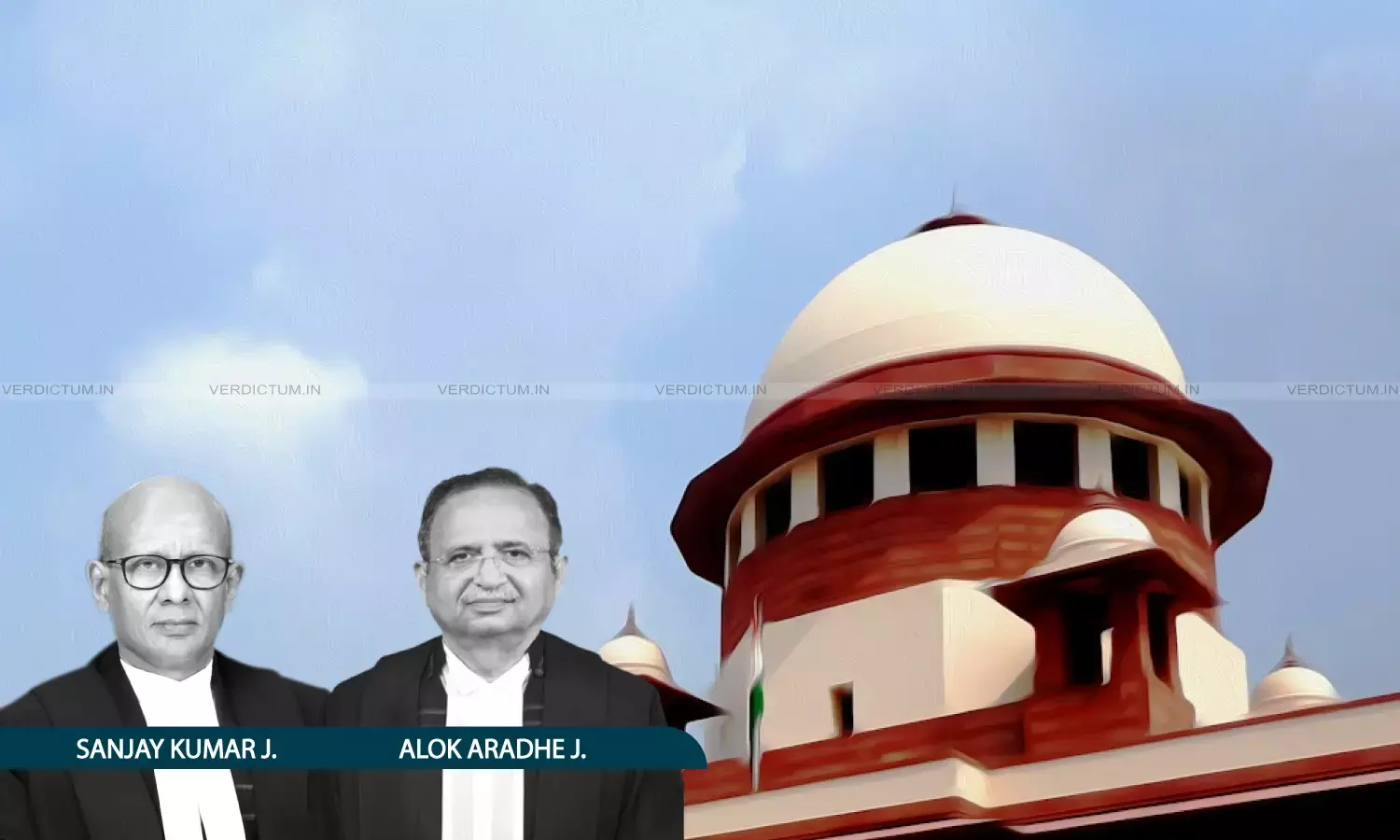
Justice Sanjay Kumar, Justice Alok Aradhe, Supreme Court
The Supreme Court has reiterated that the proceedings under the IBC cannot be defeated by a corporate debtor by raising a moonshine defence only to delay the process. The Apex Court further affirmed that the adjudicating authority must advert to the contentions put forth on the application filed under Section 7 of the IBC and examine the material placed before it by the financial creditor.
In the matter before the Apex Court, the initiation of the corporate insolvency resolution process by an operational creditor under Section 9 of the Insolvency and Bankruptcy Code, 2016 , was in issue.
The Division Bench of Justice Sanjay Kumar and Justice Alok Aradhe held, “Applying this legal standard to the case on hand we have no hesitation in holding that the defence of pre-existing disputes sought to be put forth by the CD was mere moonshine and had no credible basis or foundation. There was no dispute worth the name existing as on the date of issuance of the demand notice by the firm warranting the withholding of the operational debt due and payable by the CD. The attempt to project such pre-existing disputes was mere bluster and did not have the effect of non-suiting the firm.”
The Bench also stated, “Referring to the aforestated decision in Tata Consultancy Services Limited vs. SK Wheels Private Limited, Resolution Professional, Vishal Ghisulal Jain14, this Court reiterated that the adjudicating authority is duty-bound to advert to the material before him, as made available along with the application filed under Section 7 of the IBC by the financial creditor to indicate default along with the version of the corporate debtor. It was noted that this is for the reason that, keeping in perspective the scope of the proceedings under the IBC and there being a timeline for the consideration to be made by the adjudicating authority, the process cannot be defeated by a corporate debtor by raising moonshine defence only to delay the process. Therefore, per this Court, the adjudicating authority must advert to the contentions put forth on the application filed under Section 7 of the IBC, examine the material placed before it by the financial creditor and record satisfaction as to whether there is default or not and, while doing so, the contention put forth by the corporate debtor shall also be noted to determine as to whether there is substance in the defence and to arrive at the conclusion whether there is default.”
Advocate Nikhil Singhvi represented the Appellant while Advocate Shaurya Sahay represented the Respondent.
Factual Background
The National Company Law Tribunal, Mumbai Bench, admitted a Petition filed by a registered partnership firm under Section 9 of the IBC and initiated the CIRP against Dhanlaxmi Electricals Private Limited, the corporate debtor, by appointing an Interim Resolution Professional. Aggrieved thereby, a suspended director of the CD filed a Company Appeal before the National Company Law Appellate Tribunal, Principal Bench, New Delhi, under Section 61 of the IBC. The NCLAT allowed the said appeal and set aside the order of admission passed by the NCLT on the ground that there was a pre-existing dispute between the parties as to the firm’s debt prior to the institution of the application under Section 9 of the IBC. Hence, the appeal was filed by the firm.
Reasoning
The Bench noted that a separate CIRP had already been initiated against the CD, vide an order passed in an application filed under Section 9 of the IBC by another operational creditor. Therefore, at the time the reply was furnished by the Technical Director of the CD to the firm’s demand notice, a CIRP against the CD had commenced, and an Interim Resolution Professional had taken over its management. The Bench was of the view that in such a situation, the Technical Director of the CD, who stood suspended, had no authority to reply on its behalf. Further, it was an admitted fact that, even after issuance of the demand notice by the firm under Section 8 of the IBC, the CD continued to make payments to the firm and, in all, a sum of ₹61 lakh was paid.
“Surprisingly, the NCLAT seems to have been kept in the dark about a separate CIRP having been initiated against the CD, vide order dated 06.09.2021, and the fact that there was no possibility of the firm initiating its own CIRP at that stage. As per procedure, the firm attempted to lodge its claim with the Interim Resolution Professional appointed in that CIRP and it was only upon coming to know of the filing of a withdrawal application in that CIRP that the firm filed its own application under Section 9 of the IBC. The delay on its part, therefore, could not be held against it”, it added.
The Bench explained that even in the pre-IBC era, in the context of a defence of a pre-existing dispute in a creditor’s petition for winding up of a company in the regime obtaining under the Companies Act, 1956, the Court always stressed upon a dispute as to the entitlement of the creditor being a bona fide one and not mere moonshine. Coming back to the IBC regime, the Bench noted that in Indus Biotech Private Limited vs. Kotak India Venture (Offshore) Fund and others, while dealing with a financial creditor’s application under Section 7 of the IBC, a 3-Judge Bench of the Court observed that the adjudicating authority has a duty to advert to the contentions put forth in the application, examine the material placed before it by the financial creditor and record satisfaction as to whether there is default or not.
“Applying this legal standard to the case on hand we have no hesitation in holding that the defence of pre-existing disputes sought to be put forth by the CD was mere moonshine and had no credible basis or foundation. There was no dispute worth the name existing as on the date of issuance of the demand notice by the firm warranting the withholding of the operational debt due and payable by the CD. The attempt to project such pre-existing disputes was mere bluster and did not have the effect of non-suiting the firm”, it held.
The Bench noted that the NCLAT lost sight of the critical facts while dislodging the order of admission passed by the NCLT on the application filed by the firm under Section 9 of the IBC. The NCLAT, not being informed of the full facts, attributed delay to the firm and failed to attach value and consequence to the CD’s own ledger account which clearly negated the claim of pre-existing disputes, as the minor issues raised by the CD did not have the effect of either stopping further supplies by the firm or further payments to the firm by the CD.
Allowing the appeal, the Bench set aside the judgment passed by the National Company Law Appellate Tribunal and restored the order of admission passed by the National Company Law Tribunal, Mumbai Bench. “Further proceedings in the said company petition shall be initiated in accordance with law and due procedure from the date of communication of this judgment”, it concluded.
Cause Title: M/s. Saraswati Wire and Cable Industries v. Mohammad Moinuddin Khan (Neutral Citation: 2025 INSC 1410)
Appearance
Appellant: Advocates Nikhil Singhvi, Manan Sisodia, AOR Shraddha Deshmukh, Advocates Soham Krishan Luthra, Sanyam Kumar
Respondent: Advocates Shaurya Sahay, Aarushi Malik, Aditya Kumar, AOR Yoothica Pallavi