

"Intended Use" May Govern Procurement, But "Actual Use" Determines Naphtha Excise Exemption: Supreme Court
The Court also considered whether extended limitation under the Central Excise Act, 1944 can be invoked in absence of intent to evade duty.

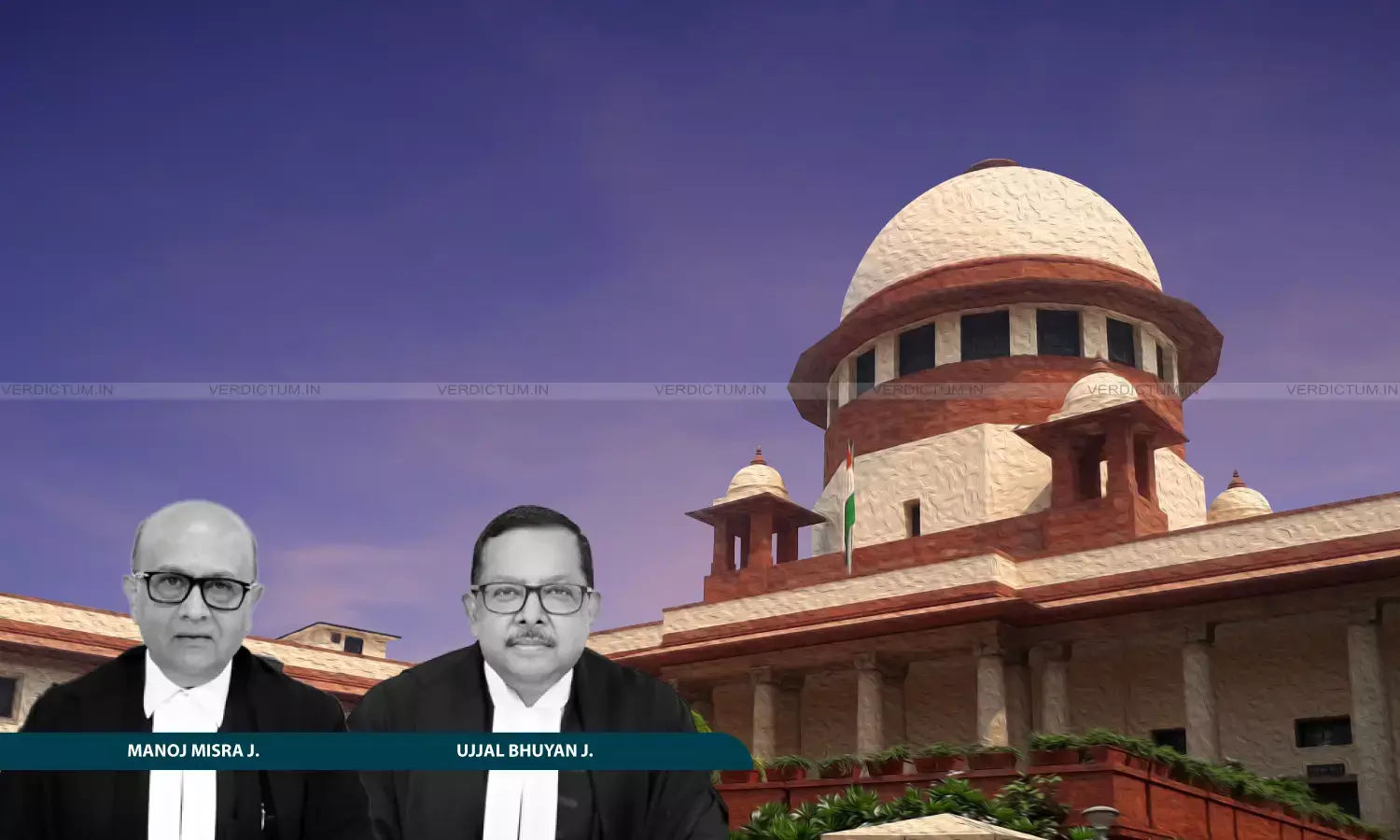
Justice Manoj Misra, Justice Ujjal Bhuyan, Supreme Court
The Supreme Court has clarified that while exemption notifications may permit duty-free procurement of inputs based on their declared “intended use”, the ultimate entitlement to such exemption depends on the “actual use” of the goods. Setting aside the orders passed by the adjudicating authority and the Customs, Excise and Service Tax Appellate Tribunal (CESTAT), the Court ruled in favour of the assessee and held that denial of exemption was not justified in the facts of the case.
On the issue of limitation, the Court reiterated that the extended period of five years under the proviso to Section 11A Central Excise Act, 1944 applies only where there is fraud, suppression, or intent to evade duty. Mere non-compliance or interpretational dispute is insufficient to invoke the extended limitation, it noted. The Court emphasised that intent to evade duty must be clearly established, failing which the demand beyond the normal limitation period cannot be sustained.
Justice Manoj Misra and Justice Ujjal Bhuyan referring to Rule 6 of the Central Excise (Removal of Goods at Concessional Rate of Duty for Manufacture of Excisable Goods) Rules, 2001, observed “…It says that where the subject goods are not used by the manufacturer for the intended purpose, the manufacturer shall be liable to pay the amount equal to the difference between the duty leviable on such goods but for the exemption and that already paid, if any, at the time of removal from the factory of the manufacturer of the subject goods alongwith interest and provisions of Section 11A and Section 11AB of the Central Excise Act, 1944 shall apply mutatis mutandis for effecting such recovery. The Explanation clarifies that such goods shall be deemed not to have been used for the intended purpose even if any of the quantity of the subject goods is lost or destroyed by natural causes or by unavoidable accidents during transportation from the place of procurement to the manufacturer’s premises or during handling or storage in the manufacturer’s premises”.
However, adverting to the specific facts in the matter, and considering the cogent precedents on the subject matter, the Bench noted, “…it is quite evident that Naphtha which was procured from HPCL was intended for use by the appellant in the manufacture of fertilizer and ammonia. It is immaterial that a fraction of such procured Naphtha had to be used for generation of electricity which was also mostly used in the manufacture of fertilizer and ammonia but a portion of which had to be used in the chemical plant beside being supplied to the Maharashtra State Electricity Board. If that be the position, appellant would be entitled to avail the benefit of concessional rate of duty in terms of the exemption notifications alluded too hereinabove”.
Senior Advocate Balbir Singh and Senior Advocate Devashish Bharukha appeared for the respondent.
The Court was dealing with appeals filed by M/s Rashtriya Chemicals and Fertilizers Limited, a public sector undertaking engaged in the manufacture of fertilizers and ammonia, challenging the order of the Customs, Excise and Service Tax Appellate Tribunal (CESTAT), which had upheld the demand of excise duty, interest and penalty on Naphtha procured without payment of duty under exemption notifications.
In the matter, it was the allegation of the department that the Naphtha, though procured for use in fertilizer manufacturing, was used along with natural gas in a common boiler to generate steam, which in turn was utilised not only in fertilizer and ammonia plants but also in generating electricity and in other units such as chemical and heavy water plants. On this basis, the department sought to deny exemption to the extent of such alleged non-fertilizer use and raised a substantial duty demand by invoking the extended period of limitation.
The adjudicating authority accepted the department’s case and held that since part of the steam and electricity generated using Naphtha was used for non-fertilizer purposes, the appellant was not entitled to full exemption. It confirmed the demand of duty along with interest and imposed penalty, a view which was substantially affirmed by the CESTAT.
Now before the Court, the appellant contended that the exemption notifications only required proof of “intended use” and that Naphtha was in fact procured and used as a fuel in the integrated manufacturing process of fertilizer. It was argued that the use of a common steam generation system made it impossible to segregate the exact end-use of each input and that there was no diversion of Naphtha for independent non-eligible purposes.
Examining the scheme of the Central Excise Act, the exemption notifications, and the rules governing concessional procurement, the Court noted the distinction between “intended use” at the stage of procurement and “actual use” at the stage of consumption. It held that while intended use is relevant for granting permission to procure goods without payment of duty, the benefit of exemption ultimately depends on whether the goods are used for the specified purpose.
The Court noted that precise segregation of Naphtha usage was not feasible in an integrated plant with common utilities, and the demand was largely based on estimated apportionment rather than definitive evidence of diversion.
“Thus, fraud, collusion, willful mis-statement or suppression of facts stand in one category and contravention of any of the provisions of the Central Excise Act or the rules made thereunder is another category. In the first category, the act is deliberate and is so egregious that such omission or infraction would by itself be sufficient to attract the extended period of limitation. However, in the later category, the contravention of the statute would have to be accompanied by an intent to evade payment of duty to attract the extended period of limitation”, it noted on limitation and penalty.
Clarifying on the issue of extended limitation under the law, it observed, “…it is evident that all along appellant had furnished the requisite particulars to the central excise authorities based on which the jurisdictional officer had issued CT-2 certificates. On the strength of such certificates, appellant had availed exemption from payment of excise duty on the procured Naphtha which was mostly used in the manufacture of fertilizer and ammonia. Applicability of the exemption notifications is dependent on interpretation of the expression intended for use used therein. When the availing of exemption is dependent on interpretation of a statutory notification, which interpretation we have upheld, it cannot be said that the assessee (appellant herein) had any intention to evade payment of excise duty. That apart, we need to keep in mind that appellant is after all a central government public sector undertaking. It is on record that appellant receives subsidy to maintain the regulated price. Whatever excise duty it would have had to pay had it not been for the exemption notifications, would have been reimbursed by the Central Government by way of subsidy. Therefore, it is a clear case of revenue neutrality. In such a case, as has been pointed out by this Court in Nirlon, question of invoking the extended period of limitation does not arise”, it further noted.
Cause Title: M/S. Rashtriya Chemicals And Fertilizers Limited v. Commissioner Of Central Excise And Service Tax (LTU) [Neutral Citation: 2026 INSC 285]
Appearances:
Appellant: Balbir Singh, Sr. Adv., Karan Sachdev, HG Dharmadhikari, Shivani Shah, Rajesh Kumar, AOR, Lalita Phadke, Rahul Krishna, Praveen Agnihotri, Siddharth Singh, Rajkumar Prasad, Vinod Kumar, Alek Apurv, Mohit Singh, Manishà Sharma, Devavrat Anand, Lalita Phadke, Alekh Apurv, Mukesh Kumar Maroria, AOR, Advocates.
Respondent: M.H. Patil, Sandeep Narain, Manasi Patil, Viraj Reshamwalla, M/s S. Narain & Co., AOR, Gurmeet Singh Makker, AOR, Vikramjit Banerjee, A.S.G., Siddharth Sinha, Shubhendu Anand, Devashish Bharukha, Sr. Adv., Rajeev Ranjan, B. Krishna Prasad, AOR, Advocates.