

Failure To Commence Industrial Operations Within Time Bars Equitable Relief: Supreme Court Upholds Cancellation Of 33-Acre Noida Industrial Plot
Court noted that the primary objectives of industrial allotments is to foster economic development and employment, and delay of seven years violated the core covenants of the lease deed.

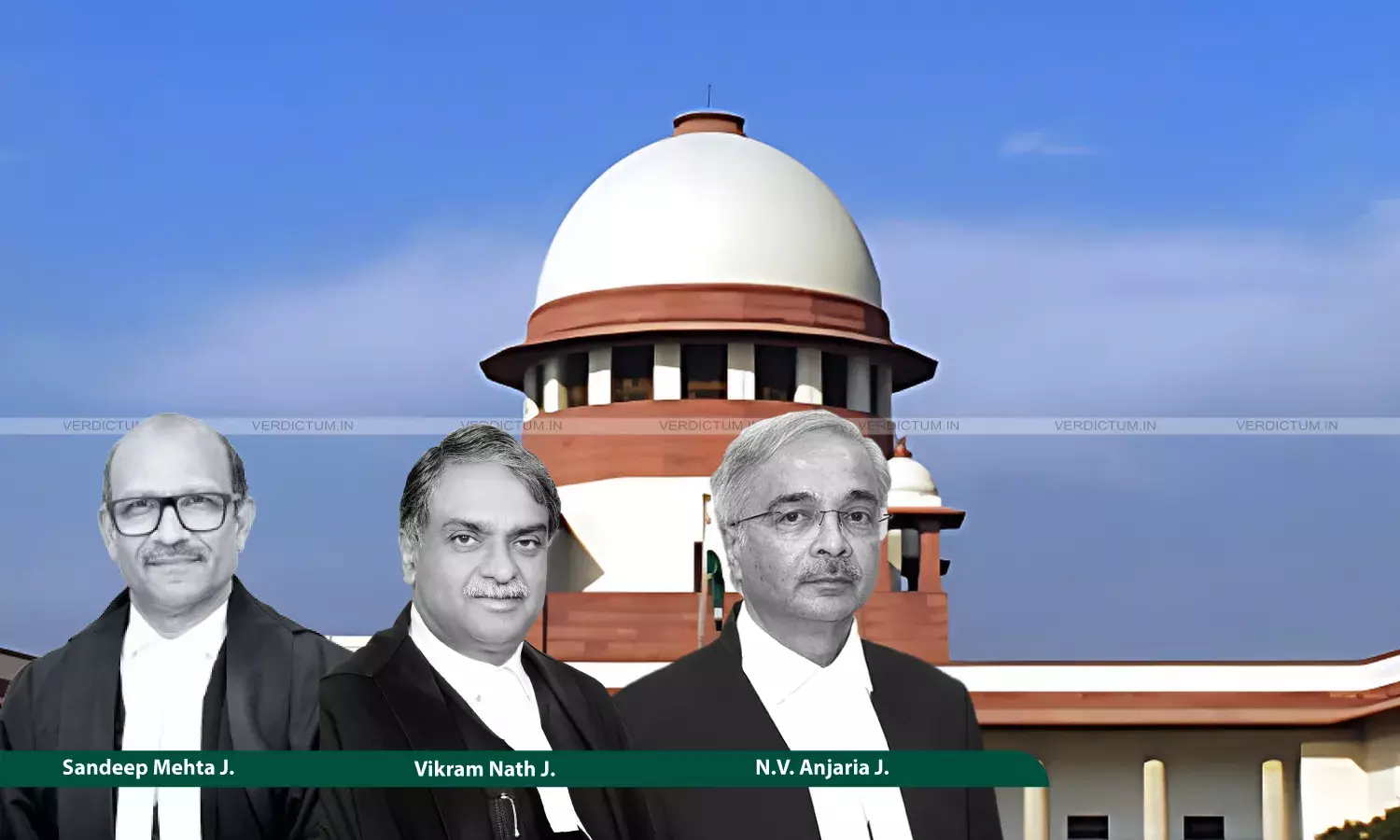
Justice Vikram Nath, Justice Sandeep Mehta, Justice N.V. Anjaria, Supreme Court
The Supreme Court has held that the failure of an allottee to utilise an industrial plot for its sanctioned purpose within the stipulated timeframe constitutes a fundamental breach of lease conditions, undermining the state's objectives of fostering economic development and employment generation. Affirming the cancellation of a 33-acre industrial plot lease in Noida, the Bench observed that the equitable jurisdiction of the Court cannot be invoked by a party that has shown no bona fide intent to commence production over several years.
The Bench noted that the lease deed is the governing instrument, and its clauses clearly mandated construction and industrial use within six months of possession. It noted that for over six years, the appellant failed to put up "a single brick" of new construction or even obtain an approved layout plan. The Bench rejected the argument that a fresh lease deed in July 10, 2007 waived prior breaches, clarifying it was a mere formal document to reflect a corporate name change after amalgamation. Furthermore, the Court held that the appellant’s strategic choice to prioritise its Baramati plant did not constitute a "reason beyond control" to justify the delay in Noida.
A Bench comprising Justice Vikram Nath, Justice Sandeep Mehta and Justice N.V. Anjaria observed, “…the lackadaisical conduct of the appellant-company in failing to adhere to the terms and conditions of the lease deed, and thereby delaying development of the industrial plot by almost six to seven years, as against the mandatory period of six months prescribed under the lease deed, would equally disentitle it to discretionary relief. Equities cannot work in favour of the litigants whose conduct is callous, laconic and in clear violation of the applicable rules and regulations”.
Senior Advocate Amar Dave appeared for the appellant and Senior Advocate Atmaram N.S. Nadkarni appeared for UPSIDA.
The dispute pertained to Plot No. A-1, Site-B, admeasuring 33 acres in the Surajpur Industrial Area, District Gautam Budh Nagar. Originally allotted in 1985 to M/s. Stallion Shox Limited, the rights were transferred to the predecessor of M/s. Piaggio Vehicles Pvt. Ltd. (the appellant) in 2001, with a formal lease executed in March 2002. Despite obtaining various NOCs and claiming to have invested in a testing facility, the appellant failed to raise any new construction beyond the 7.68% area already built by the original allottee. The appellant admitted that its focus remained on scaling up its primary facility in Baramati, Maharashtra, leading to the non-utilization of the Noida plot.
In September 2007, the Uttar Pradesh State Industrial Development Authority (UPSIDA) issued a notice regarding the breach of lease covenants. Although the appellant sought extensions and even deposited a time extension fee, UPSIDA found the accompanying affidavits and proposals insufficient and not in the prescribed format.
Consequently, UPSIDA cancelled the lease and forfeited the premium on August 25, 2008. The appellant challenged this before the Allahabad High Court, which dismissed the writ petition in October 2009, leading to the present statutory appeal before the Supreme Court.
The Bench, thus, noted, “…Upon perusing the pleadings of the writ petition filed before the High Court and so also the appeal by special leave, we find no averment which can even remotely or vaguely indicate the details of the persons or entities in whose favour such discretion has been exercised by UPSIDA. It may be noted that though the Government may have devised a policy for liberal licensing in favour of Electric Vehicle manufacturers, but there is no material on record to suggest that, should the appellant-company fail to establish the unit, there would be no other takers for the plot”.
“…we feel that it is absolutely in the domain of the State Government to consider the case of a particular applicant for grant of an industrial plot at concessional rate, and this Court, in exercise of its extraordinary jurisdiction under Article 136 of the Constitution of India, would be loath to substitute its own discretion for that of the State Government in such commercial decisions”, the Bench further observed.
Accordingly, the Court dismissed the appeal, finding no error in the High Court's judgment, and the appellant was directed to handover vacant and peaceful possession of the plot to UPSIDA within thirty days. However, the Court ordered that the sum of approximately Rs. 10.95 crore deposited by the appellant during the pendency of the appeal be refunded along with accrued interest.
Cause Title: M/s. Piaggio Vehicles Pvt. Ltd. v. State of U.P. & Ors. [Neutral Citation: 2026 INSC 321]
Appearances:
Appellant: Suman Kukrety, AOR.
Respondents: Shashank Shekhar Singh, AOR, Abhinav Singh, Atmaram N S Nadkarni, Sr. Adv., Ruchira Gupta, Salvador Santosh Rebello, AOR, Pooja Tripathi, Mohtisham Ali, Yashika Sharma, Sumriddhi Agrawal, Nitender Yadav, Advocates.