

"Sharbat Rooh Afza" Classifiable As Fruit Drink Or Processed Fruit Product Under UPVAT Act: Supreme Court
Regulatory classification cannot control or curtail the interpretation of a fiscal entry

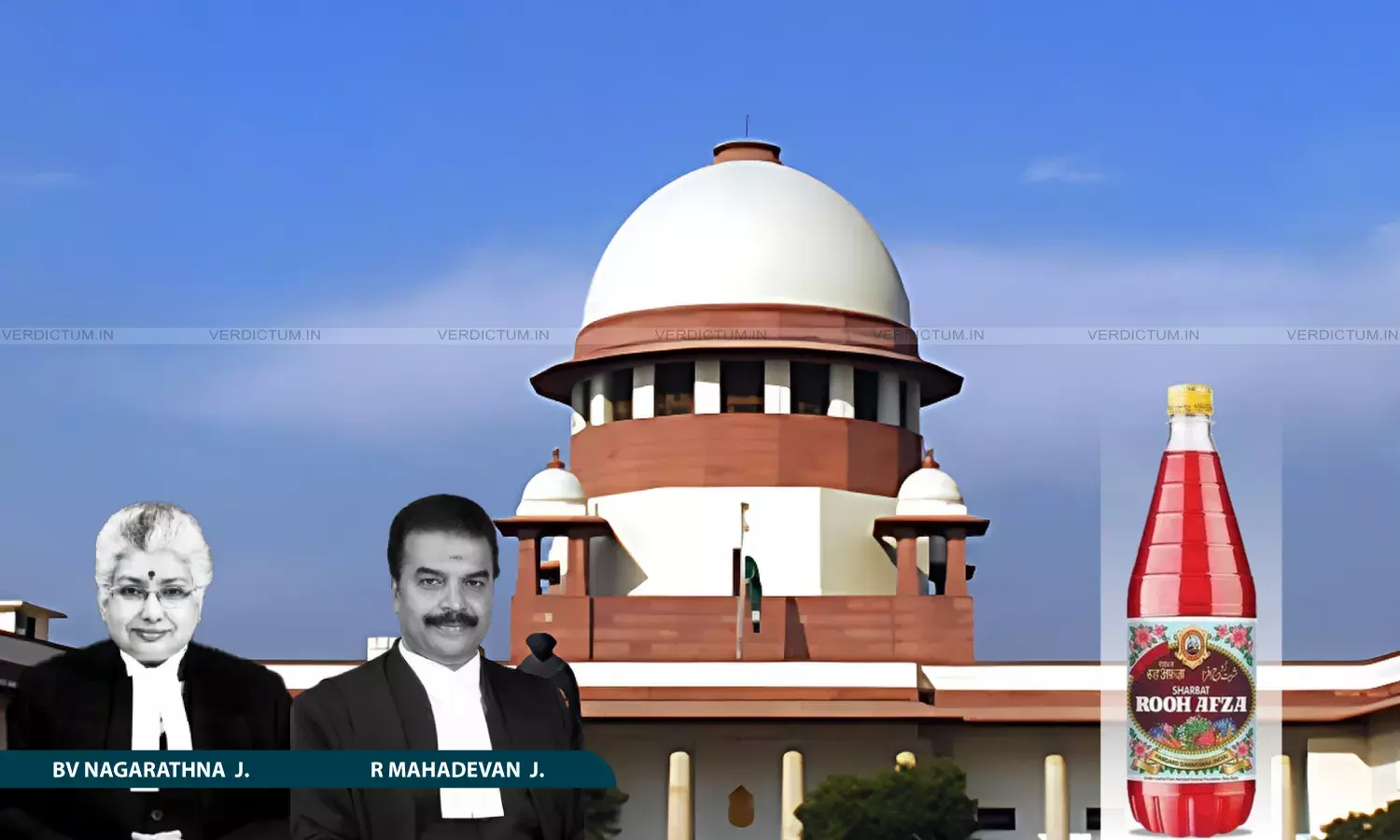
The Supreme Court on fiscal classification has held that “Sharbat Rooh Afza” manufactured by Hamdard (Wakf) Laboratories is liable to Value Added Tax (VAT) at 4% under Entry 103 of Schedule II Part A of the Uttar Pradesh Value Added Tax Act, 2008, and not at 12.5% under the residuary entry.
It was noted that the expression “fruit drink” is not defined under the UPVAT Act, therefore, in such circumstances, classification must be determined on the basis of how the product is understood in common or commercial parlance. The Court clarified that regulatory classifications under food safety laws, such as labelling requirements under the Fruit Products Order cannot control interpretation of a fiscal entry unless expressly incorporated into the taxing statute.
It reiterated that the burden lies squarely on the Revenue to establish that the product falls outside the specific entry claimed by the assessee. In the present case, the Revenue had not produced trade surveys, consumer perception studies, or market evidence to show that “Rooh Afza” was not understood as a fruit-based beverage preparation.
Accordingly, a Bench of Justice B.V. Nagarathna and Justice R. Mahadevan allowing the appeals filed by Hamdard, set aside the judgments of the Allahabad High Court which had affirmed the view of the tax authorities that “Rooh Afza” was an unclassified item taxable under Schedule V. The Bench observed, “Thus, once it is demonstrated that the product is a fruit-based beverage preparation intended for dilution and consumption, it bears a reasonable and substantial claim to classification as a “fruit drink” within Entry 103. It cannot be relegated to the residuary entry merely because it is marketed as a “sharbat”. The nomenclature adopted by the parties, or the description of the product as a “non-fruit syrup” under the licensing statute, is not determinative for the purposes of classification under a taxing statute. What is decisive is the nature, composition and commercial identity of the product. If, on a proper application of the common parlance and essential character tests, the product reasonably answers the description of a “fruit drink”, the same cannot be denied merely on account of its label or regulatory categorization”.
“It is well settled that recourse to a residuary clause is permissible only when the goods cannot reasonably be brought within the ambit of any specific entry. Such inability must be established by the Revenue on the basis of relevant material; the residuary entry cannot be invoked merely because the specific entry is construed narrowly or because some ambiguity is perceived”, the Bench further observed.
Senior Advocate Arvind P. Datar appeared for appellant and Advocate Vikas Singh Jangra appeared for the respondent.
The dispute related to the assessment period between 01-01-2008 and 31-03-2012, since during this period, the appellant had classified “Sharbat Rooh Afza” as a “fruit drink” falling under Entry 103 covering “processed or preserved vegetables and fruits including fruit jams, jelly, pickle, fruit squash, paste, fruit drink and fruit juice”, and paid VAT at 4%.
The Assessing Authority, however, treated the product as a sugar-based syrup containing only 10% fruit juice and therefore not qualifying as a “fruit drink.” It classified the product under the residuary entry in Schedule V, attracting tax at 12.5%. The first appellate authority and the Commercial Tax Tribunal affirmed this view, which was subsequently upheld by the High Court.
Now the Court, applying the “essential character” test, noted that although invert sugar syrup constituted approximately 80% of the product, it merely functioned as a carrier and preservative medium. The beverage identity, flavour, and commercial character of “Rooh Afza” were derived from its fruit juices and distillates. Therefore, quantitative predominance of sugar was held not to be determinative.
Further, emphasising settled principles of tax jurisprudence, the Court held that recourse to a residuary entry is permissible only when a product cannot reasonably be brought under any specific enumerated entry.
“…the Revenue has produced no trade enquiry, consumer survey, market evidence or documentary material to demonstrate that the product is not understood in commercial circles as a fruit-based beverage preparation. Reliance has been placed primarily on licensing norms and the nomenclature “sharbat”. Such material, without more, cannot substitute the evidentiary burden required to displace classification under a specific entry. Accordingly, it must be held that the Revenue has failed to discharge the burden cast upon it in law”, the judgment read.
“Classification must follow the component that confers upon the product its essential beverage character”, it noted.
The Court observed that where two views are reasonably possible, the interpretation favourable to the assessee must prevail.
The Court also took note of the fact that similarly worded VAT entries in other States including Delhi, Gujarat, West Bengal, Madhya Pradesh and Andhra Pradesh had treated the product as falling within fruit-based beverage categories and taxed it at concessional rates.
While such classification was not binding on Uttar Pradesh, the Court held that it had evidentiary value in assessing commercial understanding.
The appeals were accordingly allowed, with directions to grant consequential relief, including refund or adjustment of excess tax paid in accordance with law.
Cause Title: M/S. Hamdard (Wakf) Laboratories v Commissioner Of Commercial Tax [Neutral Citation: 2026 INSC 195]
Appearances:
Appellant: Arvind P. Datar, Sr. Adv., Aditya Bhattacharya, Abhishek Kumar Singh, AOR, Ritwik Tyagi, Simran Tandon, Simran Tandon, Akriti Sharma, Vipin Upadhyay, Advocates.
Respondent: Bhakti Vardhan Singh, AOR, Vikas Singh Jangra, Samar Vijay Singh, Pawan Kishore Singh, J. Tarun Kumar, Sandeep Singh Somaria, Advocates.