

Precedent Operates In Rem While Res Judicata Operates In Personam: Supreme Court Clarifies Effect Of Section 11 Orders In Pre-Amendment Arbitration Act
The Apex Court, stating that there is a clear conceptual distinction between ‘precedent’ and ‘res judicata’, ruled that an earlier Section 11 order appointing an arbitrator, passed in the pre-2015 regime, operates as res judicata on the existence and validity of the arbitration agreement and cannot be reopened in later proceedings after the order appointing the Arbitrator attains finality with no challenge being thrown.
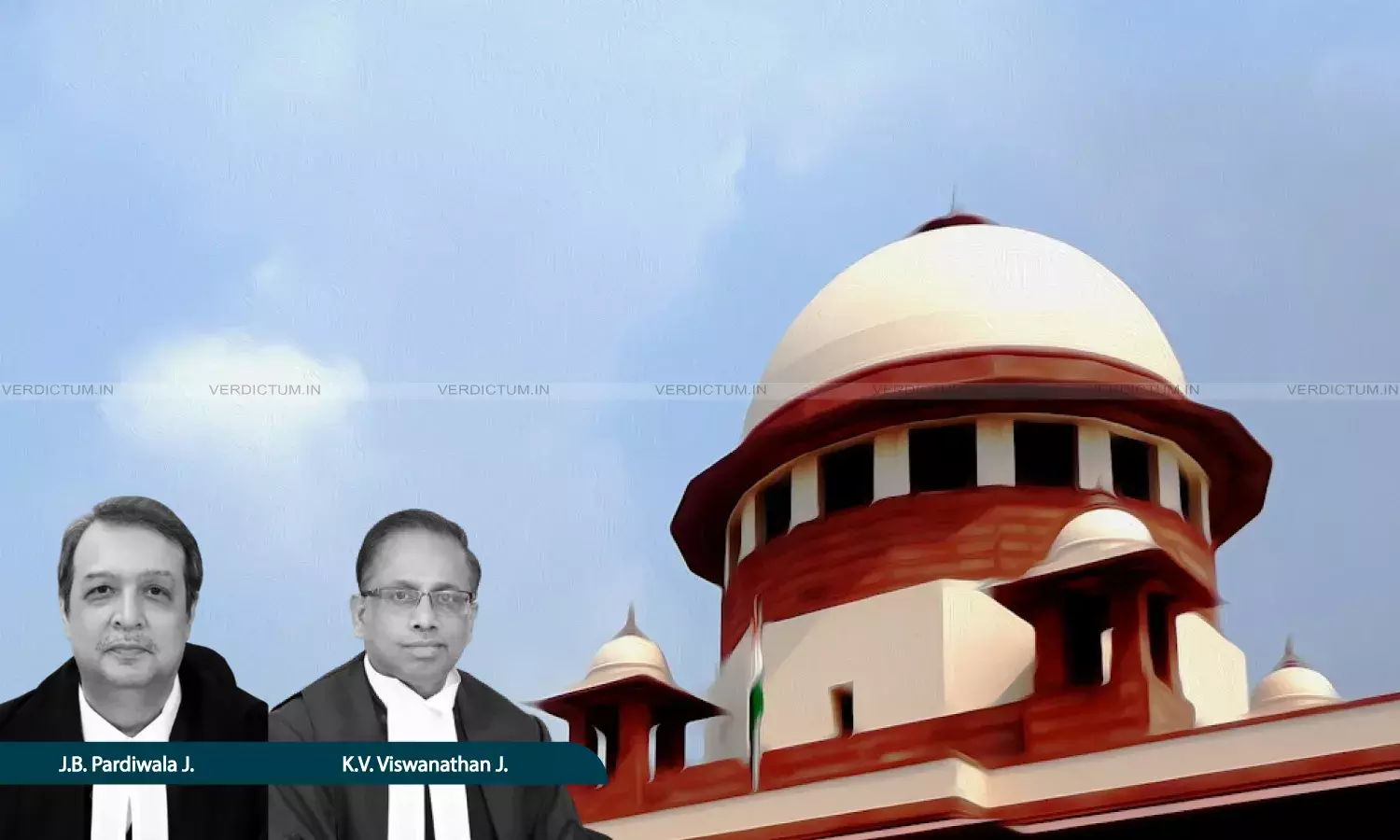
Justice J.B. Pardiwala, Justice K.V. Viswanathan, Supreme Court
Emphasizing the doctrinal difference between ‘precedent’ and ‘res judicata’, the Supreme Court has held that once a Court exercising powers under Section 11 of the Arbitration and Conciliation Act, 1996, appoints an arbitrator under the pre-amendment framework and the order attains finality, the finding on the existence and validity of the arbitration agreement binds the parties in subsequent stages, and cannot be revisited under Section 34.
The Court was hearing civil appeals arising out of arbitral proceedings in which an arbitrator had been appointed by a High Court under Section 11 of the Arbitration and Conciliation Act, 1996, before the 2015 amendments.
The appeals arose after a challenge was mounted under Section 34 of the Act, where the existence and validity of the arbitration clause were once again questioned despite the earlier Section 11 appointment.
A Bench of Justice J.B. Pardiwala and Justice K.V. Viswanathan, while stating that the Commercial Court had missed the conceptual distinction between 'Precedent' and 'Res judicata’, observed that “the order appointing the Arbitrator read with the law laid down in SBP & Co. vs. Patel Engineering Limited & Anr (2005) clearly operates as a res judicata, insofar as the existence of and validity of the arbitration agreement between the parties is concerned”.
Background
The disputes arose from construction contracts containing a dispute resolution clause. When disputes regarding payments arose, the contractor invoked Section 11 seeking the appointment of an arbitrator. The High Court appointed an arbitrator after concluding that the contractual clause permitted arbitral adjudication. That order was accepted and attained finality.
The arbitrator passed awards in favour of the contractor. The opposing party challenged the awards under Section 34, arguing that the clause was not an arbitration agreement and that the arbitrator lacked jurisdiction.
The Commercial Court accepted this contention, reasoning that the Section 11 order had no precedential value and did not conclusively decide validity. The High Court affirmed this view.
The appeals before the Supreme Court raised a core question: whether, under the legal regime prevailing before the 2015 amendments, the Section 11 appointment order barred subsequent challenges to the existence and validity of the arbitration agreement.
Court’s Observation
The Supreme Court began by reaffirming the legal position laid down by the Constitution Bench in SBP & Co. v. Patel Engineering Ltd. Under that regime, a Section 11 court exercised judicial power and was obligated to determine jurisdictional issues, including the existence and validity of an arbitration agreement. Such determination attained statutory finality in the absence of a challenge to the order.
The Court held that once the Section 11 court appointed the arbitrator, it necessarily implied a finding that a valid arbitration agreement existed. Even if not elaborately reasoned, the appointment could not have occurred otherwise. Acceptance of that order without challenge rendered the finding binding.
Turning to jurisprudence, the Court drew a doctrinal distinction between precedent and res judicata. The Court explained: “A decision between two parties which sets out a principle of law will operate as a precedent for disputes between two other parties too. A precedent operates in rem. In contrast, a res judicata operates in personam between the same parties either in the later stage of the same litigation between them or in a different litigation between them”.
The Court further emphasised that the correctness of the earlier decision is immaterial and that finality between parties is the governing principle unless jurisdictional defects exist.
Applying this framework, the Court found that the Section 11 order functioned as res judicata on the issue of the existence and validity of the arbitration agreement. Therefore, the Court held that “not only will the parties be bound before the Arbitrator with regard to the finding on existence and validity of the arbitration agreement, they will also be bound during the subsequent stages of the proceedings, which will include the Section 34 application stage, the Section 37 appeal stage and before this Court”.
The Court contrasted this position with the post-2015 regime, where Section 11(6A) limits judicial inquiry to prima facie examination of existence. However, since the present proceedings arose under the earlier framework, the Court stressed that the broader adjudicatory power and resulting finality governed the case.
The Court concluded that the Commercial Court erred by conflating precedent with res judicata and by revisiting an issue already conclusively settled between the parties.
Conclusion
Concluding that “the Commercial Court and the High Court clearly erred in going into the existence and validity of Clause 23 and pronouncing that the said clause was not an arbitration clause”, the Supreme Court set aside their orders, and the Section 34 proceedings were remitted for consideration of other objections unrelated to the arbitration clause.
The Commercial Court was directed to dispose of the matters within a fixed timeline. The appeals were, accordingly, disposed of.
Cause Title: M/s Eminent Colonizers Private Limited v. Rajasthan Housing Board & Ors. (Neutral Citation: 2026 INSC 116)
Appearances
Appellants: Advocates Akshat Gupta, Lakhan Lal Gupta, Pranav Jain, Prakhar Saunakiya, Yoothica Pallavi, AOR.
Respondents: Advocates K. L. Janjani, AOR, Kailash J. Kashyap, Pankaj Kumar Singh, Archla
