Person Directly Affected By Interim Order In Writ Proceedings Cannot Be Denied Hearing Merely For Not Being Original Party: Supreme Court
The Court reiterated that in writ jurisdiction, the distinction between necessary and proper parties guides impleadment, enabling effective adjudication where the presence of a party aids complete resolution.
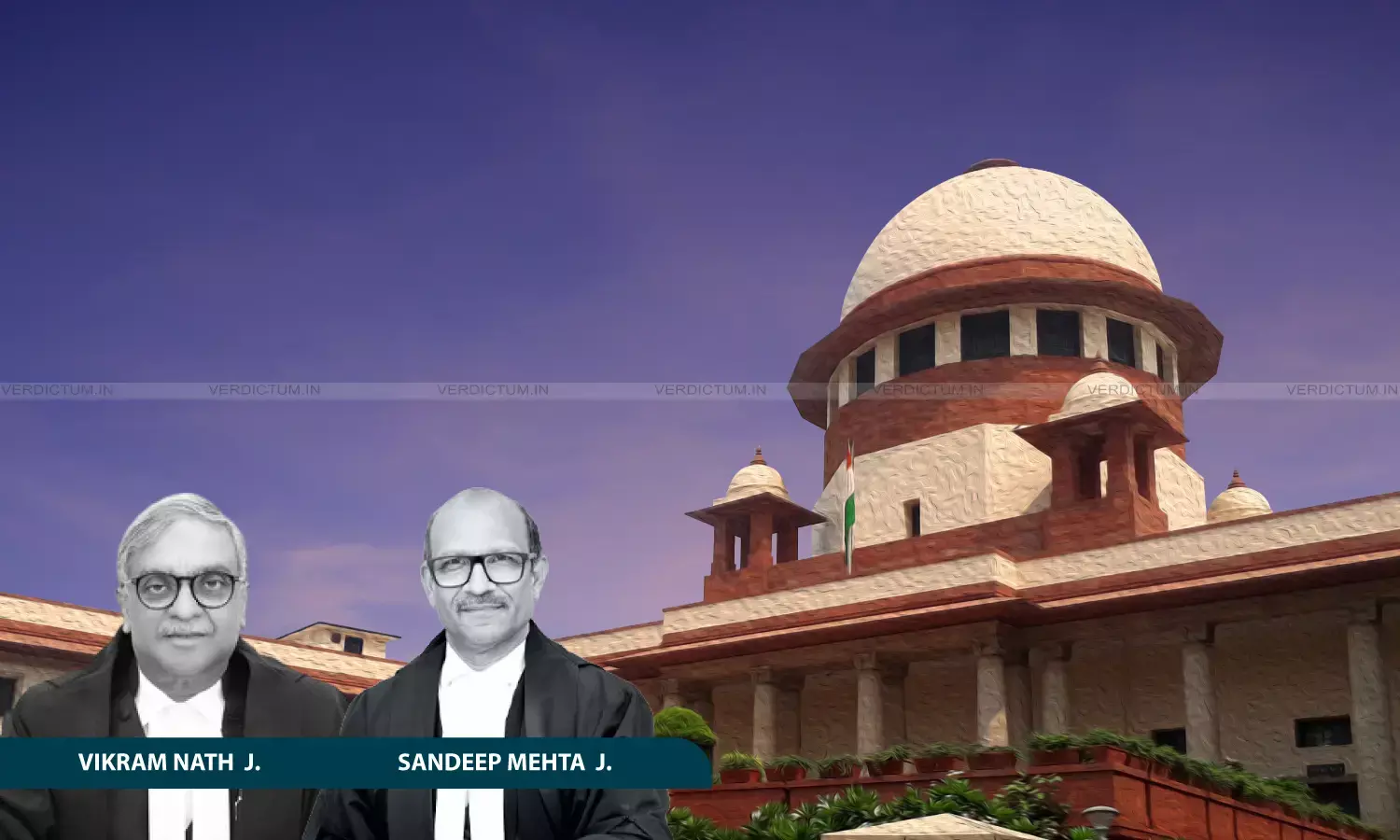
Justice Vikram Nath, Justice Sandeep Mehta, Supreme Court
The Supreme Court has held that in writ proceedings, a person who is directly and demonstrably affected by an interim order cannot be denied participation merely on the ground that such a person was not an original party to the principal challenge.
The Court was hearing civil appeals arising out of the Punjab & Haryana High Court’s order declining impleadment of the appellant and refusing clarification of an interim order passed in a writ petition challenging the Punjab Unified Building Rules, 2025.
A Bench comprising Justice Vikram Nath and Justice Sandeep Mehta observed: “In writ proceedings, where the Court is called upon to interpret the scope and operation of an interim order already passed by it, a person who is shown to be directly and demonstrably affected by that order cannot be shut out merely because such person was not an original party to the principal challenge.”
Senior Advocates Dr A.M. Singhvi, Maninder Singh and Nikhil Goel appeared for the appellant, while Senior Advocates Shadan Farasat, Gopal Sankaranarayanan and Maninderjit Singh Bedi, Advocate General, appeared for the respondents.
Background
The appellant is the owner of a property situated in Jalandhar, for which a change of land use from residential to commercial had been granted, and a building plan for the construction of a hotel had been approved. During the process of obtaining a completion certificate, discrepancies relating to the front setback were pointed out.
Subsequently, the State of Punjab notified the Punjab Unified Building Rules, 2025, under which the minimum front setback requirement was reduced. According to the appellant, its building became compliant under the new regime.
The 2025 Rules were challenged before the High Court in a writ petition. By an interim order dated 24.12.2025, the High Court directed that provisions of the new Rules inconsistent with earlier regulations be kept in abeyance and that violations under earlier rules should not be regularised.
The appellant contended that this interim order was subsequently relied upon by municipal authorities to initiate coercive action against its property, including sealing of premises and issuance of a demolition order.
The appellant pursued multiple remedies, including statutory appeal and independent writ proceedings. It also sought impleadment in the pending writ petition challenging the 2025 Rules and sought clarification/modification of the interim order, contending that the said order was being applied to its detriment.
The High Court dismissed the applications on the ground that the appellant had no lis before it and was not a necessary party. Aggrieved thereby, the appellant approached the Supreme Court.
Court’s Observation
The Supreme Court examined the principles governing impleadment in writ proceedings and noted that while procedural technicalities do not strictly bind writ jurisdiction, the principles underlying Order I Rule 10 CPC continue to provide guidance.
Referring to Mumbai International Airport Pvt. Ltd. v. Regency Convention Centre (2010), the Court reiterated the distinction between a necessary party and a proper party. It was observed that even if a party is not strictly necessary, its presence may still be essential for effective and complete adjudication.
Applying these principles, the Court found that the High Court erred in holding that the appellant had no lis. It noted that the interim order had not remained an abstract direction but had been actively relied upon by authorities while dealing with the appellant’s case.
The Court observed that the appellant’s representations and revised building plans were rejected specifically on the ground that the 2025 Rules stood kept in abeyance by the interim order. It further noted that even the High Court, in subsequent proceedings, had relied on the same reasoning to deny relief to the appellant.
In this context, the Court held that the appellant could not be treated as a stranger to the proceedings. It was observed that even if the appellant was not an original party to the writ petition, the direct civil consequences flowing from the interim order entitled it to participate in the proceedings.
The Court further held that the High Court’s rejection of the application for clarification/modification was also unsustainable. It was observed that once it was demonstrated that the interim order was being invoked against the appellant, the High Court could not have relegated the appellant to other remedies without granting an opportunity of hearing in the same proceedings.
At the same time, the Supreme Court clarified that it would not adjudicate upon the substantive issues relating to the applicability of the 2025 Rules or the correctness of the interim order. These issues, it held, must be left for determination by the High Court in appropriate proceedings.
The Court also examined the interplay between multiple proceedings initiated by the appellant, including the intra-court appeal and civil revision arising from the demolition action. It noted that while these proceedings were interrelated, they arose from distinct causes of action and did not warrant being held in abeyance pending the outcome of the parent writ petition.
“Courts must ordinarily lean in favour of preserving, and not stultifying, a remedy otherwise available in law, particularly where the controversy is still live, and the consequences asserted by the party are continuing”, the Apex Court concluded.
Conclusion
The Supreme Court allowed the appeals and set aside the High Court’s order rejecting the appellant’s impleadment and clarification applications.
It directed that the appellant be impleaded as a party respondent in the writ petition challenging the 2025 Rules. The Court further directed that the High Court shall proceed with the writ petition independently, and that the intra-court appeal and civil revision arising from related proceedings be heard together and decided on their own merits.
The Court also directed that the status quo be maintained with respect to the property in question until disposal of the pending proceedings before the High Court.
All questions on merits, including applicability of the 2025 Rules and legality of the demolition action, were expressly kept open.
Cause Title: M/s Chopra Hotels Private Limited v. Harbinder Singh Sekhon & Ors (Neutral Citation: 2026 INSC 335)
Appearances
Petitioner: Senior Advocates Dr A.M. Singhvi, Maninder Singh, Nikhil Goel; Advocates Varun Chugh, Shubham Singh, Sumit Kumar Gautam, Khyati Sharma, Divyajot Singh, Mahesh Agarwal, Swapnil Gupta, S. Lakshmi Iyer, Harshit Gupta, Devansh Srivastava; AOR E.C. Agrawala
Respondents: Senior Advocates Shadan Farasat, Gopal Sankaranarayanan, Balbir Singh; Advocate General Maninderjit Singh Bedi; Advocates Karan Sharma, Madhav Gupta, Simrathi Gangadhar, Praffull Bardwaj, Vikram Choudhary; AOR Siddhant Sharma; Advocate General Arkaprava Das