Claimant Not Restricted To Claims Raised In Pre-Arbitration Notice; Claims And Counterclaims Can Be Amended Before Arbitral Tribunal: Supreme Court
The Apex Court clarified that a claimant is not bound to confine its statement of claim to disputes raised in a pre-arbitration notice, unless the arbitration agreement expressly restricts the reference, and that both claims and counterclaims may be amended or supplemented before the arbitral tribunal, in accordance with the statutory scheme of the Arbitration and Conciliation Act, 1996.
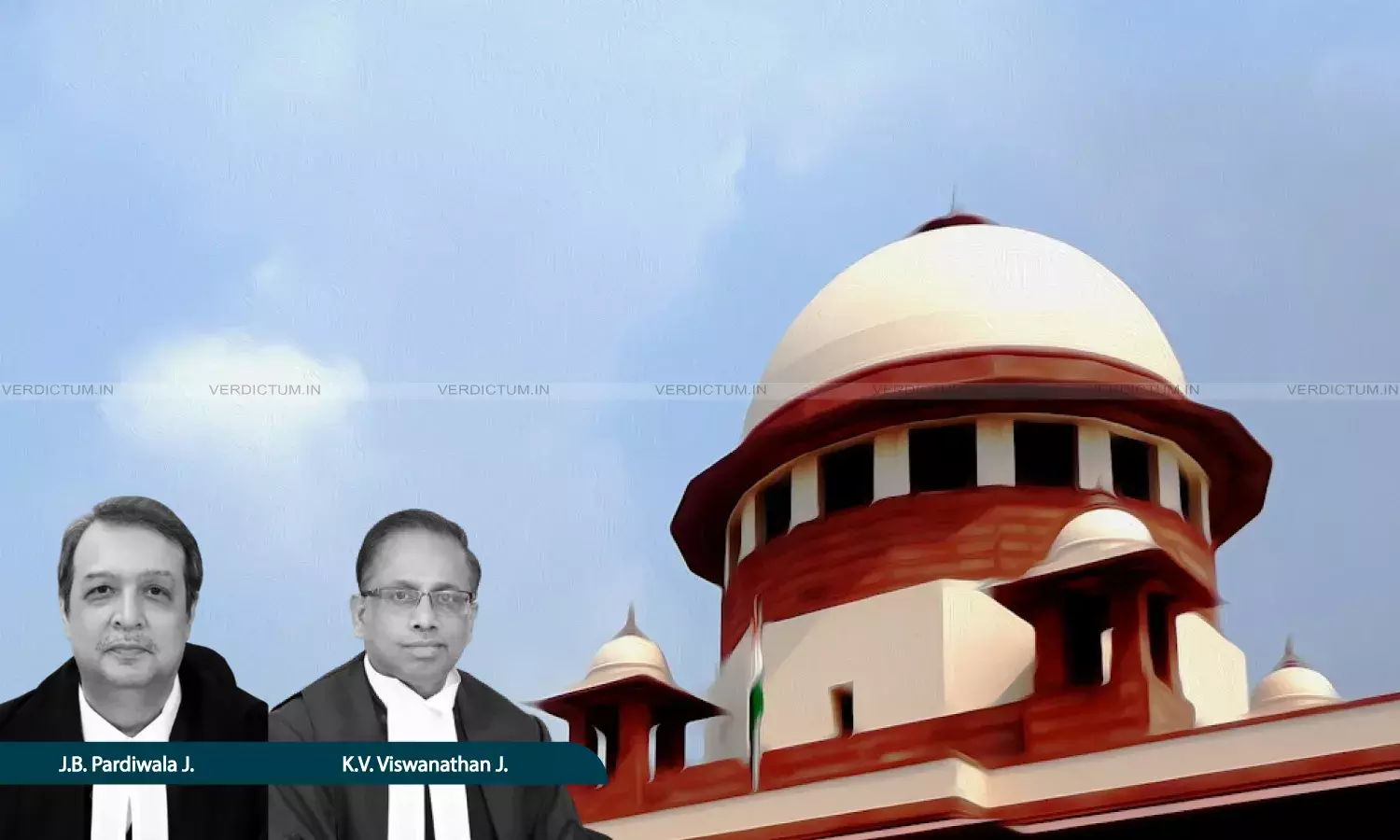
Justice J.B. Pardiwala, Justice K.V. Viswanathan, Supreme Court
The Supreme Court held that the arbitral process under the Arbitration and Conciliation Act, 1996, does not limit a claimant to only those claims mentioned in a notice invoking arbitration, unless the arbitration agreement mandates adjudication of only specifically referred disputes.
The Court was hearing an appeal challenging a judgment of the Kerala High Court, which had set aside an arbitral award on the ground that the arbitral tribunal exceeded its jurisdiction by entertaining disputes that were not specifically referred in the notice invoking arbitration.
A Bench of Justice J.B. Pardiwala and Justice K.V. Viswanathan, while setting aside the High Court’s decision, held: “…when the Arbitral Tribunal is constituted, the claimant is required to file the statement and the respondent to file his defence statement with counter claim, if any, before the arbitrator. The claimant is not bound to restrict his statement of claim to the claims raised by him in the notice issued, if any, before. The claimant can also amend or supplement the claims in the claim statement unless the arbitration agreement requires the arbitrator to decide only the specifically referred disputes. Equally, counterclaims can also be filed and amended”.
Senior Advocate Rajiv Shakdher appeared for the appellant, while Senior Advocate Naveen R. Nath represented the respondent State.
Background
The dispute arose out of multiple road maintenance contracts awarded by the State of Kerala under a World Bank-assisted infrastructure project. The contracts contained a multi-tier dispute resolution mechanism, providing for reference of disputes first to an adjudicator and thereafter to arbitration.
Several disputes relating to price adjustment, escalation during extended periods, interest on delayed payments, and valuation of work were placed before the adjudicator, who partly ruled in favour of the contractor and partly against it. Dissatisfied with the adjudicator’s decision, the State initiated arbitration proceedings.
An arbitral tribunal was constituted, before which both parties raised claims and objections. The tribunal, after dealing with jurisdictional objections under Section 16 of the Arbitration and Conciliation Act, proceeded to adjudicate the disputes and passed an award in favour of the contractor.
The award was set aside by the District Court under Section 34, and the Kerala High Court, while hearing an appeal under Section 37, upheld the setting aside of the award on the ground that the tribunal could not have adjudicated disputes beyond those specifically referred through notice under Section 21 of the Act.
Court’s Observation
The Supreme Court examined the scope and object of Section 21 of the Arbitration and Conciliation Act, 1996, and clarified that the provision is concerned only with the commencement of arbitral proceedings for the purpose of limitation. The Court held that “there is no mandatory prerequisite for issuance of a Section 21 notice prior to the commencement of Arbitration. Issuance of a Section 21 notice may come to the aid of parties and the arbitrator in determining the limitation for the claim. Failure to issue a Section 21 notice would not be fatal to a party in Arbitration if the claim is otherwise valid and the disputes are arbitrable”.
Relying on earlier decisions, the Court reiterated that the claimant is not bound to restrict his statement of claim to the claims raised by him in the notice issued, if any, before, and that claims may be amended or supplemented unless the arbitration agreement requires the arbitrator to decide only specifically referred disputes. The Court further noted that counterclaims are equally permissible and capable of amendment.
The Supreme Court found that the arbitration clause in the present case was of wide amplitude, covering any dispute or difference arising out of or connected with the contract. In such circumstances, the Apex Court held that the High Court erred in holding that the arbitral tribunal lacked jurisdiction to entertain disputes beyond those mentioned in the initial notice.
On the contention that the appellant cannot be referred to as a claimant because no notice under Section 21 had been issued, the Court observed: “once the Arbitral Tribunal is constituted, claims, defence and counterclaims are filed. The party which normally files the claim first is, for convenience, referred to as the ‘claimant’ and the party which responds is called the ‘respondent’. The said respondent is also along with the defence statement entitled to file its counter claim. Hence, to contend that the appellant cannot be referred to as a claimant because no notice under Section 21 has been issued is completely untenable”.
The Bench further held that procedural requirements under the contract and the Act had, in any event, been waived by conduct, and that a party cannot take advantage of its own actions to defeat arbitral jurisdiction.
Conclusion
The Supreme Court concluded that the High Court had erred in setting aside the arbitral award on the ground of non-issuance of notice under Section 21 for all disputes. It held that such a view was contrary to the statutory framework and settled jurisprudence governing arbitral proceedings.
Accordingly, the Supreme Court set aside the judgment of the Kerala High Court and upheld the arbitral award in its entirety. The appeal was allowed, and no order as to costs was passed
Cause Title: M/s Bhagheeratha Engineering Limited v. State of Kerala (Neutral Citation: 2026 INSC 4)
Appearances
Appellant: Senior Advocate Rajiv Shakdher, with Advocates George Thomas, Dhiraj Abraham Philip, AOR, Sunny George, Febin Mathew Varghese, Lija Merin John, and Soyarchon Khangrah
Respondent: Senior Advocate Naveen R. Nath with Advocates Nishe Rajen Shonker, Anu K Joy, Alim Anvar, Devika A.L., Santhosh K, Disha Gupta, Aditya Nath, and Sai Vaishnav