

Termination Proceedings Shouldn’t Be Conflated With Blacklisting Proceedings; Blacklisting Must Comport With Principles Of Natural Justice: Supreme Court
The Supreme Court was considering an appeal of a contractor challenging a termination cum blacklisting order.

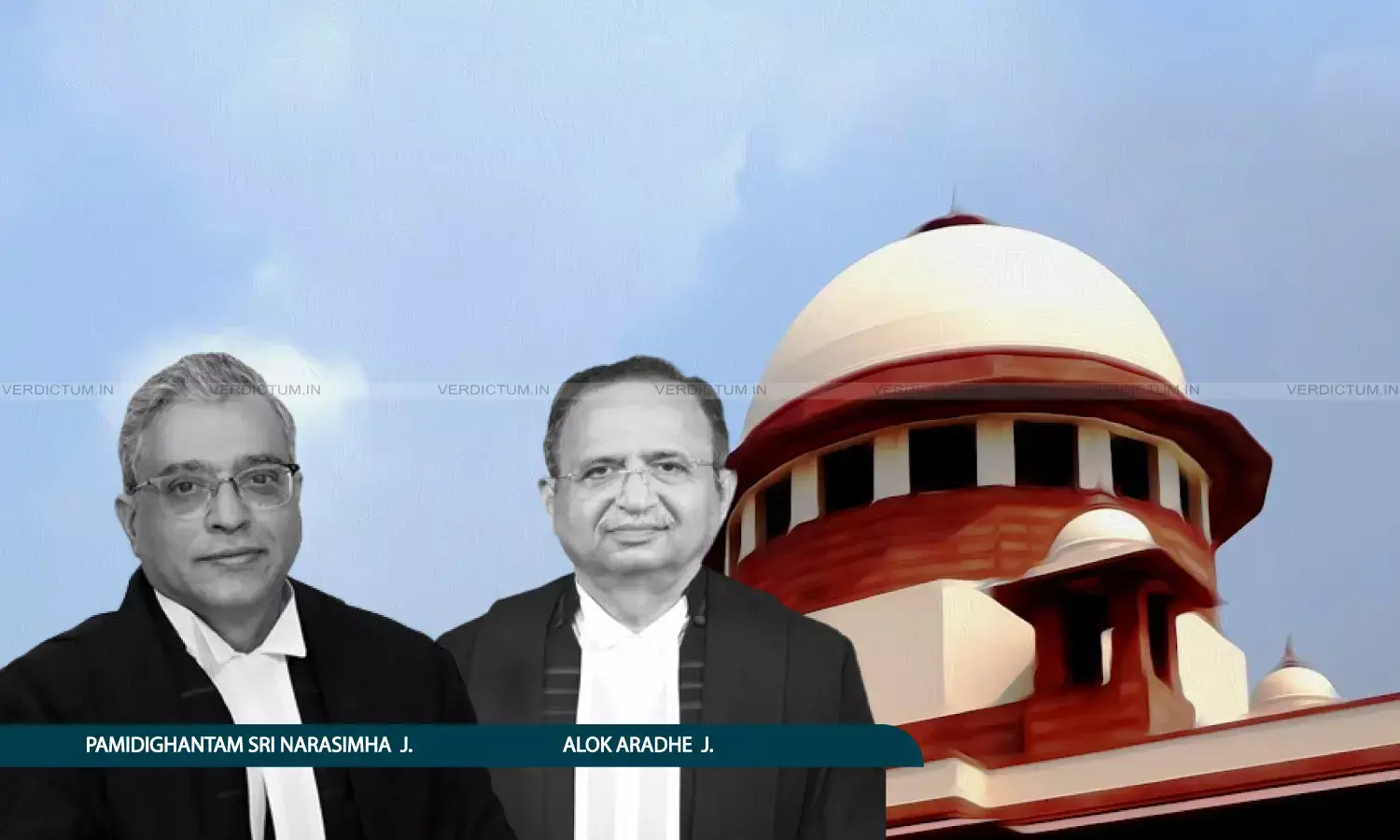
Justice Pamidighantam Sri Narasimha and Justice Alok Aradhe, Supreme Court
While setting aside an order of blacklisting which suffered from patent infirmities, the Supreme Court has held that blacklisting cannot be imposed mechanically but must comport with principles of natural justice and reasonableness. The Apex Court also stated that the proceedings for termination should not be conflated with proceedings for blacklisting.
The Apex Court was considering an appeal of a contractor working with the Water and Sanitation Department, aggrieved by a termination cum blacklisting order.
The Division Bench of Justice Pamidighantam Sri Narasimha and Justice Alok Aradhe held, "Blacklisting, being stigmatic and exclusionary in nature, cannot be imposed mechanistically but must comport with principles of natural justice and reasonableness."
“The contractual relationship between the parties is governed by two legal regimes. While GCC governs termination, the 2012 Rules govern blacklisting. Proceedings for termination should not be conflated with proceedings for blacklisting. In the latter action, what is at stake is the future of the contractor. A blacklisting order assumes that the contractor is an incorrigible entity, at least for some time to come, in this case such an assumption was intended to operate for five years. For giving effect to such a premise, there has to be sufficient evidence, clear application of mind and stronger adherence to principles of natural justice.The blacklisting order dated 23.08.2004 falls short of this requirement and is liable to be set aside", it added.
AOR R. Ayyam Perumal represented the Appellant, while Advocate Kumar Anurag Singh represented the Respondent.
Factual Background
The appellant, a registered contractor with the Water and Sanitation Department, was contracted for the construction of an Elevated Service Reservoir (ESR) by issuance of a Letter of Acceptance (LOA). During the subsistence of the contract, the top dome of the reservoir collapsed. Though it was justified as being a result of an unexpected cyclone, the appellant offered to reconstruct it at their own expense. However, the Department issued a show-cause notice, seeking an explanation as to why action should not be taken for the negligence and bad quality of work. Following the show-cause notice, multi-level enquiries were conducted. Initially, a three-member committee gave its report. Thereafter, the Superintending Engineer also examined the matter in detail. Upon receiving concurrent reports indicating negligence on the part of the appellant, the Chief Engineer, Drinking Water and Sanitation Department, passed the termination cum blacklisting order.
Aggrieved, the appellant filed an appeal, which came to be dismissed by the Appellate Authority cum Principal Secretary, Drinking Water and Sanitation Department. The appellant filed a writ petition, and by the impugned judgment, the High Court dismissed the writ petition, while also imposing a cost of Rs 2 lakh on the appellant. It was also held that the orders impugned were neither illegal nor arbitrary, as a proper opportunity was given to the appellant at every stage.
Reasoning
Referring to Contractor Registration Rules, 2012, the Bench explained that as per Rule 10, an order of blacklisting has serious consequences, affecting not only the existing contracts but also bars future business transactions for some years. The Bench also explained that the Department must issue a specific notice proposing blacklisting of a contractor and call for an explanation as to why an order of blacklisting should not be passed. “This is exactly the purpose and object behind Rule 10.5”, it added.
Noting that the requirement under Clause 10.5 is a clear case of legislative (in this case, subordinate legislation) incorporation of principles of natural justice, the Bench highlighted how the Court has time and again emphasised the need to adhere to principles of natural justice while passing blacklisting orders, given the grave consequences that follow.
On a perusal of the facts of the case, the Bench noted that the show cause notice does not purport to be a show cause notice for blacklisting at all, and it expects the contractor to assume that it is for termination as well as for blacklisting. “Even if we accept the submissions of Mr. Kumar Anurag Singh that, as there is no provision for prior notice before termination, this show cause notice must be taken to be for blacklisting, we are of the opinion that it still falls short of the requirement of a proper show cause notice for blacklisting”, it stated.
The Bench was of the view that the decision to blacklist is independent of the decision to terminate, the Department must demonstrate application of mind before it takes the next step of blacklisting the contractor, over an order of termination. Upon taking such a decision, it must also issue a show cause notice calling upon the contractor to explain why a consequential order of blacklisting should not be passed. The letter must be indicative of the proposed decision to blacklist and the requirement of the contractor to respond to it. The Bench thus held that the show cause notice fell short of these requirements, and the final order of blacklisting did not list the reasons as to why an order of blacklisting had become necessary.
Thus, holding that the order of termination of all contracts was legal but the decision of blacklisting was illegal, the Bench set aside the declaration of blacklisting.
Cause Title: M/S A.K.G. Construction and Developers Pvt. Ltd. v. State of Jharkhand (Neutral Citation: 2026 INSC 312)
Appearance
Appellant: AOR R. Ayyam Perumal
Respondent: Advocate Kumar Anurag Singh, AOR Jayant Mohan, Advocates Zain A. Khan, Adya Shree Dutta, Dorjee Ongmu Lachungpa, Priyanshu Teotia, Dev Aaryan, Mohd. Abran Khan