

Substratum Of Disciplinary Proceedings Ceased To Exist Once Complainant Sought To Withdraw Complaint: Supreme Court Allows Advocate’s Appeal
The Supreme Court was considering a statutory appeal filed under Section 38 of the Advocates Act, 1961 assailing the final judgment of the Disciplinary Committee of the Bar Council of India.

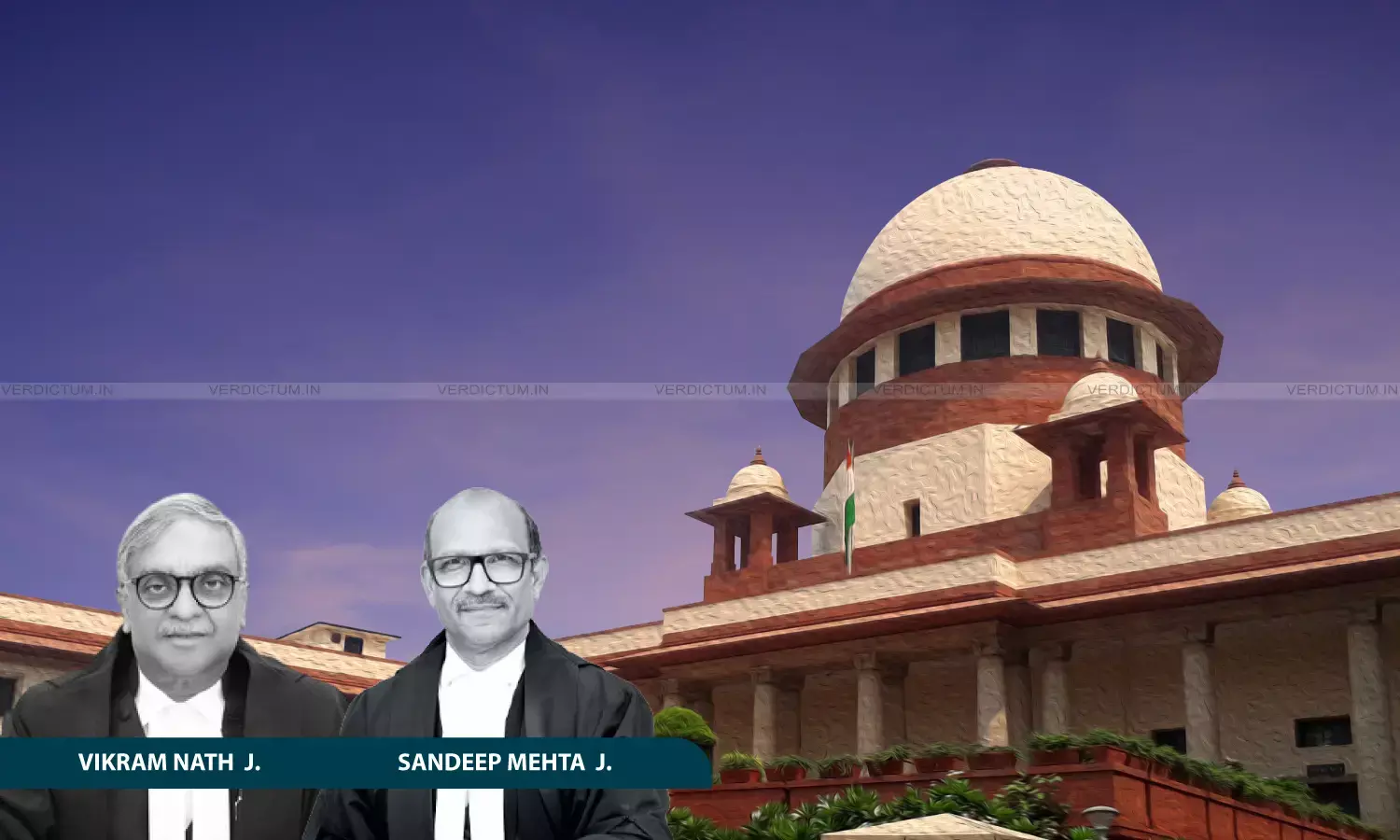
Justice Vikram Nath, Justice Sandeep Mehta, Supreme Court
While granting relief to an Advocate by setting aside an order holding him guilty of professional misconduct, the Supreme Court has held that once the complainant himself expressed complete satisfaction with the professional services rendered by the advocate and categorically sought to withdraw the complaint, the very substratum of the disciplinary proceedings ceased to exist.
The Apex Court was considering a statutory appeal filed under Section 38 of the Advocates Act, 1961 assailing the final judgment of the Disciplinary Committee of the Bar Council of India in a BCI Transferred Case whereby, the appellant-advocate was held guilty of professional misconduct for alleged failure to act with reasonable diligence and absence from Court hearing which led to dismissal of the respondent’s quashing petition.
The Division Bench of Justice Vikram Nath and Justice Sandeep Mehta held, “Thus, considering the totality of the facts and circumstances, particularly that the genesis of the dispute was a mere misunderstanding regarding the deposit of costs which stood resolved during the pendency of the proceedings, the impugned judgment cannot be sustained. Once the respondent-complainant himself expressed complete satisfaction with the professional services rendered by the appellant-advocate and categorically sought to withdraw the complaint, the very substratum of the disciplinary proceedings ceased to exist. In these circumstances, the order holding appellant-advocate guilty of professional misconduct is considered wholly unsustainable in facts as well as in law.”
AOR Disha Singh represented the Appellant.
Factual Background
The respondent came to be arraigned as an accused in an FIR registered for offences under section 451, 323, 506, 427, 148 and 149 of the Indian Penal Code. Upon a compromise being arrived at between the accused and the complainant in the aforesaid FIR, the appellant/advocate was engaged by the respondent complainant to move a petition before the Punjab and Haryana High Court for quashing the FIR based on the compromise. The High Court quashed the FIR subject to the respondent depositing a cost of Rs.10,000. However, the said costs were not deposited within the stipulated time. Consequently, due to the non-production of receipts evidencing compliance, the High Court recalled its earlier order and dismissed the quashing petition for want of prosecution, thereby reviving the criminal proceedings against the respondent.
An application for recalling the order was filed by the appellant-advocate. The High Court recalled the dismissal order, thereby reviving the order quashing the FIR, subject to payment of costs enhanced to Rs 50,000. The respondent instituted a complaint under Section 35 of the Advocates Act before the State Bar Council of Punjab and Haryana. During the pendency of the disciplinary proceedings, the appellant-advocate and respondent complainant arrived at an amicable settlement, wherein the misunderstanding regarding the deposit of costs was resolved. The matter was transferred to the Disciplinary Committee of the BCI. Despite the affidavit praying for withdrawal of the complaint filed by the respondent-complainant before the State Bar Council, the Disciplinary Committee proceeded hold the appellant-advocate guilty of professional misconduct for failing to ensure the timely deposit of costs and dereliction of his professional duties. Accordingly, the Disciplinary Committee imposed a penalty of Rs 1 Lakh, with a further direction that failure to comply would entail suspension of the appellant’s license to practice for a period of one year. This order of the BCI was challenged before the Apex Court.
Reasoning
On a perusal of the impugned judgment, the Bench noted that the Disciplinary Committee failed to appreciate that the substratum of the complaint had ceased to exist once the dispute was amicably resolved and the complaint was sought to be withdrawn by the respondent-complainant himself by way of a duly sworn affidavit. “The impugned judgment neither adverts to the affidavit filed by the respondent-complainant nor deals with the categorical withdrawal of allegations and the expression of satisfaction with the professional conduct of the appellant-advocate”, it added.
The Bench was of the view that the impugned judgment did not reflect that any evidence was led by the respondent-complainant to substantiate the allegations set out in the complaint. “It appears that the appellant-advocate has been held guilty of professional misconduct merely on the basis of bald allegations contained in the complaint, without the complainant being examined on oath and without affording the appellant-advocate the indefeasible right of cross-examination, thereby rendering the finding of professional misconduct legally unsustainable”, it added.
Thus, setting aside the impudgment, the Bench allowed the appeal.
Cause Title: Monty Goyal v. Navrang Singh (Neutral Citation: 2026 INSC 94)
Appearance
Appellant: AOR Disha Singh, Advocate Siddhant Saroha