

No Absolute Exclusion Of Degree Holders: Supreme Court Upholds Bihar Govt. Decision To Make Diploma In Pharmacy Essential Qualification For Pharmacist Posts
The Apex Court held that a Diploma in Pharmacy cannot be treated as an “in-line” higher qualification vis-à-vis a Bachelor of Pharmacy degree, and that the State is within its policy domain to prescribe Diploma holders as the preferred eligibility class for public posts of Pharmacists.
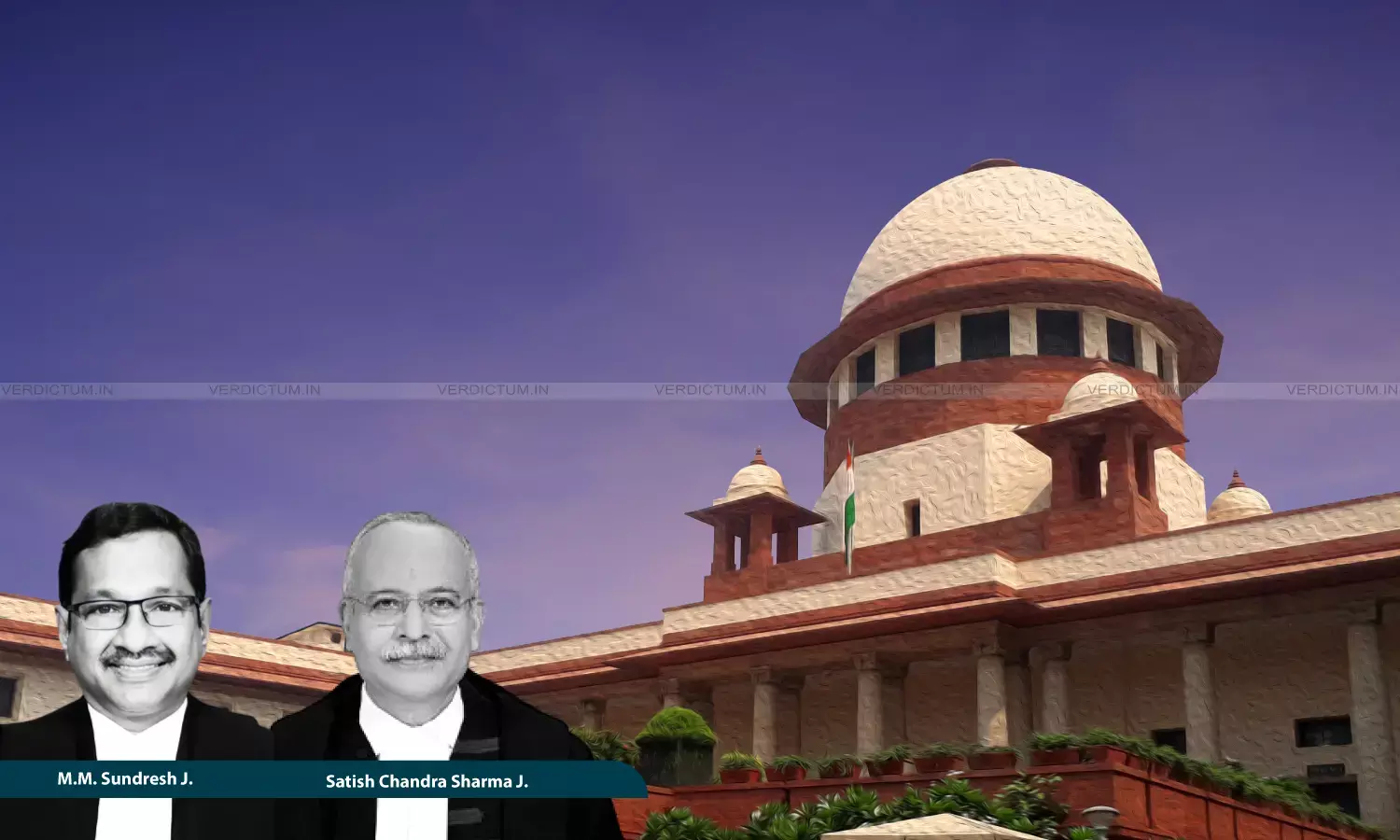
Justice M.M. Sundresh, Justice Satish Chandra Sharma, Supreme Court
The Supreme Court has upheld the validity of recruitment rules framed by the State of Bihar prescribing Diploma in Pharmacy as the essential qualification for appointment to the post of Pharmacist (basic category), rejecting the contention that a Bachelor's or Master of Pharmacy degree should automatically be treated as a higher or equivalent qualification.
The Court was hearing a batch of appeals challenging the judgment of the Patna High Court, which had upheld the constitutional validity of the Bihar Pharmacists Cadre Rules, 2014, as amended in 2024, mandating possession of a Diploma in Pharmacy even for degree holders seeking appointment to public posts.
The Bench comprising Justice M.M. Sundresh and Justice Satish Chandra Sharma examined whether the exclusion of candidates holding only B.Pharm or M.Pharm degrees from public recruitment was arbitrary, discriminatory, or repugnant to the Pharmacy Act, 1948 and the Pharmacy Practice Regulations, 2015.
The Court, while stating that once repugnancy is ruled out, the determination of eligibility criteria squarely falls within the domain of the employer, further held: “…the decision of the State in making possession of a Diploma an essential qualification for appointment cannot be said to be arbitrary. The State has merely identified a narrower catchment of candidates it considers most suitable for a particular purpose, from within the larger pool registered pharmacists”.
Background
The appellants were holders of Bachelor’s and Master’s degrees in Pharmacy, registered with the Bihar State Pharmacy Council. They sought appointment to the post of Pharmacist under the State of Bihar, contending that the Cadre Rules impermissibly excluded them by insisting on possession of a Diploma in Pharmacy as the minimum qualification.
They further contended that the impugned provisions of the Bihar Pharmacist Cadre (Amendment) Rules, 2024 are liable to be set aside as being repugnant to the Pharmacy Act, 1948 and the Pharmacy Practice Regulations, 2015, framed thereunder by the Pharmacy Council of India.
They argued that the Pharmacy Act and the 2015 Regulations recognise both Diploma and Degree holders as pharmacists, and therefore, the State could not deny public employment to degree holders. It was further contended that the Diploma qualification was a feeder qualification for the B.Pharm course, rendering the degree a higher qualification in the same stream.
The State, on the other hand, defended the Cadre Rules on the ground that prescription of qualifications for public employment lies within the exclusive policy domain of the employer, and that Diploma and Degree courses serve distinct objectives with different training structures.
Court’s Observation
The Supreme Court first examined the scope and object of the Pharmacy Act, 1948, noting that the legislation is confined to regulating educational qualifications, registration, and professional conduct of pharmacists. The Act, the Court held, merely creates a pool of eligible persons who may practise pharmacy, and does not confer any right to public employment.
The Court observed that the Pharmacy Practice Regulations, 2015, framed under Sections 10 and 18 of the Act, govern professional standards and ethical practice. They do not regulate public recruitment nor restrict the discretion of the State, as an employer, to select candidates from within the broader pool of registered pharmacists.
Rejecting the plea of repugnancy, the Court reiterated that such conflict arises only where compliance with one law necessarily results in disobedience of another. It clarified that “the Act only creates a pool of eligible persons who may be appointed as pharmacists, the 2015 Regulations certify who is technically competent to practice as a pharmacist, while the Cadre Rules reflect the State’s policy choice in selecting from the broader pool for public employment”, therefore holding that “no conflict arises unless the State appoints someone lacking the minimum technical qualification”.
On the question of equivalence, the Court undertook a detailed comparison of the course structures. It noted that the Diploma in Pharmacy mandates 500 hours of compulsory practical training, including 250 hours devoted to dispensing prescriptions, with training focused on hospital, dispensary, and clinic-based activities. In contrast, the B.Pharm Regulations, 2014 require 150 hours of practical training, with an option to undertake training in pharmaceutical industry settings.
The Court categorically held that “merely because there is a provision for lateral entry of diplomates into the second year of the B.Pharm course, it does not render the degree an in-line higher qualification.” It emphasised that “a qualification in one stream does not presuppose a qualification in another”, and that Diploma and Degree courses are designed with different objectives, skill sets, and employment orientations.
The Bench further accepted the State’s rationale that Diploma holders have comparatively limited employment avenues, whereas degree holders enjoy broader opportunities in industry and higher technical posts. The State, therefore, was entitled to identify a narrower catchment of candidates it considered most suitable for public health services.
Reaffirming settled principles, the Court held that prescription of eligibility qualifications, determination of equivalence, and recruitment policy fall squarely within the employer’s domain, and courts cannot rewrite service rules or substitute their own views unless the rules are shown to be arbitrary or violative of fundamental rights.
Conclusion
The Supreme Court concluded that the State’s decision to prescribe Diploma in Pharmacy as an essential qualification for appointment to public posts of Pharmacist is neither arbitrary nor unconstitutional.
Accordingly, the appeals were dismissed, and the validity of the Bihar Pharmacists Cadre Rules, as amended, was upheld.
Cause Title: MD. Firoz Mansuri & Ors. v. State of Bihar & Ors. (Neutral Citation: 2026 INSC 68)
Appearances
Appellants: Advocates Vinod Kumar Tewari, AOR, Dilip Singh, R Karthik, Maahi Singh, Pramod Tiwari, Vivek Tiwari, Priyanka Dubey and Others
Respondents: Senior Advocate Santosh Kumar, with Advocates Rajiv Ranjan Mishra, Suruchi Yadav, Dheeraj P. Deo, AOR, Manish Kumar, AOR, Divyansh Mishra, Kumar Saurav and Others
