

Follow Standardized Format For Cataloguing Witnesses, Documentary Evidence & Material Objects: Supreme Court Issues Directions To Trial Courts
The Supreme Court said that such directions will serve to facilitate better comprehension and immediate reference for all stakeholders, including the Appellate Courts.
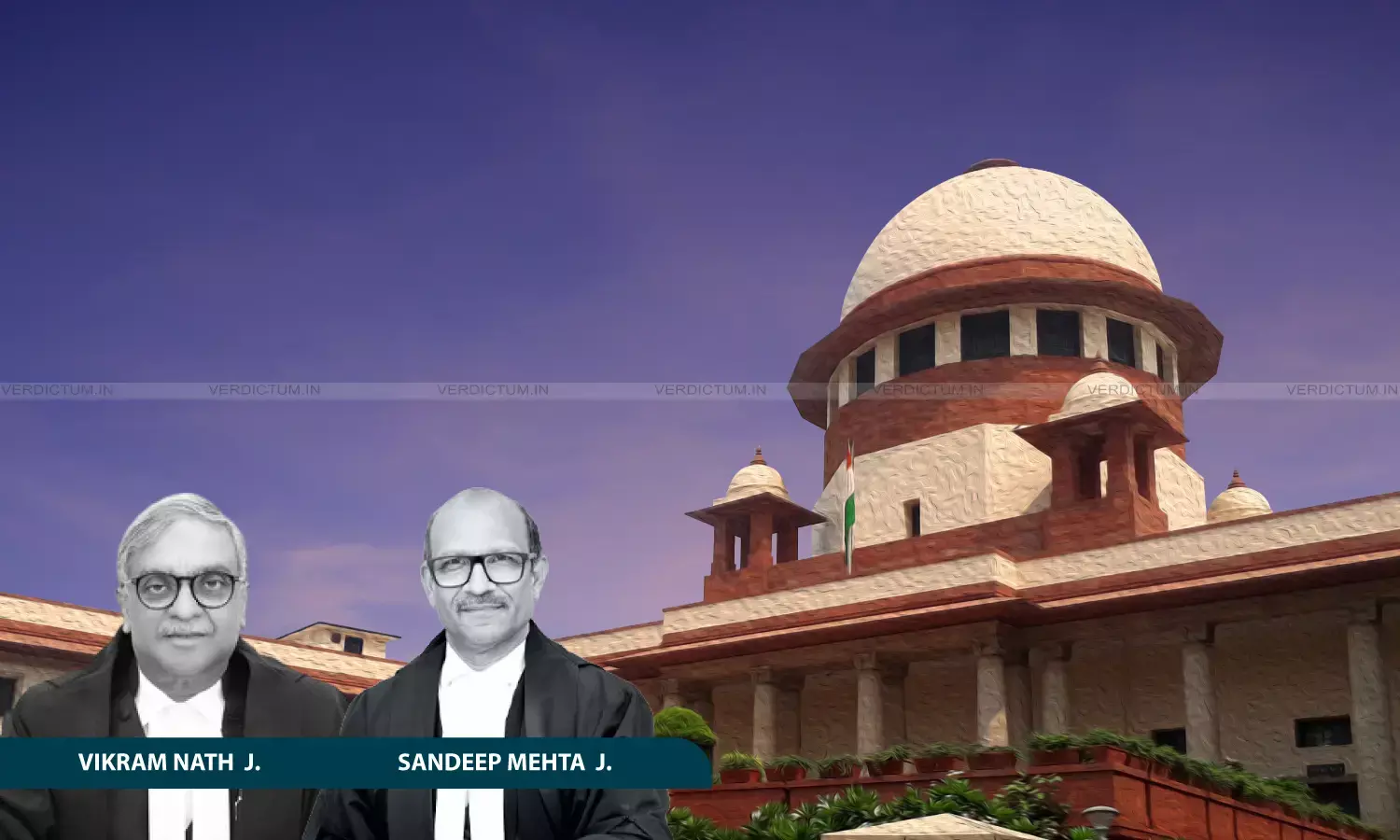
Justice Vikram Nath, Justice Sandeep Mehta, Supreme Court
The Supreme Court has issued necessary directions to the Trial Courts to institutionalize a standardized format for cataloguing witnesses, documentary evidence, and material objects.
The Court was hearing a Criminal Appeal filed by an accused challenging the Judgment of the Gujarat High Court, which upheld his conviction for the offences punishable under Sections 363, 376(2)(i), and 201 of the Indian Penal Code, 1860 (IPC) and Sections 3 and 4 of the Protection of Children from Sexual Offences Act, 2012 (POCSO Act).
The two-Judge Bench of Justice Vikram Nath and Justice Sandeep Mehta observed, “… we would like to highlight that the judgments of the trial Court as well as the High Court in the instant case have indeed appended charts of witnesses and documents in their respective judgments. However, we are of the considered view that a more structured and uniform practice must be adopted to enhance the legibility of criminal judgments. Accordingly, to ensure a systematic presentation of evidence that enables efficient appreciation of the record, we issue the following directions to all trial Courts across the country. These directions aim to institutionalize a standardized format for cataloguing witnesses, documentary evidence, and material objects.”
The Bench added that such directions will serve to facilitate better comprehension and immediate reference for all stakeholders, including the Appellate Courts and hence, the same shall be adhered to by all Trial Courts across the country.
AOR Vijay Kumar appeared for the Appellant/Accused, while Standing Counsel (AOR) Swati Ghildiyal appeared for the Respondent/State.
Factual Background
In 2013, the Complainant had taken his dinner and was resting with his family members in the open courtyard of his house. At about 11 o’clock in the night, he saw three to four boys going from the front of his house with the child victim who did not have a stitch of cloth on her body. The Complainant stopped them and made an inquiry as to where they were taking the child, on which one of the boys replied that they suspected the child to be from the Nayak community and that she might have gone missing and thus, they were taking her to the Nayak Faliya for making an inquiry. The Complainant thereupon brought the child victim under some light in order to identify her. He judged that the child was aged about four years and saw blood dribbling down her legs. He accompanied the boys to Nayak Faliya and made inquiries from two to three people; however, no information was forthcoming regarding her family. He tried to inspect the victim’s body on which he found that she was bleeding continuously from her nether regions.
He suspected that some untoward incident had happened with the child victim. He, therefore, asked the boys as to where they had brought the child victim from, on which, they replied that the child victim was found nearby a house situated in front of pan stall. The victim was admitted to the hospital and as per the doctor, she was sexually assaulted and due to that reason, she was bleeding from her private parts. Hence, a complaint was lodged and the four boys who had brought the child victim claimed that they had seen the accused-Appellant pushing the child victim out of his house. Hence, the accused was arrested and thereafter, the Trial Court convicted and sentenced him to undergo life imprisonment along with a fine of Rs. 5,000/-. This was challenged before the High Court, which affirmed the conviction. Being aggrieved, the accused was before the Apex Court.
Court’s Observations
The Supreme Court after hearing the contentions of the counsel, noted, “We further find the conduct of the police officers who conducted the investigation of the case to be highly pedantic and gravely negligent.”
The Court said that the entire story of the prosecution wherein it has been claimed that the accused-Appellant was seen throwing out the child victim in a denuded condition after committing forcible sexual assault upon her is not established by any credible or reliable evidence.
“Therefore, it is firmly established that the prosecution case is clearly missing the key component of an unbroken chain of incriminating circumstances to convict the accused-appellant on the basis of last seen together circumstance”, it remarked.
Court’s Directions & Conclusion
Before parting with the case, the Court issued the following directions to the Trial Courts –
1. Preparation of Tabulated Charts in all the Judgments:
All Trial Courts dealing with criminal matters shall, at the conclusion of the Judgment, incorporate tabulated charts summarizing: -
a. Witnesses examined,
b. Documents exhibited, and
c. Material objects (muddamal) produced and exhibited.
2. Standardized Chart of Witnesses:
Each criminal Judgment shall contain a witness chart with at least the following columns:
a. Serial Number
b. Name of the Witness
c. Brief Description/Role of the Witness, such as: Informant, Eye-witness, Medical Jurist/Doctor, Investigating Officer (I.O.), Panch Witness, etc.
3. Standardized Chart of Exhibited Documents:
A separate chart shall be prepared for all documents exhibited during trial. This chart shall include:
a. Exhibit Number;
b. Description of document;
c. The Witness who proved or attested the document.
4. Standardized Chart of Material Objects/Muddamals:
Whenever material objects are produced and marked as exhibits, the Trial Court shall prepare a third chart with:
a. Material Object (M.O.) Number;
b. Description of the Object;
c. Witness who proved the Object’s Relevance (e.g., weapon, clothing, tool, article seized under panchnama, etc.)
5. Special Provisions for Cases Involving Voluminous Evidence:
In complex cases, such as conspiracies, economic offences or trials involving voluminous oral or documentary evidence, the list of witnesses and exhibits may be substantially long. Where the number of witnesses or documents is unusually large, the Trial Court may prepare charts only for the material, relevant, and relied-upon witnesses and documents, clearly indicating that the chart is confined to such items. This ensures that the charts remain functional reference tools rather than unwieldy compilations.
6. Application to Defence Witnesses and Evidence:
The aforesaid directions shall apply, mutatis mutandis, to all witnesses examined and all evidence adduced by the defence.
7. Adoption of Specimen Format and Permissible Deviations:
The specimen charts provided herein shall ordinarily serve as the standard format to be followed by Trial Courts across the country.
8. Observations Regarding Applicability to Civil Proceedings
The Court clarified that while these directions are primarily intended to streamline criminal trials, it is left open to the High Courts to consider, wherever appropriate, the adoption of similar tabulated formats in civil matters as well, particularly in cases involving voluminous documentary or oral evidence, so as to promote clarity, uniformity, and ease of reference.
“The High Court may consider incorporating the above directions in their respective rules governing the procedure of trial Courts. … Registry shall forthwith transmit a copy of this judgment to the Registrar General of all the High Courts to ensure due compliance with the directions issued by this Court in paragraph Nos. 81-90 (supra)”, it directed and concluded.
Accordingly, the Apex Court allowed the Appeal, acquitted the accused, and issued necessary directions.
Cause Title- Manojbhai Jethabhai Parmar (Rohit) v. State of Gujarat (Neutral Citation: 2025 INSC 1433)
Appearance:
Appellant: AOR Vijay Kumar and Advocate Vidushi Garg.
Respondent: Standing Counsel (AOR) Swati Ghildiyal and Advocate Rishi Yadav.
