

Narrow Or Mechanical Construction Of Rules Governing Compassionate Appointment Can’t Be Permitted To Override Welfare-Oriented Purpose Of Scheme: Supreme Court
The Civil Appeal before the Supreme Court was preferred by the Managing Director, M.P. State Agricultural Marketing Board, against the judgment passed by the Madhya Pradesh High Court.

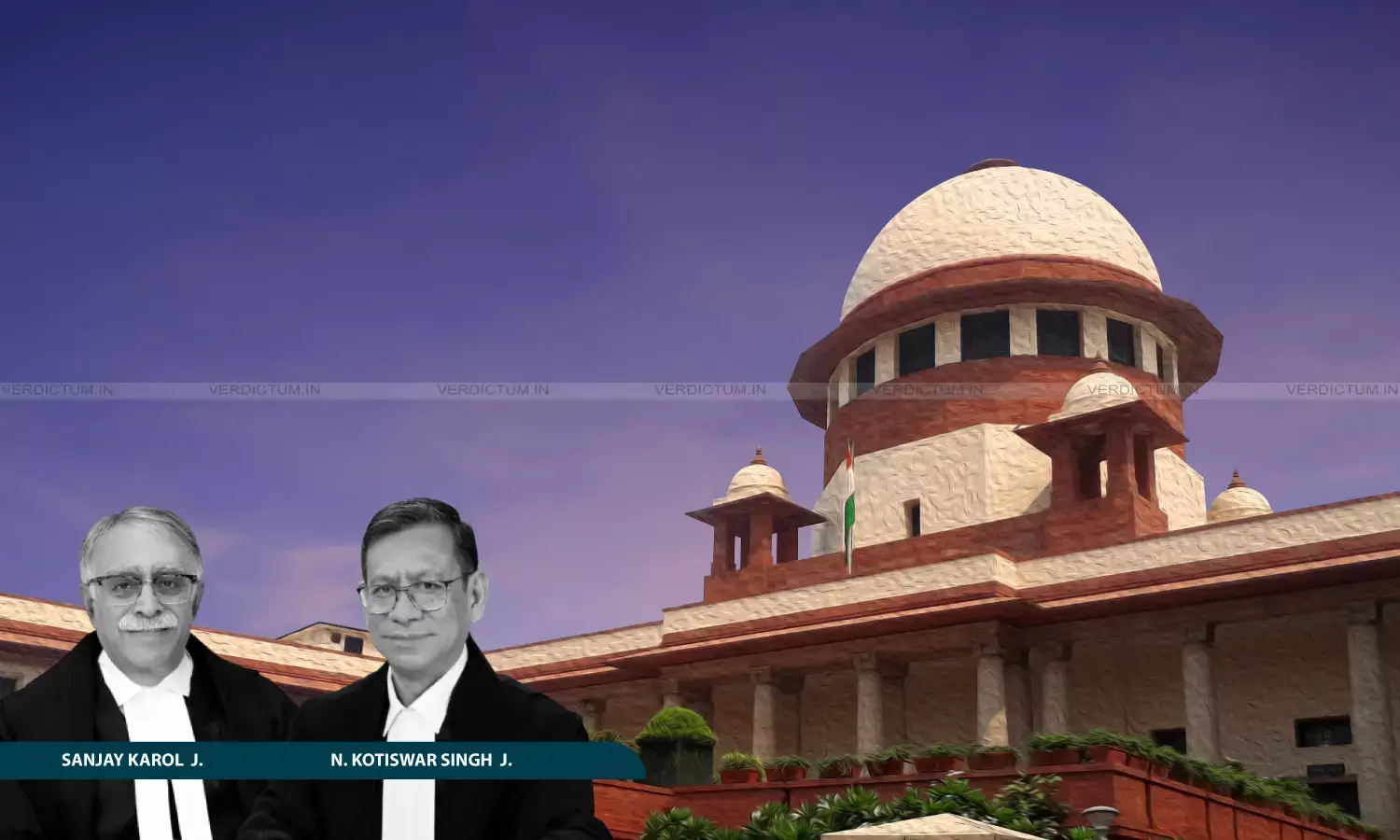
Justice Sanjay Karol, Justice Nongmeikapam Kotiswar Singh, Supreme Court
While upholding the compassionate appointment granted to a Krishi Upaj Mandi Samiti employee to a lower post, the Supreme Court has observed that a narrow or mechanical construction of the rules governing compassionate appointment cannot be permitted to override the welfare-oriented purpose of the scheme.
The Civil Appeal before the Apex Court was preferred by the Managing Director, M.P. State Agricultural Marketing Board, against the judgment passed by the Madhya Pradesh High Court. The Single Bench of the High Court directed the competent authorities to sympathetically consider the compassionate appointment of the first respondent to a lower post (ClassIV), subject to his willingness to serve in such a post.
The Division Bench of Justice Sanjay Karol and Justice Nongmeikapam Kotiswar Singh stated, “It can be safely concluded that a narrow or mechanical construction of the rules governing compassionate appointment cannot be permitted to override the welfare-oriented purpose of the scheme. Where a procedural rigidity ceases to advance the humanitarian intent of the policy and instead operates as an obstacle to its effective implementation, such a procedure must be construed liberally to ensure that justice is not sacrificed at the altar of technicality.”
AOR Sunny Choudhary represented the Appellant while Advocate Seema Kushwaha represented the Respondent.
Factual Background
The first Respondent claimed appointment on compassionate grounds, on the ground that his father died in harness, while serving as a Peon in the Krishi Upaj Mandi Samiti. Thereafter, in accordance with the policy governing compassionate appointment, the first Respondent was sanctioned an appointment on compassionate grounds to a Class-III post, namely Assistant Grade-III, in the Krishi Upaj Mandi Samiti, Morena. As per Clause 6.5 of a Government Memorandum dated September 29, 2014, an appointment to the post of Assistant Grade-III was conditional, as the concerned candidate had to clear the Computer Proficiency Certification Test (CPCT) within three years of joining service. In consonance with the above Clause, the appointment order of the first Respondent expressly stipulated that he was required to acquire the requisite computer qualifications within a period of three years. This caveat was incorporated in Conditions No. 15 and 16 of the appointment order.
The dispute arose when, notwithstanding the expiry of the stipulated three-year period under Condition No. 15, and despite the grant of an additional one-year extension, the first Respondent failed to obtain and submit the requisite CPCT scorecard, culminating in the termination of his services issued by the appointing authority. Aggrieved thereby, the first Respondent filed a Writ Petition before the High Court seeking the quashing and setting aside of his termination order and restoration of his service in the department. The Single Bench of the High Court directed the competent authorities to sympathetically consider the case of the Respondent for appointment to a lower post (Class-IV) in which the CPCT qualification was not mandatory, subject to expressing his willingness to serve in such a post. The appellant approached the Apex Court challenging this direction.
Reasoning
The Bench stated, “A welfare State, committed to the Constitutional ideals of justice with the mandate of reducing inequality, promoting social justice and ensuring a basic standard of living for all, cannot afford to allow such bereaved families to slide into destitution by the mechanical operation of procedural formalities. Significantly, a responsibility has been cast upon the State under the provisions of Part IV of the Constitution of India, i.e., Article 39 of the Directive Principles of State Policy to serve such a welfare State. Thus, the policy of compassionate appointment is not a concession, largesse or mercy shown to hapless dependents of a deceased employee, but a structured response of the State to ensure that the death of an employee does not mark the beginning of economic calamity for those left behind.”
As per the Bench, the Single and Division Bench of the High Court rightly directed the competent authority to consider the case of the first Respondent for compassionate appointment to a lower post (Class IV), which did not require CPCT qualification. “The undertaking furnished by Respondent no. 1 to be considered for appointment to a lower post (Class-IV), identical to the one held by his deceased father, does not entail any relaxation of eligibility norms, nor does it confer upon him any undue or undeserved advantage”, it added.
Considering that the humanitarian objective of the compassionate appointment scheme along with the surrounding circumstances, where the first Respondent fulfilled all other essential qualifications and also rendered prima facie unblemished service for a continuous period of four years, the Bench directed the competent authority to consider him for appointment to a Class-IV post, which couldnot be said to transgress any statutory or policy conditions.
Finding no merit in the appeal, the Bench dismissed the same and directed the appellants to consider the case of the Respondent for compassionate appointment to a Class-IV post within six weeks.
Cause Title: Managing Director, M.P. State Agricultural Marketing Board v. Harpal Singh (Neutral Citation: 2025 INSC 1490)
Appearance
Appellant: AOR Sunny Choudhary, Advocate Mayur Chaturvedi
Respondent: Advocates Seema Kushwaha, Sunil Prakash Pandey, AOR Niteen Kumar Sinha, Advocates Swaraj Maurya, Saurabh Kumar, Government Advocate Abhimanyu Singh, AOR Yashraj Singh Bundela, Pratima Singh, Advocate Arpit Garg