

Can’t Substitute Our Opinions In Place Of That Of Testator: Supreme Court Upholds 1988 Will
The Supreme Court said that in this case, the only suspicion raised about the execution of the will is the testamentary capacity of the testator.
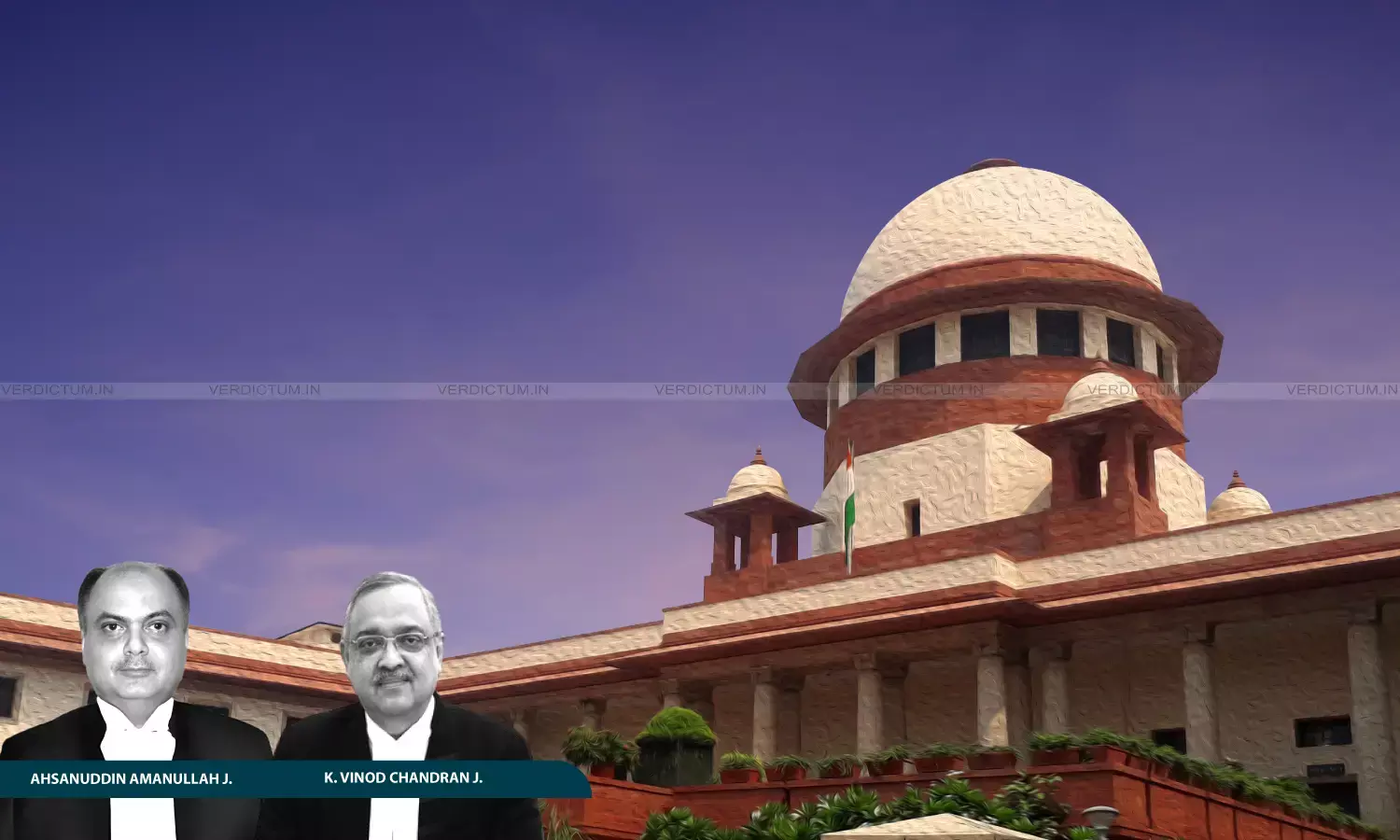
Justice Ahsanuddin Amanullah, Justice K. Vinod Chandran, Supreme Court
While upholding a 1988 Will, the Supreme Court said that it cannot substitute its opinions in place of that of Testator.
The Civil Appeals before the Court challenged the concurrent findings; disbelieving a will, excluding one out of nine children, who married out of the community, holding the estate of the testator partible.
The two-Judge Bench comprising Justice Ahsanuddin Amanullah and Justice K. Vinod Chandran remarked, “We cannot put the testator in our shoes, and we should step into his. We cannot substitute our opinions in place of that of the testator; his desire prompted by his own justifications. As is trite, we would only ensure that, sitting in the arm-chair of the testator the rule of prudence is satisfied for the exclusion; which on the facts of this case amply satisfies the judicial conscience.”
The Bench said that in this case, the only suspicion raised about the execution of the will is the testamentary capacity of the testator, relatable specifically to his physical disposition, questioned in the cross-examination of the witness; unequivocally affirmed as sound.
Senior Advocates V. Chitambaresh and A. Hariprasad appeared on behalf of the Appellants, while Senior Advocate P.B. Krishnan appeared on behalf of the Respondents.
Brief Facts
One N.S. Sreedharan executed a will in 1988 and registered it on the very next day, a Sunday, the Sub-Registrar having come to his house on commission. The will provided for allocation of the properties to the eight out of the nine children of the testator; the Plaintiff having been left out. An injunction suit was filed by the Defendant in the year 1990, against the Plaintiff, who was the sole Defendant therein, to restrain her from interfering with the peaceful possession and enjoyment of the suit property. A copy of the will was produced along with the plaint and the sole Defendant did not choose to contest the matter. There was an ex-parte Judgment and Decree passed by the Principal Munsif Court and later in 2011, a suit was filed seeking partition of the father’s properties. There were two attesting witnesses, one of whom was no more at the time of trial.
The Trial Court decreed the suit on the ground that the witness only spoke of the execution of the will by the testator and his own attestation. Though, the presence of the other attesting witness at the time of execution was spoken of, his attestation was not deposed to. The High Court found that though in the examination-in chief, the witness did not depose on the attestation by the other witness, in cross-examination to a leading question he answered that all persons signed on the will on the date when the witness signed the same. It was held that by the leading question, the answer was put in the mouth of the witness and hence, it lacks probative value and fell short of the mandate under Section 63(c) of the Indian Succession Act, 1925 (ISA) read with Section 68 of the Indian Evidence Act, 1872 (IEA). This was under challenge before the Apex Court.
Reasoning
The Supreme Court in view of the above facts, observed, “We also reiterate, with respect, that the rule of prudence; of the caution required in upholding a will which divests the legal heirs as a whole, is not the situation existing in the instant case. But, the person excluded was one of the children of the plaintiff, the sole one excluded. The propounders of the will are the siblings of the one excluded. There is a reason stated for such exclusion, the acceptability of which to our minds, is not what the rule of prudence dictates.”
The Court was of the view that there is no reason to uphold the Judgment of the High Court which affirmed the Judgment of the Trial Court.
“We set aside both and find the will to have been proved satisfactorily. The presence of the testator and the attesting witnesses and the signatures affixed on the will by each of them have been stated by DW-2 in his deposition. What was lacking in the examination-in-chief was brought out in the cross examination by way of a positive suggestion”, it added.
The Court further said that leading questions are permitted in cross-examinations and the response elicited cannot be said to have lesser probative value, as held by the High Court.
“The testator was also established to be of sound and disposing mind at the time of execution of the will. There can be no interference to the will which stands proved unequivocally. The judgment and decree of the High Court and that of the trial court stands set aside. The plaintiff is found to have no partible claim over the properties of her father, which by a will have been bequeathed to the other siblings of the plaintiff”, it also observed.
The Court, therefore, concluded that it is not on equity, and the wish of the testator assumes pre-eminence and the last will and testament of the testator cannot be digressed from or frustrated.
Accordingly, the Apex Court allowed the Appeals and dismissed the suit.
Cause Title- K. S. Dinachandran v. Shyla Joseph & Ors. (Neutral Citation: 2025 INSC 1451)
Appearance:
Appellants: Senior Advocates V. Chitambaresh, A. Hariprasad, AORs Bijo Mathew Joy, Mukund P. Unny, Advocates Gifty Marium Joseph, Swathi H. Prasad, and Sanjay Nair S.
Respondents: Senior Advocate P.B. Krishnan, AOR Sarath S. Janardanan, and Anila Tharakan Thomas.
