Denial Of Relaxation In Qualification Despite Granting It To Similarly Situated Employees, Arbitrary And Violative Of Articles 14 & 16 Constitution: Supreme Court
The Court held that where relaxation in qualification is permissible under rules and extended to similarly placed employees, denial of the same to another eligible employee amounts to arbitrary discrimination and violates equality principles.
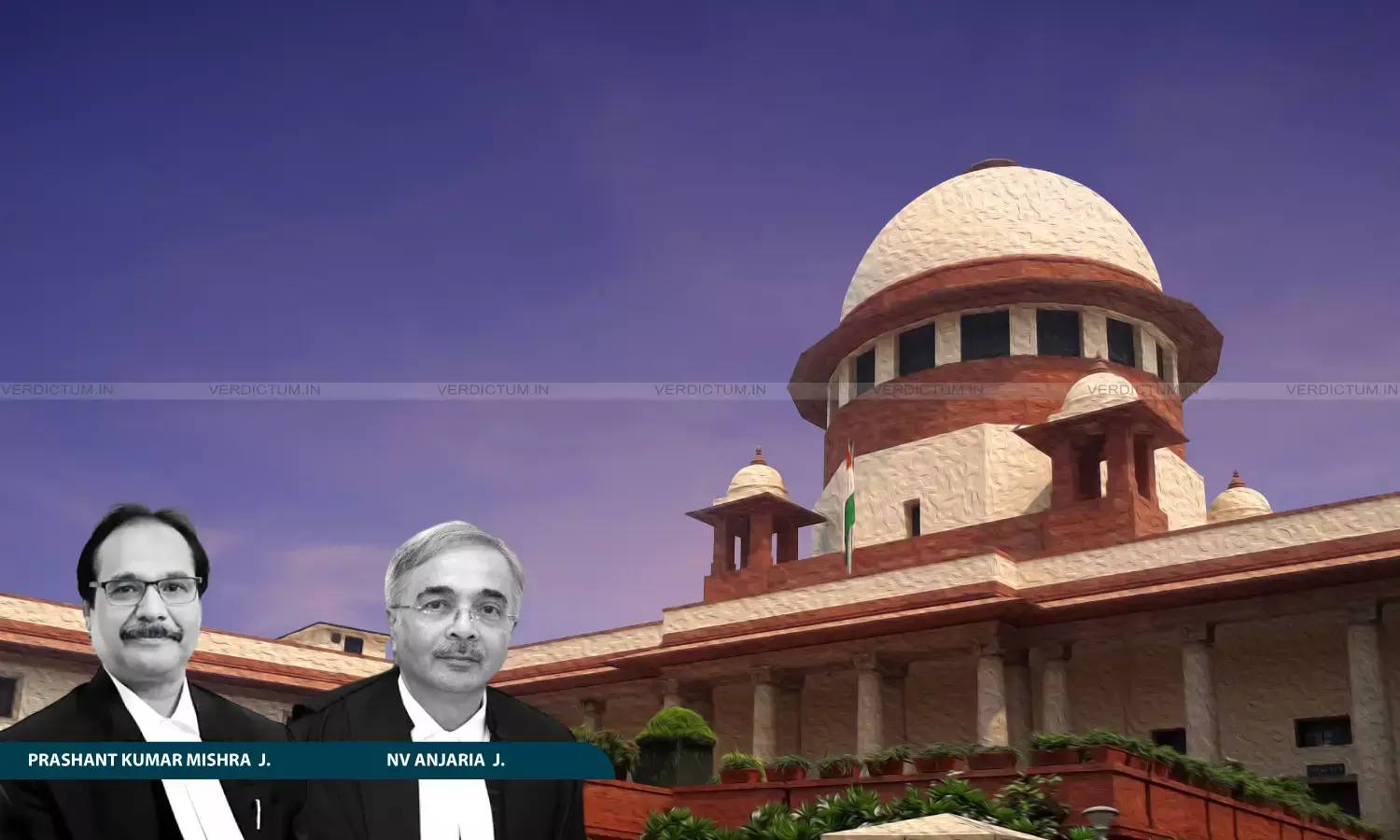
Supreme Court, Justice Prashant Kumar Mishra, Justice N.V. Anjaria
The Supreme Court held that where similarly situated employees are granted relaxation in educational qualifications for promotion, denial of the same benefit to another employee placed in identical circumstances is arbitrary and violative of Articles 14 and 16 of the Constitution.
The Court emphasised that such discriminatory treatment cannot be sustained when the governing rules themselves permit relaxation.
The Court was hearing civil appeals challenging the judgment of the Madhya Pradesh High Court, which had set aside the order of the learned Single Judge granting relief to the appellant by directing consideration of his promotion with relaxation in educational qualification.
A Bench comprising Justice Prashant Kumar Mishra and Justice N.V. Anjaria, while stating that “the relaxation in educational qualification was permissible and the Board of Directors extended the same to the appellant in view of his long-standing service”, held that “the Registrar, in approving two other employees for promotion and negativing and discarding the case of the appellant though all the three cases were attended by similar circumstances, acted arbitrarily”.
The Bench further observed: “The equal treatment came to be denied to the appellant to his discrimination, … the facts obtained strikingly attract the tenets of Articles 14 and 16 of the Constitution, to violate the fundamental concept of equality in law and equal treatment in the matters of employment, … substantive justice and real justice is always subserved by applying the doctrine of equality”.
Advocate Ruchi Gupta appeared for the appellant, while Advocate Abhimanyu Singh appeared for the respondents.
Background
The appellant, an employee of a Primary Agricultural Cooperative Society since 1987, had served for over 28 years and was working as Assistant Society Manager. At the time of his appointment, the applicable rules prescribed a Higher Secondary qualification for promotion to the post of Society Manager.
Subsequently, new rules introduced in 2013 prescribed graduation along with a computer qualification as the eligibility criteria. However, the rules also contained a proviso permitting relaxation in educational qualifications based on experience, competence, and seniority.
Considering the appellant’s long-standing service, clean record, and seniority, the Board of Directors of the Society passed a resolution recommending his promotion with relaxation in qualification. This recommendation was unanimously approved by the General Body of the Society.
Despite this, the Registrar cryptically rejected the proposal without assigning reasons.
The appellant challenged the rejection before the High Court. The learned Single Judge allowed the petition, directing the grant of relaxation and promotion. However, the Division Bench reversed this decision, holding that the appellant did not possess the requisite qualification and that the Registrar was justified in refusing relaxation.
Court’s Observation
The Supreme Court examined the statutory framework governing promotions and relaxation of qualifications and found that the rules expressly permitted such relaxation.
The Court noted that the power to grant relaxation was vested in the competent authority and had been validly exercised by the Board of Directors in recommending the appellant’s promotion.
The Court further observed that two other employees, possessing identical qualifications of Higher Secondary, had been granted promotion during the same period upon recommendation of the Board, which was accepted by the Registrar. The Court held that in denying the same relaxation to the appellants, the registrar acted arbitrarily.
Addressing the argument of “negative equality,” the Court clarified that the appellant was not seeking parity with ineligible candidates. Rather, it found that all three employees were eligible under the relaxation provision and stood on equal footing.
The Court noted that the other two employees were not eligible to be promoted, yet they were promoted. Thus, the Court observed, “the case of the appellant is not one that the appellant seeks parity and equality for promotion with ineligibles or that he is not fit to be promoted, … no concept of negative equality is attracted that the appellant is to be given equal treatment with those persons who are not eligible”.
The Court also found fault with the reasoning of the Division Bench of the High Court, noting that it had adopted a contradictory approach by simultaneously observing that the power to grant relaxation lay with the Board of Directors, while upholding the Registrar’s refusal.
It observed that “even as the discriminatory treatment writ large in the case of the appellant, the Division Bench, for no good reason, did not approve the finding of the learned Single Judge regarding discrimination”.
Conclusion
The Supreme Court held that the denial of relaxation and consequent refusal to promote the appellant was arbitrary, unreasonable, and violative of Articles 14 and 16 of the Constitution.
Accordingly, the Court set aside the judgment of the Division Bench of the High Court and restored the relief granted by the learned Single Judge.
The appeals were allowed, and all pending applications were disposed of.
Cause Title: Kamal Prasad Dubey v. State of Madhya Pradesh & Ors. (Neutral Citation: 2026 INSC 353)
Appearances
Petitioners: Advocates Ruchi Gupta (AOR), Arnab Kumar Mondal.
Respondents: Advocates Abhimanyu Singh, Yashraj Singh Bundela (AOR), Pratima Singh, Arpit Garg, Dhruv Sharma; Chand Qureshi (AOR), Naresh Kumar Sharma, Mukul Gupta, Lovedeep Bangia, M. Tajdar Siddiqui.