

Supreme Court Clarifies Justice Asha Menon Advisory Committee Lacks Power To Adjudicate Transgender Recruitment Rights Issue
It has also been reported recently that the Committee, chaired by Justice Asha Menon, has requested the Centre to withdraw the Transgender Persons Amendment Bill, 2026.

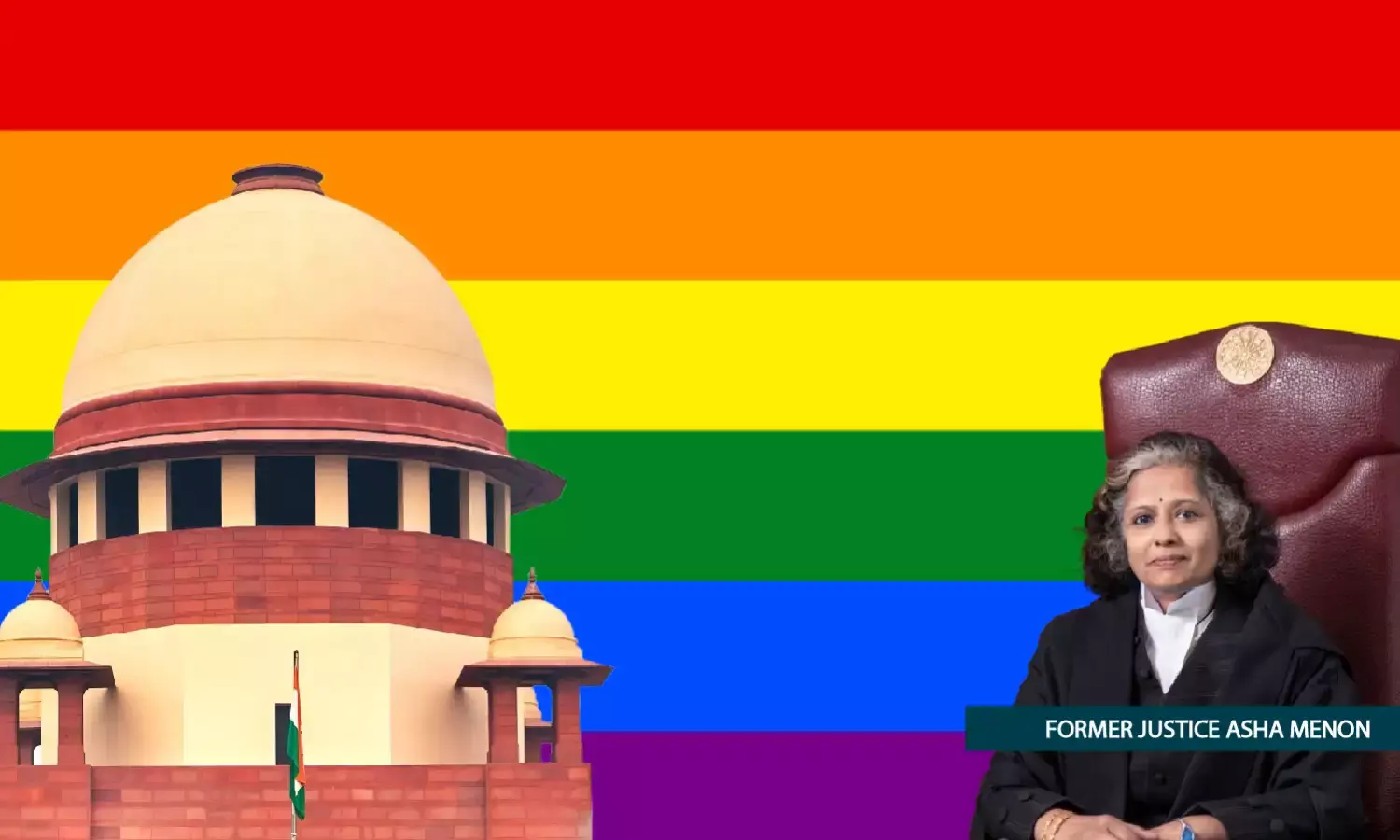
The Supreme Court, while issuing notice in a plea concerning transgender recruitment rights, has observed that the Delhi High Court committed a prima facie error by disposing of petitions and directing the petitioners to approach the Justice (Retd.) Asha Menon, Advisory Committee for redressal.
The Supreme Court clarified that this committee is a recommendatory body for policy formulation and lacks adjudicatory powers to resolve specific legal disputes.
Recently, it has been reported that the Court-appointed Advisory Committee, led by former Delhi High Court judge Justice Asha Menon, has urged the Union Government to withdraw the Transgender Persons (Protection of Rights) Amendment Bill, 2026.
The writ petitions filed before the Delhi High Court sought several directions to institutionalize the recruitment and rights of transgender persons in public employment. The petitioners primarily prayed for the notification of separate vacancies and the extension of reservations for transgender persons in all public appointments, including teaching positions within the NCT of Delhi.
The Bench comprising Justice J.B. Pardiwala and Justice K.V. Viswanathan observed, "Prima facie, we are of the opinion that the High Court committed an error in disposing of the writ petition by directing the petitioner to approach the Advisory Committee as the Committee possesses no adjudicatory powers."
Advocate Amritananda Chakravorty appeared for the Petitioners.
The Court clarified that the Advisory Committee possesses no adjudicatory powers; its role is limited to conducting studies and providing recommendations on policies like the Equal Opportunity Policy (EOP) and grievance redressal mechanisms.
The Court also said, "We must note at the outset that in 2023, the petitioner had also approached this Court under Article 32 of the Constitution during the pendency of the aforesaid writ petition before the High Court. The petitioner prayed for reliefs pertaining to the framing of an equal opportunity policy, the implementation of various provisions of the TPPR Act and TPPR Rules including various other reliefs in the specific facts of her case. While dealing with the said petition, this Court delivered the judgment titled Jane Kaushik v. Union of India, reported in 2026 (1) SCC 336, wherein several binding directions relating to the implementation of the TPPR Act and TPPR Rules, respectively were issued."
The Advisory Committee, chaired by Justice (Retd.) Ms. Asha Menon was asked to conduct an in-depth study of and provide recommendations on the following points: (a) Formulation of an Equal Opportunity Policy; (b) Study of the TPPR Act and TPPR Rules to suggest measures to address lacuna therein; (c) Reasonable Accommodation for transgender persons in public spaces; (d) Grievance Redressal Mechanism; (e) Gender and Name Change; (f) Inclusive Medical Care for Transgender and Gender Diverse Persons; (g) Protections for Gender Non-Conforming and Gender Diverse Persons.
The Court said, "The Advisory Committee is currently in the process of working on the aspects broadly delineated in their remit including the formulation of a model equal opportunity policy in employment and education."
The Court granted interim relief by allowing the petitioner to apply for vacancies under the transgender category, ignoring the gender specified for the vacancy, consistent with a previous interim order from January 2023. Accordingly, the Court issued notice.
Before the Delhi High Court, a writ petition was filed concerning the recruitment and rights of transgender persons in public employment. The petitioners sought several directions aimed at institutionalizing transgender rights, including, i) notifying separate vacancies and extending reservations for transgender persons in all public appointments and teaching positions within the NCT of Delhi. ii) Framing a comprehensive recruitment policy and implementing the Transgender Persons (Protection of Rights) Act, 2019 and Rules, 2020. iii) Granting age and qualification relaxations for transgender candidates. iv) Allowing name and gender updates on registration portals (OARS) and considering specific applications as a one-time measure.
In its deliberations, the High Court had referenced the landmark NALSA vs. Union of India (2014) judgment, which recognized transgender people as the "Third Gender" and directed the government to treat them as socially and educationally backward classes for the purpose of public appointments. The Court also noted the more recent Supreme Court decision in Jane Kaushik vs. Union of India (2025), which addressed ongoing shortcomings in the implementation of the 2019 Act and the 2020 Rules. The Supreme Court ruling mandated the creation of an eight-member Advisory Committee, headed by retired Justice Asha Menon, to formulate a comprehensive Equal Opportunity Policy (EOP) for the transgender community.
Given that the Supreme Court is currently overseeing the matter, the High Court determined it would be most appropriate for the petitioners to seek redress through the newly established Advisory Committee. The Committee is tasked with consulting stakeholders to draft a policy for the Union's consideration and has the authority to address grievances beyond the specific issues originally referred by the Supreme Court. Consequently, the High Court disposed of the writ petitions and all pending applications, granting the petitioners the liberty to approach the Advisory Committee once it is fully constituted.
Cause Title: Jane Kaushik v. Lieutenant Governor, NCT Of Delhi & Ors. [SLP(C) No.12480/2026]
Appearances:
Petitioner: Advocate Amritananda Chakravorty, AOR Shreya Munoth, Advocate Asawari Sodhi and Advocate Tavleen Kaur Saluja