

Conciliation Settlement Under A&C Act Has Status Of Award Unless Parties Expressly Exclude It: Supreme Court
The Apex Court held that a settlement arrived at through conciliation under the statutory framework of the Arbitration and Conciliation Act, 1996, automatically acquires the status and enforceability of an arbitral award unless the parties have expressly agreed to exclude that regime.
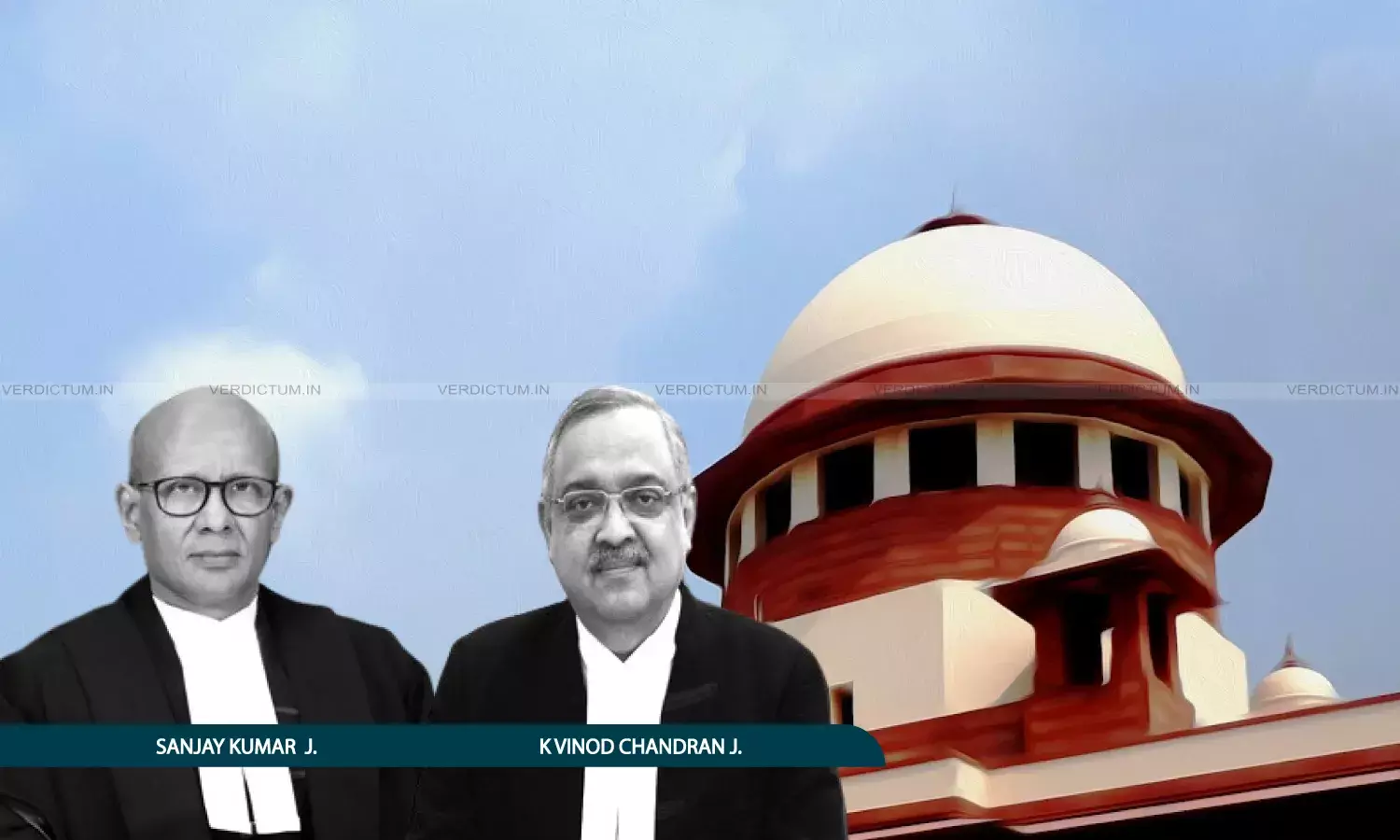
The Supreme Court has held that a settlement reached through conciliation conducted in accordance with Part III of the Arbitration and Conciliation Act, 1996, carries the same legal status and enforceability as an arbitral award, unless the parties expressly agree to exclude the statutory conciliation framework.
The Court was hearing civil appeals arising from orders of the Madras High Court affirming rejection of a plaint under Order VII Rule 11 of the Code of Civil Procedure in a dispute concerning a family partition deed and a subsequent document claimed to be a conciliation award.
A Bench of Justice Sanjay Kumar and Justice K. Vinod Chandran examined the scheme of Sections 61 to 74 of the 1996 Act and held: “On a reading of Section 61, any conciliation between two parties brought about by following the procedure in Part III of the Act of 1996 would definitely get the status and effect of an Award under the Act of 1996 unless the parties have agreed otherwise; which agreement should be expressly for the exclusion of Part III of the Act of 1996, despite a conciliation having been proceeded with and concluded.”
Background
The dispute arose out of a division of extensive family-owned business and property interests between two branches of a family. A written partition arrangement was executed among the concerned members to allocate assets and liabilities. Shortly thereafter, another document emerged, described by one group as a settlement reached through a conciliation process facilitated by a mutually accepted intermediary.
One branch of the family relied on the two documents together, asserting that the arrangement amounted to a concluded statutory conciliation settlement enforceable in the same manner as an arbitral award. The opposing branch admitted execution of the partition arrangement but alleged that it was procured through coercion and misrepresentation. It was further contended that the subsequent document did not result from any valid conciliation process and was created to give the appearance of statutory enforceability.
Execution proceedings were initiated on the footing that the settlement carried the status of an arbitral award. Parallel attempts were made to question the enforceability of the documents, including objections before executing authorities and applications invoking arbitral remedies. Those efforts did not yield substantive adjudication on the validity of the documents, though liberty was preserved to pursue remedies in accordance with law.
A civil suit was thereafter instituted seeking declarations that the partition arrangement and the purported conciliation settlement were invalid and unenforceable. The plaint was rejected at the threshold on the premise that the documents constituted a binding award immune from challenge in an ordinary civil action. The appellate proceedings that followed culminated in the present consideration by the Supreme Court.
Court’s Observations
The Supreme Court began by examining the statutory scheme governing conciliation under the Arbitration and Conciliation Act, 1996. It observed that Section 61 read with Sections 73 and 74 establishes a clear legislative framework under which a settlement reached through conciliation acquires the same status and enforceability as an arbitral award.
The statutory consequence, the Court held, flows automatically once the procedure contemplated in Part III is followed, unless the parties have expressly agreed to exclude the operation of that regime.
The Bench clarified that the expression “unless otherwise agreed by the parties” contemplates a conscious and explicit exclusion of the statutory conciliation framework. Such exclusion cannot be inferred merely from the nature of the transaction or the terminology used in the settlement document. In the absence of an express agreement displacing Part III, a settlement resulting from conciliation is statutorily elevated to the status of an award, the Court clarified.
Turning to the dispute before it, the Court noted that the plaintiffs specifically challenged whether any conciliation compliant with the Act had taken place. Allegations were raised that the document described as a conciliation settlement was fabricated and that the underlying partition arrangement was procured through coercion and misrepresentation. These assertions, the Court observed, directly implicated the existence and validity of the statutory conciliation process itself.
The Bench held that such allegations necessarily give rise to triable issues. Questions concerning compliance with statutory procedure, authentication of the settlement, and voluntariness of execution cannot be conclusively determined without evidentiary adjudication. Treating the disputed documents as definitively constituting an enforceable award at the threshold stage would amount to pre-judging contested factual matters.
The Court further observed that the jurisdiction of an executing court is confined to enforcement and does not extend to adjudicating foundational challenges to the validity of the underlying arrangement. A civil action seeking declaratory relief, therefore, remains a legally permissible avenue where the very existence or authenticity of the conciliation settlement is disputed.
The Court emphasised that judicial scrutiny at the threshold stage must avoid substituting evidentiary evaluation for trial. The presence of disputed questions relating to statutory compliance and the validity of documents mandates a full adjudicatory process rather than premature foreclosure.
Conclusion
Holding that the plaint disclosed substantive triable issues regarding the validity of the partition deed and the alleged conciliation settlement, the Supreme Court set aside the rejection of the plaint and restored the suit for trial. The matter was directed to proceed alongside pending execution objections.
The Court clarified that its observations were prima facie and would not influence final adjudication. The possibility of fresh arbitration by mutual consent was left open.
Cause Title: J. Muthurajan & Anr. v. S. Vaikundarajan & Ors. (Neutral Citation: 2026 INSC 139)
Appearances
Appellants: Senior Advocates V. Prakash and Gopal Sankaranarayanan, along with Nishant, AOR; S. Karupasamy; S. Gokul; M. Gothaman; Oviya Barathi Ur; Anurag Tandon; S. Santanam Saminadhan; and Others
Respondents: Senior Advocates Mukul Rohatgi and S. Niranjan Reddy, along with Balaji Srinivasan, AOR; S. Elambharathi; Vishwaditya Sharma; Subornadeep Bhattacharjee; Muthu Thangathurai; Harsha Tripathi; Kanishka Singh; Suganya TS; Parikshit Pitale; K. Shiva; and Others
