

Damages Cannot Be Awarded On Presumptions: Supreme Court Reduces ₹2 Crore Compensation Awarded By NCDRC For Unsatisfactory Haircut
Holding that high-value compensation cannot rest on conjecture or unsupported assertions, the Apex Court set aside a ₹2 crore award granted in a consumer dispute arising from a salon haircut service, reiterating that claims for substantial damages must be supported by credible and reliable evidence.
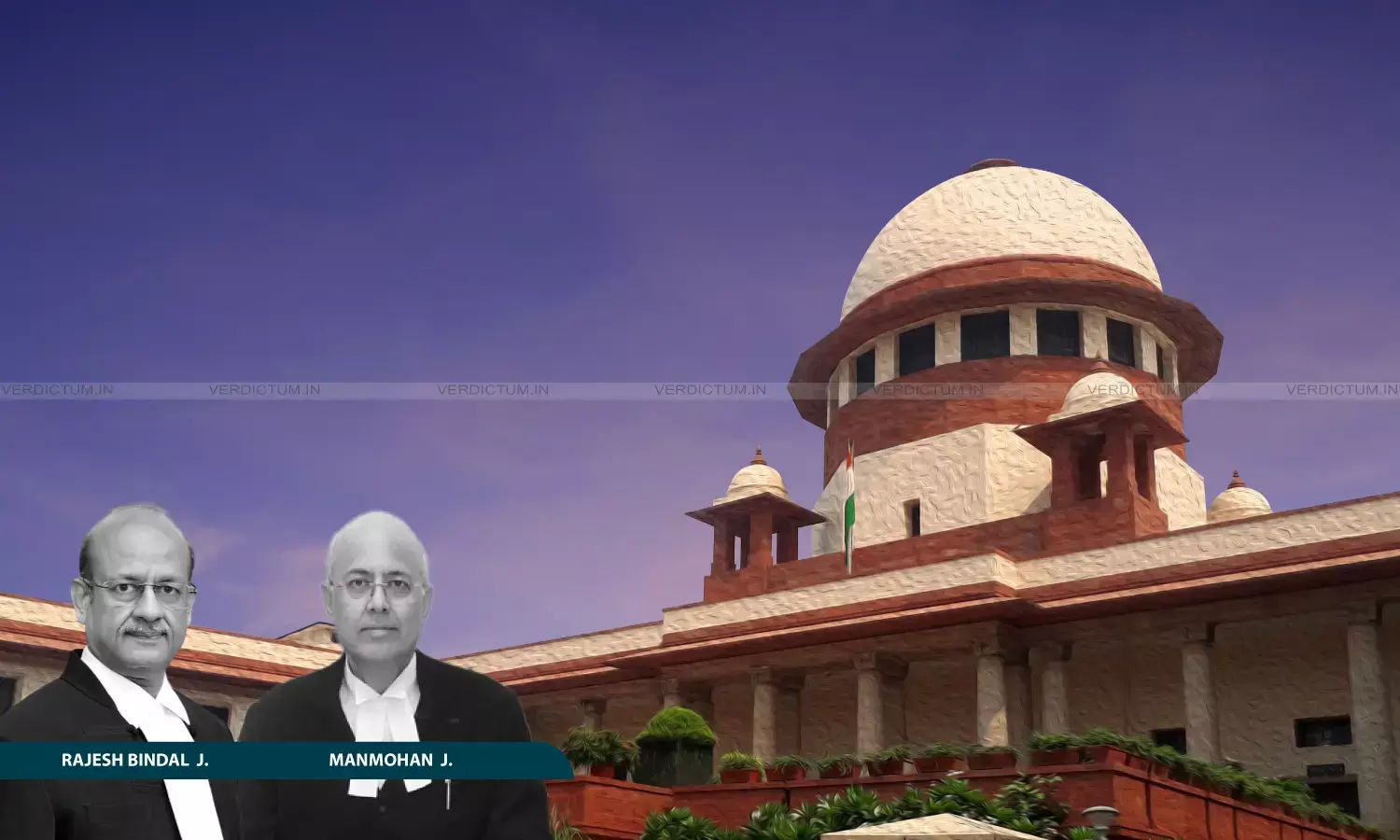
Justice Rajesh Bindal, Justice Manmohan, Supreme Court
The Supreme Court set aside a ₹2 crore compensation awarded in a consumer dispute relating to an alleged deficiency in a salon haircut service, finding that the material on record did not justify such a high monetary award, holding that damages cannot be awarded merely on presumptions or the complainant’s assertions, but must be founded on trustworthy evidence establishing actual loss.
The Court was hearing a civil appeal arising out of a consumer dispute in which compensation had been awarded against a luxury hotel chain for an alleged service deficiency related to a haircut. While the finding of service deficiency had attained finality in earlier proceedings, the dispute before the Court concerned the quantum of compensation awarded to the complainant.
A Bench comprising Justice Rajesh Bindal and Justice Manmohan, while examining the evidentiary basis for the compensation, observed: “The damages cannot be awarded merely on presumptions or whims and fancies of the complainant. To make out a case for award of damages, especially when the claim is to the tune of crores of rupees, some trustworthy and reliable evidence has to be led.”
Background
The complainant approached the beauty salon at the appellant hotel, ITC Maurya, alleging dissatisfaction with a haircut and claiming that the incident caused emotional distress and professional setbacks. The National Consumer Disputes Redressal Commission initially awarded ₹2 crore as compensation for deficiency in service and alleged medical negligence.
In an earlier round of litigation, the Supreme Court upheld the finding of deficiency but remitted the matter to the Commission to reassess compensation, noting the absence of supporting material.
Upon remand, the complainant enhanced the compensation claim and produced photocopies of documents purportedly relating to modelling assignments and medical certificates to establish loss and trauma.
The Commission again awarded ₹2 crore compensation, prompting the present appeal.
Court’s Observations
The Supreme Court scrutinised the evidentiary material produced after remand and found it insufficient to support the quantum awarded. The Court noted that the complainant relied primarily on photocopies of certificates relating to modelling assignments and medical conditions, many of which were unclear, incomplete, or unsupported by corroborative records.
The Court emphasised that while consumer fora are meant to adopt a liberal and consumer-friendly approach, such latitude cannot substitute the requirement of credible proof when awarding substantial damages. It was observed that compensation claims of this magnitude require demonstrable proof of loss, particularly where professional or financial injury is alleged.
Highlighting evidentiary deficiencies, the Court noted that the documents did not establish actual income, contractual assignments, or financial loss attributable to the incident. The Court rejected the Commission’s reasoning that photocopies could suffice due to the complainant’s alleged trauma, observing that even relaxed procedural standards cannot justify awarding large sums absent reliable proof.
The Bench reiterated that consumer adjudication must remain rooted in fairness and evidentiary discipline. Sympathy or assumptions, the Court held, cannot form the basis of crore-level compensation. The absence of original records, corroboration, or verifiable financial data rendered the award unsustainable.
Further, while noting that that the provisions of the Indian Evidence Act, 1872 (Bharatiya Sakshya Adhiniyam, 2023) are not strictly applicable for proceedings under the 1986 Act, the Bench however underscored that “even if the Code of Civil Procedure may not be strictly applicable, the Commission has not assessed as to how the respondent suffered loss to the tune of ₹2,00,00,000/-. General discussion in the impugned judgment may not justify the same”.
The Court concluded that the complainant had failed to establish measurable loss linked to the alleged deficiency in service, and that the Commission had erred in awarding compensation unsupported by substantive evidence.
Conclusion
Partially allowing the appeal, the Supreme Court modified the Commission’s order and restricted compensation to the amount already released in favour of the complainant.
The Court held that the evidentiary record did not justify awarding ₹2 crore damages and reaffirmed that substantial compensation must be grounded in credible proof rather than presumption.
Cause Title: ITC Limited v. Aashna Roy (Neutral Citation: 2026 INSC 135)
Appearances
Appellant: Advocates L.K. Bhushan, Raashi Beri, and M/s Dua Associates, AOR
Respondent: Caveator-in-person
