

Burden Of Proving Fact Rests Squarely On Party Making Such Assertion In Writ Petition Which Is Decided On Affidavits: Supreme Court Allows IOCL’s Appeal
The Supreme Court was considering an appeal filed by the Indian Oil Corporation Limited assailing identical orders rendered by the Himachal Pradesh High Court.

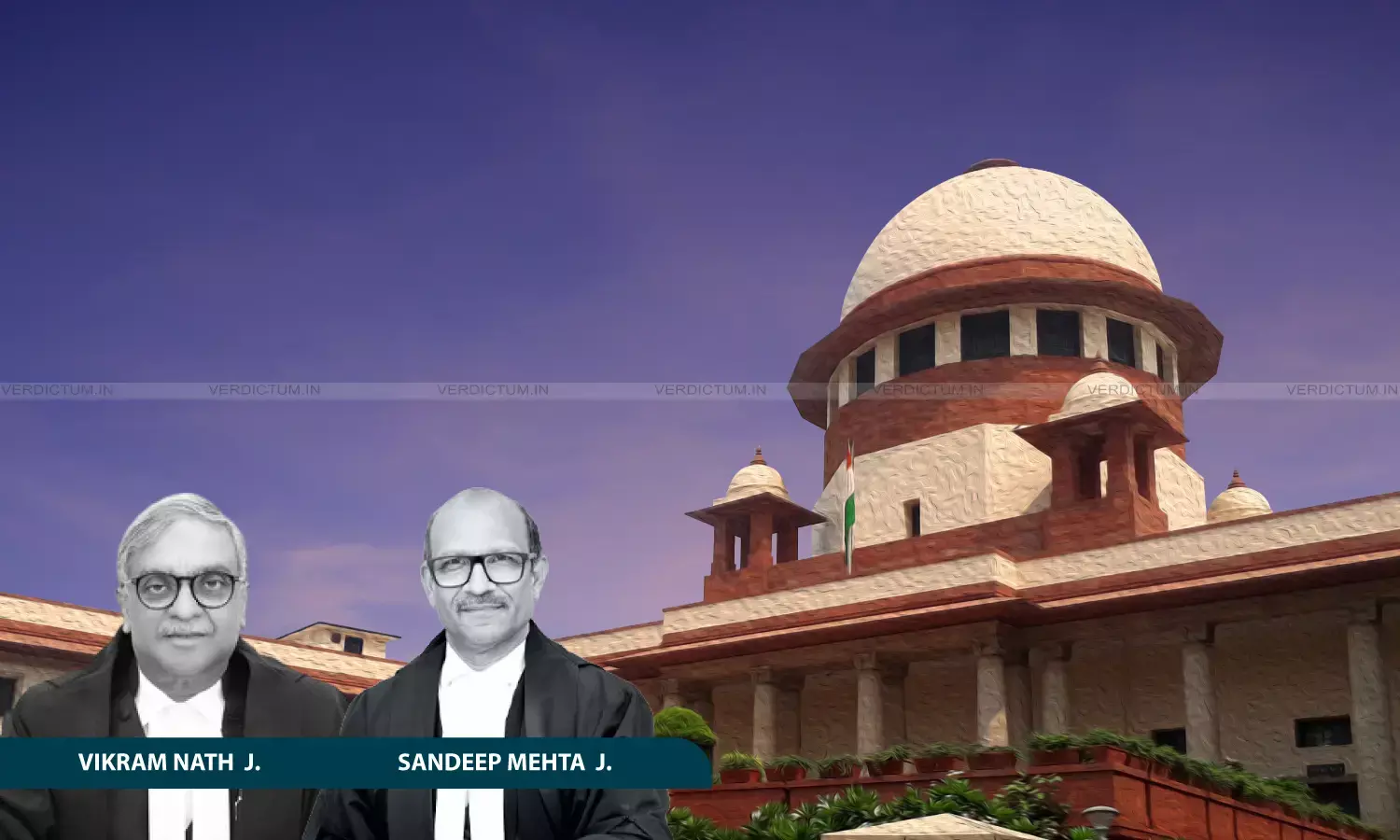
Justice Vikram Nath, Justice Sandeep Mehta, Supreme Court
While allowing an appeal filed by the Indian Oil Corporation Limited (IOCL) involving its allotment of retail outlets, the Supreme Court has reiterated that in a writ petition, which is decided on affidavits, the burden of proving a fact asserted before the Court rests squarely on the party making such an assertion.
The Apex Court was considering an appeal filed by the Indian Oil Corporation Limited assailing identical orders rendered by the Himachal Pradesh High Court. The sum and substance of the challenge laid by the respondent writ petitioners before the High Court was to the allotment of retail outlets by the appellant-IOCL in favour of Agro Industries Corporation Limited and Satwant Singh, on the ground that the said allotments were contrary to and in violation of the guidelines framed by the Indian Roads Congress and the Ministry of Road Transport and Highways.
The Division Bench of Justice Vikram Nath and Justice Sandeep Mehta held, “It is a settled principle of law that in a writ petition, which is decided on affidavits, the burden of proving a fact asserted before the Court rests squarely on the party making such assertion.”
A.S.G. Raghavendra P. Shankar represented the Appellant, while Senior Advocate M.C. Dhingra represented the Respondent.
Factual Background
The disputed retail outlets were being established on a plot of land adjacent to roads declared as Major District Roads by the State of Himachal Pradesh. The respondents-writ petitioners contended before the High Court that the guidelines framed by the IRC and by the MoRTH, having been adopted by the State of Himachal Pradesh, required that any allotment or establishment of retail outlets had to adhere strictly to the said guidelines, which prescribe a minimum distance of 300 to 1000 meters from the intersections of National Highways/State Highways/Major District Roads, whereas, they alleged that the distance of the disputed retail outlets at Village Bohan from the intersection was less than 100 meters.
It was further alleged that the requisite distances from the intersections of the National Highway and also from the Village Road were not considered and enforced. The allotments were made without issuing an advertisement, and the appellant-IOCL, while granting the retail outlet dealership to the parties, did not maintain the requisite distance between the existing retail outlets and the proposed retail outlets. The appellant-IOCL took a specific stand that the guidelines issued by the IRC were non-statutory in nature and the guidelines framed by the MoRTH were applicable only to National Highways. The High Court held that the averments made by the writ petitioners before it with respect to the violations of the IRC and the MoRTH guidelines remained unrebutted in the pleadings, as the same were neither refuted nor controverted by placing relevant material or documents on record.
The allotments of retail sale outlets of petroleum products by appellant-IOCL in favour of H.P. Agro Industries at Village Bohan, Tehsil Jwalamukhi, District Kangra, Himachal Pradesh and in favour of Shri Satwant Singh at Mohal Thara, Sub Tehsil Dulehar, District Una, Himachal Pradesh, were quashed. It was further directed that the appellant-IOCL shall make allotments, if any, in the same villages/places/location or at any other place by ensuring strict adherence to the prescribed rules, viz., the rules/guidelines framed by IRC and MoRTH and all other statutory/legal applicable requirements. During the pendency of the writ petitions, material was placed before the High Court to the effect that the authority competent to grant a No Objection Certificate for establishing the retail outlet, namely, the Deputy Commissioner, had duly considered the material on record and, thereafter, the NOC was granted. Being aggrieved by the impugned orders rendered by the High Court, the appellant-IOCL filed the appeals before the Apex Court.
Reasoning
The Bench, at the outset, reiterated that while dealing with writ petitions, the High Court proceeds on affidavits, and a writ petition cannot be entertained to adjudicate upon disputed questions of fact requiring evidence. The Bench found that the State of Himachal Pradesh was impleaded as a party respondent and the Deputy Commissioner (Solan) was impleaded as a party respondent. It was noticed that in the lead writ petition, even the Deputy Commissioner was not impleaded as a party respondent and rather, only the Himachal Pradesh Agro Industries Corporation, appellant-IOCL and the Union of India were impleaded as party respondents.
“Hence, it is apparent that, while considering the writ petitions, the High Court did not have the benefit of the stand of the State Government regarding assertion made by the respondents-writ petitioners that the IRC and the MoRTH guidelines were applicable to the Major District Roads as well”, it added.
As per the Bench, the unverified letter issued by the Assistant Engineer, HPPWD, could not have been treated as a valid substitute and substantive material in place of the categorical response required from the State Government on this crucial aspect of the matter. The observation of the High Court that the appellant IOCL had failed to rebut the averments of the respondents' writ petitioners regarding the applicability of the IRC guidelines is misconceived and untenable in the eyes of law.
The Bench was of the view that the High Court was not justified in shifting the onus of proof onto the respondents before it for deciding the crucial issue raised by the writ petitioners, who were primarily under the burden to substantiate their assertions. “Consequently, in the absence of the stand being taken by the State, there was no occasion for the High Court to have made the observations regarding applicability of the IRC guidelines and the MoRTH guidelines to the establishment of a retail outlet dealerships on Major District Roads”, it added.
Thus, the Bench held that the respondents-writ petitioners having failed to provide tangible material to establish the adoption of IRC or MoRTH guidelines by the State, and the interference drawn to the contrary by the High Court for quashing the allotments of the retail outlet dealerships made by the appellant-IOCL on this premise was perverse and unsustainable.
Thus, finding the impugned orders to be contrary to facts and law, the Bench allowed the appeals.
Cause Title: Indian Oil Corporation Limited v. M/s. Aditya H.P. Centre And Others (Neutral Citation: 2026 INSC 182)
Appearance
Appellant: ASG Raghavendra P. Shankar, AOR Priya Puri, AOR Pallavi Mishra, Advocates Neelabh Bisht, Sachin Dubey, Abhishek Mishra, Sharad Kumar Puri, Riya Dogra
Respondent: Senior Advocate M.C. Dhingra, AOR Gaurav Dhingra, Advocates Shashank Singh, AOR Aditya Singh, Advocate Ravi Bakshi, AOR S. Gowthaman, Advocate General Anup Rattan, Advocates Ravi Bakshi, Manvendra Pratap Singh, Rajnesh Gaur, Saksham Thareja, Kumar Vinayak, ASG Aishwarya Bhati, Advocates Rajat Nair, Bhuvan Kapoor, Chitrangda Rashtravara, Mrigna Shekhar, AOR N. Visakamurthy, Advocates Sachin Jain, AOR Rajiv Ranjan Dwivedi, Advocates Vishal, Shubhdara Dwivedi, Kumar Amartya, Amitabh Singh, Amitbah Singh, Aditya Bharat Manubarwala, Shaila Arora, Tanishka Grover, AOR Bharat Thakorlal Manubarwala