

Breaking| Inaccessibility Of Menstrual Hygiene Undermines Dignity Of Girl Child: Apex Court Delivers Verdict On Implementation Of Menstrual Hygiene Policy For Girls' In Schools
The Court has given various directions to the Central, State and Union Territories, including Menstrual Hygiene Management (MHM) corners in place, which includes necessity material related to menstrual hygiene.

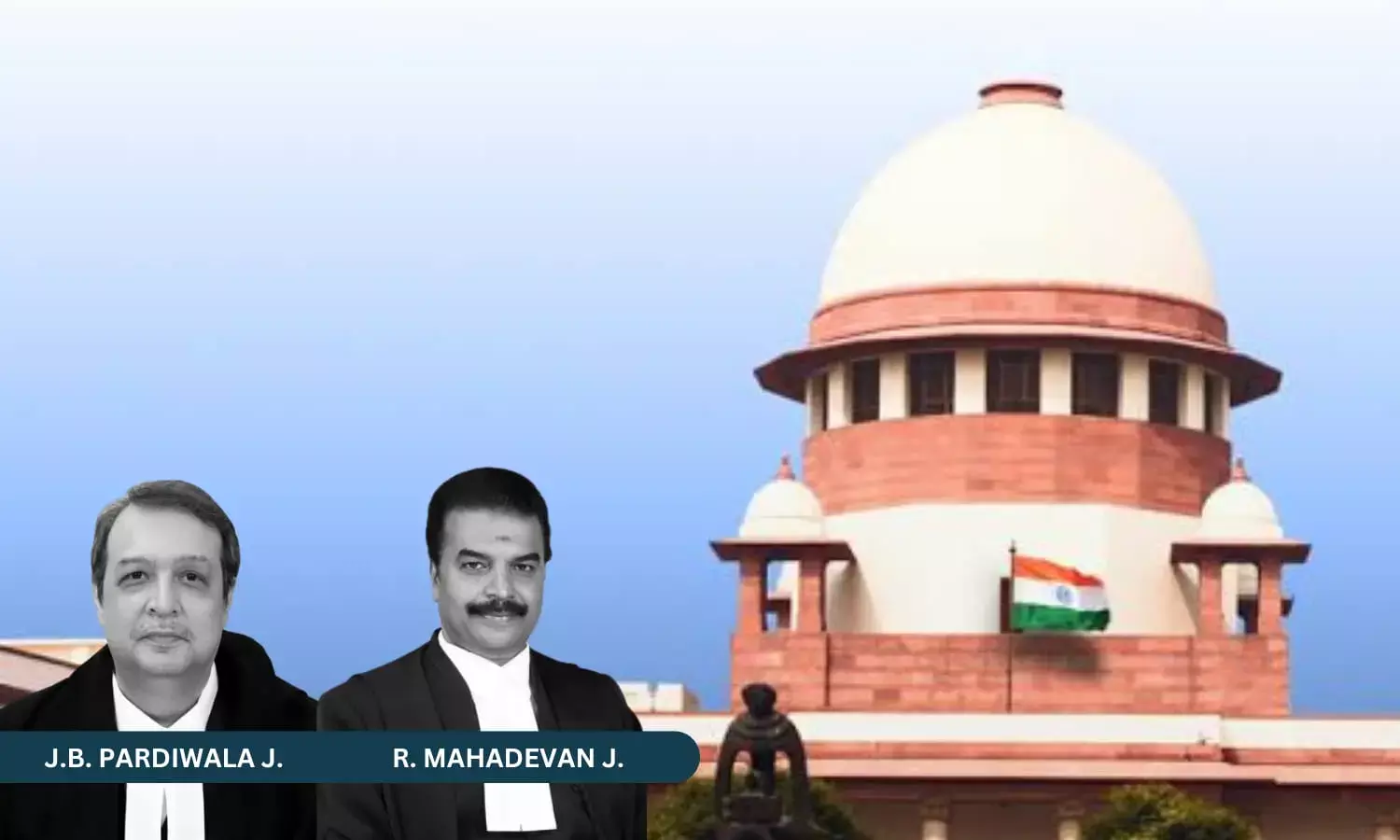
Justice J.B. Pardiwala, Justice R. Mahadevan, Supreme Court
The Supreme Court, today, has issued a comprehensive set of directives to ensure free access to sanitary pads and separate, functional toilets in all schools across the country.
The Court emphasized that menstrual hygiene is not merely a health issue but a fundamental component of the Right to Life (Article 21) and the Right to Education (Article 21A).
The judgment mandated that all States and Union Territories provide OXO biodegradable sanitary napkins (ASTM D-694 compliant) free of charge to girls in classes 6–12. These must be made available through vending machines or designated authorities within school premises to ensure easy accessibility and privacy. Furthermore, the Court ordered the establishment of Menstrual Hygiene Management (MHM) corners equipped with spare uniforms, innerwear, and disposal bags to address menstruation-related exigencies.
The Bench of Justice JB Pardiwala and Justice R Mahadevan ordered, "As regards the toilet and washing facilities, we direct that all States and Union territories shall ensure that every school, whether government-run or privately managed in both urban and rural areas, is provided with a functional, gender segregated toilets with usable water connectivity...All the existing and newly constructed toilets in schools shall be designed, constructed, and maintained so as to ensure privacy and accessibility, including by catering to the needs of children with disabilities. All school toilets shall be equipped with functional hand-washing facilities with soap and water available at all times. As regards the availability of menstrual absorbents, we direct that, all states and union territories shall ensure that every school, whether government-run or privately managed in both urban and rural areas, provides OXO biodegradable sanitary napkins manufactured in compliance with the ASTM D-694 standards free of cost. Such sanitary napkins shall be made readily accessible to girls students, preferably within the toilet premises through sanitary napkin vending machines or where such installation is not immediately visible at a designated place or with a designated authority within the school. All states and union territories shall ensure that every school, whether government-run or privately managed in both urban and rural areas, establishes menstrual hygiene management MHM corners.
Advocate Varun Thakur appeared for the Petitioner, while ASG Aishwarya Bhati, ASG Archana Pathak Dave, Sr. AAG Amit Anand Tiwari and AAG Vaibhav Srivastava appeared for the Respondents.
The Court was hearing a plea seeking direction to the Centre to ensure free sanitary pads and separate toilets for girls in classes 6-12 in Government and aided schools.
The court raised the following questions: "Having heard the Learned Council appearing for the parties and having gone through the materials placed on record, the following questions fall for our consideration. 1. Whether the unavailability of gender-segregated toilets and non-access to menstrual absorbents would be said to be in violation of the right to equality for adolescent girls students under Article 14 of the Constitution. 2. Whether a right to dignified menstrual health could be said to be part of Article 21 of the Constitution. 3. Whether unavailability of gender-segregated toilets and non-access to menstrual absorbents would be said to be in violation of the right of participation and equality of opportunity as constitutional guarantees enshrined under Article 14 of the Constitution. 4. Whether unavailability of gender-segregated toilets and non-access to menstrual absorbents could be said to be in violation of the right to education under Article 21, capital A, and the right to free and compulsory education under the right of children to free and compulsory education Act, 2009."
"It took some time...we are very grateful to our law clerks", Justice Pardiwala remarked.
The petitioner, who is a social worker, sought directions to the Respondents to ensure that: (i) Free sanitary napkins are provided to all girl children studying in Standards 6 to 12; and (ii) Separate toilets are provided for girls in all government-aided and residential schools.
The Court also ordered that a conspectus of the aforesaid detailed discussion on the Articles 14, 21 and 21A of the Constitution respectively and the RTE Act is as follows:
A. The right to education has been termed as a multiplier right as it enables exercise of other human rights. The right to education forms part of the broader framework of the right to life and human dignity, which cannot be realized without access to education.
B. The substantive approach to equality under Article 14 demands that treatment be accorded with due regard to the individual, institutional, systemic, and contextual barriers that impede the translation of rights in reality. At the same time, the state as a benefactor is under an obligation to remedy such structural disadvantages.
C. Inaccessibility of menstrual hygiene management measures undermines the dignity of a girl child, as dignity finds expression in conditions that enable individuals to live without humiliation, exclusion, or avoidable suffering. Privacy is inextricably linked with dignity as a corollary, the right to privacy entails a duty on the state to not only refrain from violating privacy, but an accompanying obligation on the state to take necessary measures to protect the privacy of an individual.
D. The right to life under Article 21 of the Constitution includes the right to menstrual health. Access to safe, effective, and affordable menstrual hygiene management measures helps a girl child attain the highest standard of sexual and reproductive health. The right to a healthy reproductive life embraces the right to access education and information about sexual health.
E. The right to equality is expressed through the right to participate on equal terms. At the same time, equality of opportunity necessitates that everyone has a fair chance to acquire the skills necessary to access benefits. Inaccessibility of menstrual hygiene management measures strips away the right to participate on equal terms in school. The domino effect of the absence of education is the inability to participate in all walks of life later.
F. The fundamental right to education under Article 21A and the RTE Act comprises free, compulsory, and quality education. Pre-education includes all kinds of charges or expenses that would prevent a child from pursuing and completing elementary education.
G. All schools, whether run by the appropriate government or privately managed, must act in accordance with the norms and standards laid down in Section 19. In case of a school not established, owned, or controlled by the appropriate government or the local authority is found to be in contravention of the provisions of the RTE Act, it would be derecognized and the consequences, therefore, would follow. Insofar as a school established, owned, or controlled by the appropriate government or the local authority is found to be in contravention of the provisions of the RTE Act, the state would be held accountable.
For MHM corners, the Court said, "Such MHM corners shall be equipped with, including, but not limited to, spare innerwear, spare uniforms, disposable bags, and other necessary materials to address menstruation-related exigencies. As regards the disposal of sanitary waste, we have issued directions. As regards the awareness and training about menstrual health and puberty, again, we have issued directions."
The Bench concluded, "It is also meant to be for the classroom where girls hesitate to ask for help. It is for the teachers who want to help but are restrained due to lack of resources. And it is for the parents who may not realize the impact of their silence and for the society to establish that progress is measured how we protect the most vulnerable. We wish to communicate to every girl child who might have become a victim of absenteeism because her body was perceived as a burden, that the fault is not hers. These words must travel beyond the courtroom, law review reports, and reach the everyday conscience of society at large. We are again treating it. We are going to keep it with us. We have called for a compliance report after a period of three months, and we'll see to it that all states comply with our directions."
Apart from this, certain other consequential reliefs have been sought, including the maintenance of toilets and the spread of awareness programmes. Though the reliefs which have been sought in the petition under Article 32 are not exhaustive of the subject, the petition raises important issues of public interest bearing on the need for sanitation and menstrual hygiene for females who are studying in schools.
The counter affidavit, which was filed by the Union of India, indicates that three Ministries of the Union Government, namely, the Ministries of Health and Family Welfare, Jal Shakti and Education, deal with the subject matter, to the extent to which they fall within their own domains. At the same time, it has been submitted that the States also have a vital role to play since education and health are State subjects.
The Court previously ordered, "Before finalizing the policy, we direct that the Union of India shall: (i) Set down a national model for the ratio of the number of girls’ toilets per female student population across government aided and residential schools in the country; (ii) Bring about uniformity in terms of the modalities to be followed for the distribution of sanitary napkins; and (iii) Consider the practices which have been followed in different States in order to arrive at the optimum policy which ensures that an adequate supply of sanitary napkins is made available to female students in schools in the requisite age group and that the modalities for distribution are facilitative in all respects."
The Court reserved the matter on December 12, 2024.
Previously, the Apex Court had directed the States, which are yet to file their response as instructed in the previous order, to submit their respective status reports in the plea seeking awareness on menstrual hygiene in schools. The bench has listed the matter for further hearing in November so that it can come up with a comprehensive policy on menstrual hygiene in schools. While passing the directions, the bench also warned States that if still they do not comply with the order, the Court will have to take recourse to the 'coercive arm of law'.
Cause Title: Dr Jaya Thakur v. Government of India [W.P.(C) No. 1000 of 2022]