

Supreme Court Urges Law Ministry To Take Serious Look At Arbitration Regime & Bring Necessary Changes While 2024 Bill Being Considered
The Supreme Court suggested that the Arbitration and Conciliation Bill, 2024 should make an effort to recognise the power of the Arbitral Tribunal to review its own orders and should clearly delineate the extent and contours of such power.
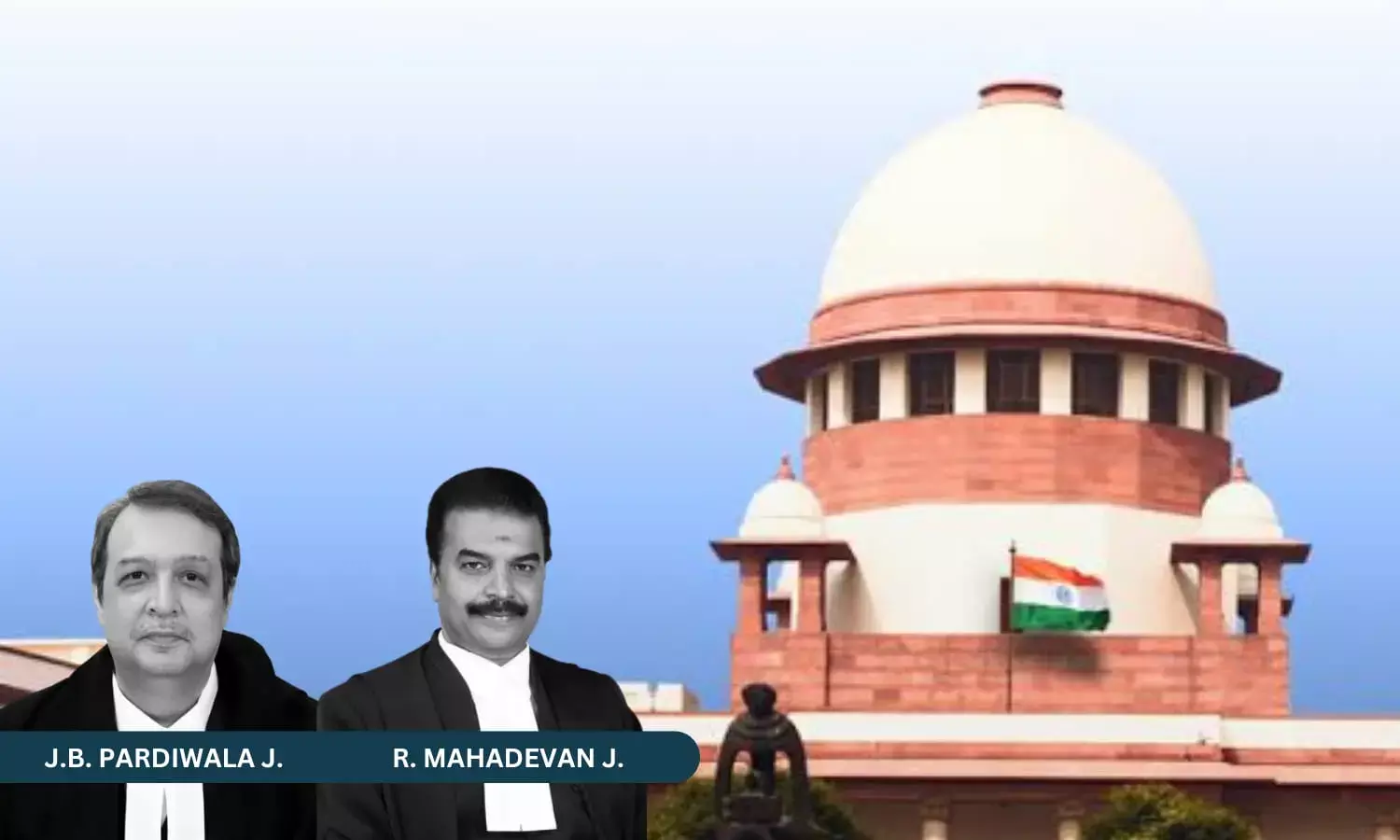
Justice J.B. Pardiwala, Justice R. Mahadevan, Supreme Court
The Supreme Court has urged the Department of Legal Affairs, Ministry of Law and Justice to take a serious look at the arbitration regime that is prevailing in India and bring about necessary changes while the Arbitration and Conciliation Bill, 2024 is still being considered.
The Court was hearing a Civil Appeal arising from the Judgment and Order of the Punjab and Haryana High Court by which the Petition for appointment of an Arbitrator under Section(s) 11(5) and (6) of the Arbitration and Conciliation Act, 1996 (A&C Act) was rejected.
The two-Judge Bench comprising Justice J.B. Pardiwala and Justice R. Mahadevan remarked, “… arbitration is not infinite. Every arbitration initiated under the Act, 1996 comes at the expense of several precious hours of the judicial time and resources. The pendency of arbitration proceedings due to unavailability of arbitrators is already alarming. If we are to add more unnecessary proceedings on top of this already overburdened system, then that, in our opinion would be the death knell of arbitration.”
The Bench added that the final call in regards to aforesaid lacunae in the A&C Act has to be ultimately taken by the Parliament.
Senior Advocate Nakul Dewan and Advocate Samarth Sagar appeared on behalf of the Appellants.
Court’s Suggestions
The Supreme Court said that the A&C Act has remained in force for almost thirty-years since its enactment and various amendments to the Act have been made over the years so as to ensure that arbitration proceedings are conducted and concluded expeditiously.
“It is indeed very sad to note that even after these many years, procedural issues such as the one involved in the case at hand, have continued to plague the arbitration regime of India”, it observed.
The Court remarked that the Department of Legal Affairs has once again proposed to replace the existing legislation on arbitration with the Arbitration and Conciliation Bill, 2024 and unfortunately, even the new Bill has taken no steps whatsoever to ameliorate the position of law as regards the termination of proceedings by the Arbitral Tribunal.
“The problem which originated forty years ago when the UNCITRAL Model Law on International Commercial Arbitration was first adopted in 1985, and thereafter continued to persist within the Act, 1996 that was drafted in accordance with the Model Law, is still present in the new Arbitration and Conciliation Bill, 2024”, it noted.
The Court was of the view that uncertainty surrounding the power of the Arbitral Tribunal to terminate the proceedings under the various provisions of the A&C Act are either consolidated into a single provision like the SIAC Rules and the LCIA Rules, or the contradictory phraseology used in the various provisions are tweaked to make the provisions consistent.
“The Arbitration and Conciliation Bill, 2024 should explicitly provide the nature and effect of the termination of proceedings insofar as the authority of the arbitral tribunal is concerned to entertain a recall application. A proper remedy against an order terminating the proceedings is the need of the hour”, it suggested.
The Court further suggested that the Arbitration and Conciliation Bill, 2024 should make an effort to recognise the power of the Arbitral Tribunal to review its own orders and should clearly delineate the extent and contours of such power.
“The Parliament in its wisdom, should also consider the option of providing a statutory appeal in Section 37 of the Arbitration and Conciliation Bill, 2024 against an order terminating the proceedings, similar to an order passed by the arbitral tribunal under Section 16 when it accedes to a plea of lack of jurisdiction”, it added.
The Court said that it will also be worthwhile, if the Arbitration and Conciliation Bill, 2024 delineates the future course of action that may be available to an aggrieved party, in the event the order for termination of proceedings is upheld.
“The Parliament should take a policy decision whether a belligerent or erring party, who wilfully allows the proceedings to terminate due to its own contumacious conduct should be allowed to have a second bite at the cherry and reinitiate arbitration once again and whether the same claims can be reinstated or reintroduced in another proceeding”, it also suggested.
Conclusion
Furthermore, the Court observed that the question of whether a party should be allowed to reinitiate arbitration after its termination has to be answered by the national laws of a particular country.
“In this regard, the provisions of the Code of Civile Procedure, 1908 may be significant. Though such termination does not partake the character or res-judicata, it may still operate as constructive res judicata, inasmuch as the majority provisions of the stipulates that a party aggrieved by the dismissal of its suit has to ordinarily move the same court for seeking its restoration, and that the filing of a fresh suit, save for a limited circumstances is otherwise barred”, it emphasised.
The Court was of the opinion that a party who has allowed the proceedings to terminate by its own obdurate stance, should ordinarily be not allowed to once again re-initiate arbitration.
“To allow the same would lead to a chilling effect, where a devious party, if it finds that the proceedings are not progressing favourably towards his claims, could mischievously let the same terminate by its own actions and then re-initiate arbitration. It would allow mischievous parties a license to forum shop without fear”, it concluded.
Accordingly, the Apex Court partly allowed the Appeal, remanded the case to the High Court for the appointment of a substitute Arbitrator, and directed the Registry to forward one copy each of the Judgment to all the High Courts and one copy to the Department of Legal Affairs, Ministry of Law & Justice, Government of India.
Cause Title- Harshbir Singh Pannu and Anr. v. Jaswinder Singh (Neutral Citation: 2025 INSC 1400)
