No Challenge To Unproduced & Unregistered Sale Deed Not Fatal; Declaratory Decree Itself Amounts To Repudiation Of Voidable Transaction: Supreme Court
The Court held that where a sale deed is neither produced nor part of the public record, failure to seek its cancellation is inconsequential, and a decree asserting title itself constitutes valid repudiation of such a transaction.
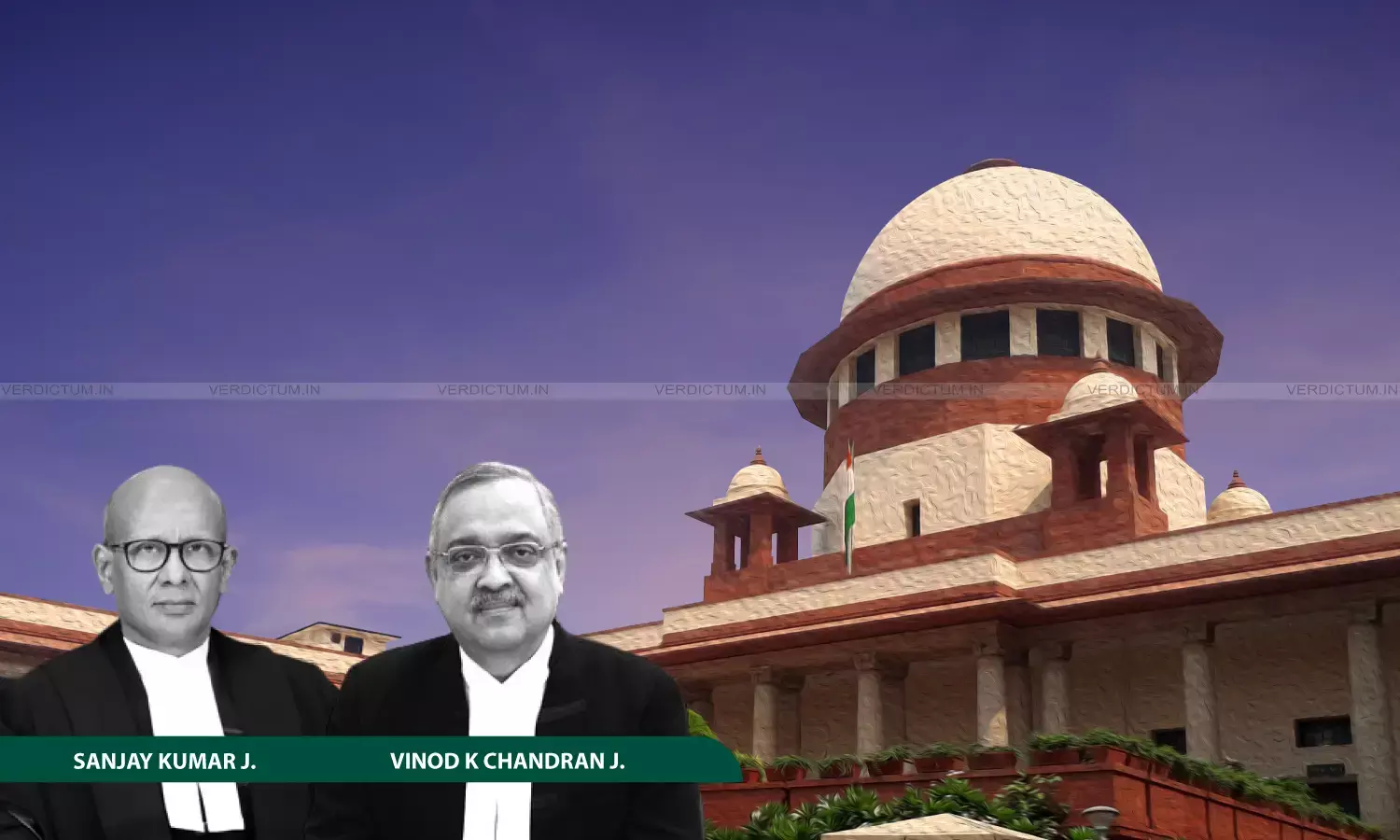
The Supreme Court held that where a plaintiff challenges encroachment based on an alleged fabricated sale deed which is neither produced nor part of the public domain, there is no necessity to seek a declaration of its invalidity. It further held that a declaratory decree asserting title operates as an effective repudiation of such a voidable transaction.
The Court was hearing a civil appeal arising out of proceedings under the Rajasthan Tenancy Act, 1955, wherein the High Court had affirmed the remand of a long-concluded suit after condoning a delay of over three decades.
A Bench comprising Justice Sanjay Kumar and Justice K. Vinod Chandran observed: “We have already found that the plaint only raises an apprehension that the encroachment was made by the defendants on the strength of a fabricated sale deed created by them, … though a defense was set up with respect to the sale deed, it was not produced, in which event there was no reason why the plaintiff should seek a declaration of nullity, especially when the same was not even a registered document available in the public domain”.
Further, while referring to K.S. Shivappa v. K. Neelamma (2025), the Bench added that “the repudiation of a voidable transaction need not necessarily be in a suit instituted to set it aside and could as well be, by way of an unequivocal conduct, … here, the appellant claimed his ‘khatedari’ rights based on the mutation entries in his father’s favour and the decree obtained thereat would be an effective repudiation of the document”.
Senior Advocate Vaibhav Gaggar appeared for the appellant, while Senior Advocate Shadan Farasat appeared for the respondents.
Background
The dispute pertained to agricultural land measuring over 158 bighas, in respect of which the appellant claimed ‘khatedari’ rights as a successor to his father, whose name stood mutated in revenue records in 1961. The appellant’s mother, acting on his behalf as a minor, instituted a suit in 1965 alleging that the defendants had encroached upon a portion of the land based on a fabricated sale deed.
The suit culminated in a decree dated 16.08.1975, whereby the appellant’s rights were recognized and recovery of possession was ordered. Though one of the defendants had initially appeared and contested the proceedings, she was eventually set ex parte after failing to pursue the defence.
After a lapse of more than 31 years, the defendant sought to challenge the decree, contending that she had no knowledge of the proceedings and alleging fraud in obtaining the decree. The delay was condoned, and the matter was remanded by the Revenue Board, whose order was affirmed by the High Court.
The appellant challenged the remand before the Supreme Court.
Court’s Observation
The Court undertook a detailed examination of the pleadings, trial court proceedings, and the conduct of the parties.
At the outset, it rejected the contention that the plaintiff’s failure to seek cancellation of the sale deed was fatal. It noted that the plaint merely referred to an apprehension of encroachment based on a fabricated document, and that the alleged sale deed was never produced in evidence.
The Court observed that though a defence was set up with respect to the sale deed, it was not produced, and consequently, there was no reason why the plaintiff should seek a declaration of nullity.
Relying on precedent, the Court further held that the repudiation of a voidable transaction need not necessarily be in a suit instituted to set it aside and could as well be, by way of an unequivocal conduct. Applying this principle, the Court held that the appellant’s assertion of ‘khatedari’ rights and the decree obtained in his favour constituted a clear repudiation of the alleged transaction.
The Court also examined the evidentiary aspects and found that the defendant had failed to produce the very document forming the foundation of her defence. It reiterated that withholding the best evidence warrants an adverse inference.
On the issue of delay, the Court held that condonation of a delay of 31 years was wholly unjustified, particularly when the defendant had participated in the original proceedings and even led evidence. The plea of fraud was found to be vague and unsupported by material particulars, and was observed to have been improved at successive stages.
The Court further noted that the proceedings of the trial court clearly demonstrated the defendant’s appearance through counsel, filing of applications, and examination of witnesses, thereby negating the claim of lack of notice.
Addressing the issue of possession, the Court categorically held that the mere non-execution of the decree does not lead to any presumption that the defendants continued in possession.
In this regard, the Court observed: “The declaratory decree in favour of the appellant cannot be set aside merely on the ground that the appellant did not seek execution since there is no presumption that the possession remained with the defendants after the passing of the decree; which continued possession had also not been substantiated”.
The Court also scrutinised the alleged sale deed relied upon by the respondents and found serious infirmities, including absence of proof of title, lack of recitals tracing ownership, and non-compliance with statutory requirements relating to transfer of property belonging to a minor.
It emphasised that transactions involving minors without court permission are hit by statutory prohibition and cannot confer a valid title.
Conclusion
The Supreme Court held that the orders of the Revenue Board and the High Court were unsustainable, as they were based on erroneous appreciation of facts, unjustified condonation of delay, and failure to consider material evidence.
Accordingly, the Court set aside the impugned orders and restored the original decree dated 16.08.1975 in favour of the appellant.
The appeal was allowed, and all pending applications were disposed of.
Cause Title: Hari Ram v. State of Rajasthan & Ors. (Neutral Citation: 2026 INSC 350)
Appearances
Petitioners: Senior Advocate Vaibhav Gaggar; Advocates Arpit Gupta (AOR), Divya Pratap Parmar, Vansh Srivastava, Akansha Agarwal.
Respondents: AAG Shiv Mangal Sharma; Advocate Nidhi Jaswal (AOR); Senior Advocate Shadan Farasat; Advocates Harsh Tikoo, Jatin Bhardwaj (AOR), Harshit Anand, Rahul Rai, Misbahul Haque, Ramkishan Saraswat.