Supreme Court: No All-Pervasive Ouster Of Jurisdiction Of Civil Court Under Wakf Act
The Apex Court has held that although Wakf Tribunals are conferred with jurisdiction to remove encroachments, such power can be exercised only when proceedings are initiated by the Chief Executive Officer of the Wakf Board under Section 54(3) and (4).
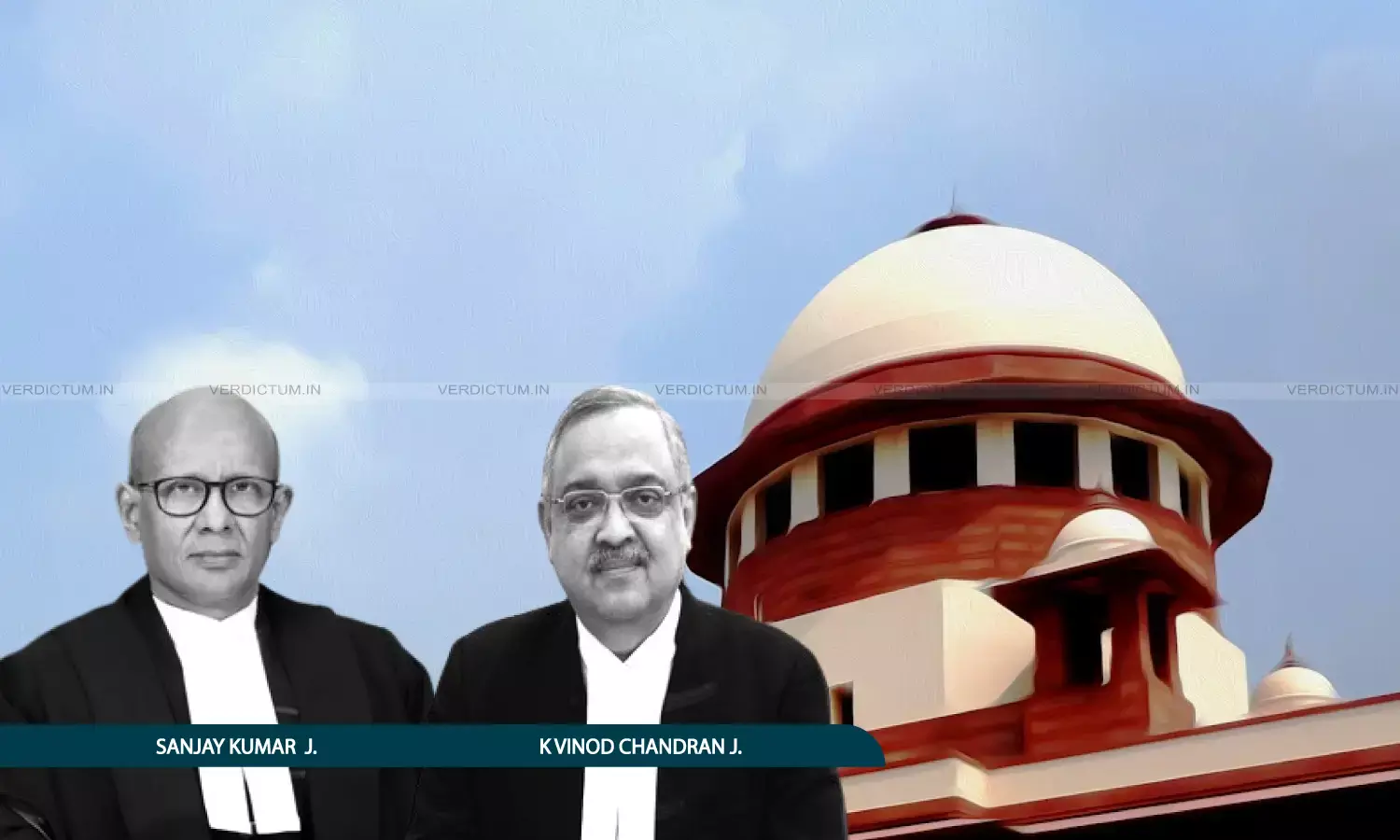
The Supreme Court has held that there is no absolute and all-pervasive ouster of jurisdiction of the Civil Court under the Wakf Act 1995.
The Court held that resolution to disputes with respect to a property being a waqf or not is expressly conferred on the Tribunal, only with respect to those properties specified in the ‘list of Auqaf’
The Court was hearing an appeal arising from proceedings relating to alleged encroachment and the scope of the Wakf Tribunal’s jurisdiction under Sections 54 and 83 of the Wakf Act, 1995.
A Bench of Justice Sanjay Kumar and Justice K. Vinod Chandran, while interpreting the statutory scheme, observed: “…There is hence no absolute and all-pervasive ouster of jurisdiction of the Civil Court even under Section 85 of the Act of 1995. The definition of ‘waqf’ under Section 85, 3(r) and the applicability of the Act of 1995 on all auqaf (Section 2) does not also determine jurisdiction which, in resolution to disputes with respect to a property being a waqf or not is expressly conferred on the Tribunal, only with respect to those properties specified in the ‘list of Auqaf’.
Background
The dispute arose out of proceedings relating to alleged encroachment and the maintainability of proceedings before the Wakf Tribunal under the Wakf Act, 1995.
The respondent instituted proceedings asserting rights in respect of certain premises and sought reliefs which, according to the appellants, were not maintainable before the Wakf Tribunal in the absence of the property being notified or registered as wakf property in accordance with the statutory scheme.
The appellants filed an application under Order VII Rule 11 of the Code of Civil Procedure seeking rejection of the plaint on the ground that the Wakf Tribunal lacked jurisdiction. It was contended that the subject premises had not been notified as wakf property and that the Tribunal could not entertain proceedings in the absence of compliance with statutory requirements.
The High Court rejected the revision and held that the plaint disclosed a case of “waqf by user” and that the Wakf Tribunal had jurisdiction to entertain the proceedings.
Aggrieved by the said order, the appellants approached the Supreme Court, raising substantial questions on the scope of Sections 6, 7, 54, 83 and 85 of the Wakf Act, 1995, and the extent of the Tribunal’s jurisdiction.
Court’s Observation
The Supreme Court undertook an extensive examination of the statutory framework of the Wakf Act, 1995, particularly Sections 6, 7, 54, 83 and 85, and the evolution of the law through judicial precedents and the 2013 amendment.
The Court reiterated the settled principle that exclusion of civil court jurisdiction is not absolute and is confined to matters which the statute expressly requires to be determined by the Wakf Tribunal.
The Court examined the decision in Ramesh Gobindram v. Sugra Humayun Mirza Wakf and held that the principle laid down therein, regarding the limited and specific jurisdiction of the Wakf Tribunal, continues to hold the field even after the 2013 amendment.
The Court held that Section 83, which provides for the constitution of Wakf Tribunals, does not by itself confer substantive jurisdiction to adjudicate all disputes relating to wakf or wakf property. The Court held that Section 83 must be read in conjunction with other substantive provisions of the Act which specifically confer jurisdiction on the Tribunal.
The Court examined the effect of the 2013 amendment and noted that the amendment introduced a structured mechanism for the removal of encroachments by conferring specific powers under Section 54(3) and (4). The Court held that the amendment did not expand Section 83 to permit bypassing of the special procedure under Section 54.
The Court also analysed Section 54 and held that the statutory scheme clearly vests the power to initiate encroachment proceedings in the Chief Executive Officer of the Wakf Board, either suo motu or on a complaint. The Tribunal’s role, the Court held, is activated only upon such initiation.
The Court further held that permitting parties to directly approach the Tribunal under Section 83 for removal of encroachments would render Section 54 otiose and defeat the legislative intent behind providing a specialised administrative-judicial process.
The Bench further held that statutory interpretation must give full effect to each provision and avoid constructions that render any provision redundant.
The Court also examined conflicting precedents and clarified that wider interpretations of Section 83, which treat it as a standalone, all-encompassing jurisdictional provision, are inconsistent with the statutory structure and earlier binding precedent.
“Section 83 does not confer any jurisdiction on the Tribunal, either/or an omnibus consideration of any dispute, question or other matter related to waqf or of waqf property, nor with respect to eviction of a tenant or determination of the rights and obligations of lessor and lessee of waqf property”, the Bench remarked.
On this basis, the Court held that removal of encroachments on wakf property must be initiated only in accordance with Section 54 and that Section 83 cannot be used to bypass the statutory procedure.
Conclusion
The Supreme Court concluded that, in the matter at hand, “neither is the property specified in the ‘list of auqaf’ as published in Chapter II nor registered under Chapter V and hence the decision as to whether the property is a waqf property or not cannot be decided by the Tribunal since the property is not one specified in the ‘list of auqaf’, which is the mandatory requirement under Section 6(1) and Section 7(1) of the Waqf Act of 1995 to approach the Tribunal”.
Accordingly, the Court set aside the order of the Tribunal, ascertaining jurisdiction and that of the High Court, affirming it.
Consequently, the Appeal was allowed, leaving the question of whether the scheduled property is a waqf or not open to be agitated in accordance with the law.
Cause Title: Habib Alladin & Ors. v. Mohammed Ahmed (Neutral Citation: 2026 INSC 90)
Appearances
Appellants: C. A. Sundaram, Senior Advocate, With Advocates Pranab Kumar Mullick, AOR, Soma Mullick, S. N. Shakeel, Venkaiah Naidu, Abhishek Gupta, Hemant Kumar
Respondents: S. Niranjan Reddy, Senior Advocate, with Advocates Anirudh Wadhwa, Debarshi Chakraborty, Akhila P., Vipul Kumar, AOR