

AICTE Career Advancement Scheme Regulations Don’t Apply To Direct Recruitment Process Under State Rules: Supreme Court
The Appeal before the Supreme Court was filed by the Gujarat State Public Service Commission against an order of the Division Bench setting aside the order by which the writ petition of the candidate was dismissed.

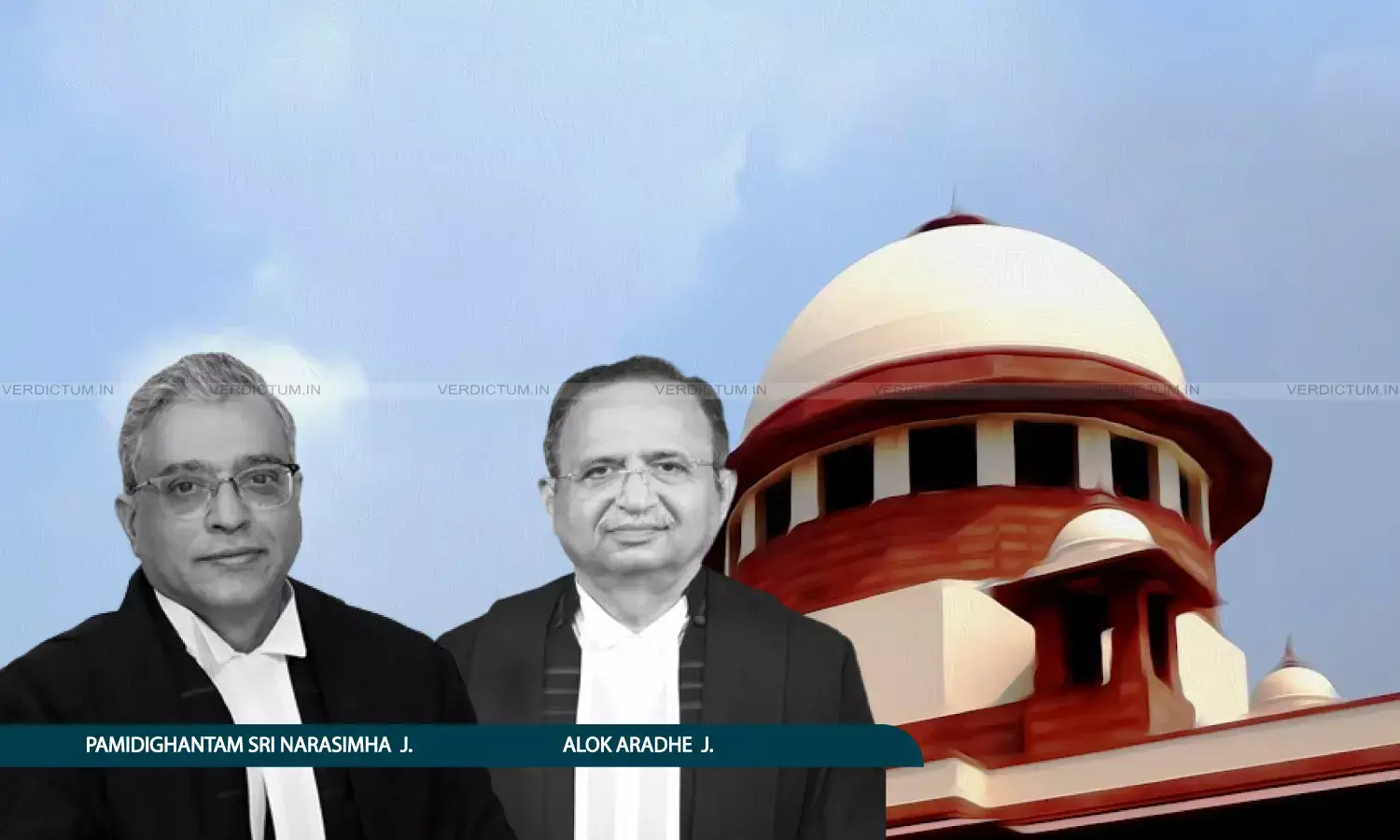
Justice Pamidighantam Sri Narasimha and Justice Alok Aradhe, Supreme Court
While allowing an appeal filed by the Gujarat State Public Service Commission (Commission), the Supreme Court has held that the AICTE Regulations do not apply to the process of direct recruitment under the State Rules. The Apex Court also held that the law does not permit a regulation crafted as a ladder to be used as a gate.
The Appeal before the Supreme Court was filed by the Gujarat State Public Service Commission (Commission), against an order of the Division Bench setting aside the order by which the writ petition preferred by the respondent candidate seeking appointment to the post of Professor (Plastic Engineering) was dismissed.
The Division Bench of Justice Pamidighantam Sri Narasimha and Justice Alok Aradhe held, “To apply AICTE Regulations to a candidate participating in recruitment for the post of Professors in the Engineering Colleges in the State conducted by the Commission under State Rules framed by the State, would be to stretch the AICTE Regulations beyond its text, context, and purpose. The law does not permit a regulation crafted as a ladder to be used as a gate. Thus, the AICTE Regulations do not apply to the process of direct recruitment under the State Rules, which is the subject matter of this appeal. The issue is answered accordingly,”
Senior Advocate P. S. Patwalia represented the Appellant while the Respondent appeared in-person.
Factual Background
An advertisement was issued in 2015 by the Commission for recruitment to seven posts of Professors in various disciplines, including one post of Professor (Plastic Engineering) in Government Engineering Colleges in the State of Gujarat. The candidate applied for the post of Professor (Plastic Engineering). The recruitment was conducted under the Government Engineering Colleges Recruitment Rules, 2012 (State Rules), framed by the State Government and in accordance with general guidelines for the advertisement. The candidate participated in the interview. The minimum qualifying marks prescribed for female candidates of the unreserved category were 45 marks out of 100 marks. The candidate secured 28 marks only and was, therefore, not recommended for selection.
The candidate, after being declared unsuccessful in the interview, for the post of Professor (Plastic Engineering), invoked the All India Council for Technical Education (Career 3 Advancement Scheme for the Teachers and Other Academic Staff in Technical Institutions) (Degree) Regulations, 2012 (AICTE Regulations), to challenge the process of selection for the post in question in a writ petition. The candidate also sought a direction from the Commission to offer her the post of Professor (Plastic Engineering). The Single Judge dismissed the Petition. In appeal, the Division Bench held that the AICTE Regulations govern even the direct recruitment to the post of a Professor in Government Engineering Colleges in the State and invalidated the entire selection process. It was in such circumstances that the appeal came to be filed before the Apex Court.
Reasoning
On a perusal of the All India Council for Technical Education (Career Advancement Scheme for the Teachers and Other Academic Staff in Technical Institutions) (Degree) Regulations, 2012, the Bench noted that the Regulations provide for stages of promotion under the Career Advancement Scheme of incumbent and newly appointed Assistant Professors/Associate Professors/Professors. The entire scheme of the Regulations proceeds on one foundational basis that the person to whom the Regulations apply must already be an incumbent or a newly appointed Assistant Professor/Associate Professor or Professor. The Regulations are not Recruitment Rules but are Promotion and Progression Rules. “The provisions of the Regulations, therefore, cannot logically apply to a person who is not yet a part of that system”, it added.
The Bench held that the reliance placed on Table II (C) to Appendix-I of the AICTE Regulations was misconceived, as the same provided the criteria for grant of benefit under the Career Advancement Scheme to Professor (stage 5), but the candidate was neither a Professor (stage 4) nor an aspirant for promotion as Professor (stage 5) under the Career Advancement Scheme.
Holding that the AICTE Regulations do not apply to the process of direct recruitment under the State Rules, the Bench held that the AICTE Regulations and State Rules operate in different fields. As per the Bench, the Division Bench of the High Court committed an error in assuming that the AICTE Regulations override the State Recruitment Rules in the matter of initial appointment. “The Act does not empower the AICTE, to abolish the State Rules for recruitment in Government Colleges, but empowers it to ensure standard of education and service conditions, particularly for career progression”, it clarified.
Considering that the candidate, only after being declared unsuccessful, sought to invoke an entirely different regulatory regime, the Apex Court held that the Division Bench erred in holding that the candidate was not precluded from challenging the process of selection. “We must, however, take note of the fact that though the records indicate substantial research credentials, international publications and technical expertise on the part of the candidate. Yet, the fact remains that the courts do not make appointments. A recruitment concluded in 2015 cannot be reopened in 2025, on the basis of the Regulations that never applied to it”, it held.
Thus, allowing the appeal, the Bench quashed the judgment of the Division Bench of the High Court. “The recruitment conducted by the Commission in pursuance of the advertisement dated 23.09.2015 is upheld”, it ordered.
Cause Title: Gujarat Public Service Commission v. Gnaneshwary Dushyantkumar Shah (Neutral Citation: 2026 INSC 70)
Appearance
Appellant: Senior Advocate P. S. Patwalia, Advocates Premal Joshi, Aastha Mehta, Prerana Mohapatra, Prina Sharma, AOR Anshuman Srivastava
Respondent: Respondent-in-person