

Adjudicating Authority Has To Satisfy Itself Of Existence Of Plausible Pre-existing Dispute While Considering Application U/S 9 IBC: Supreme Court
The appeal before the Supreme Court was filed by the corporate debtor in a case pertaining to the Insolvency and Bankruptcy Code.

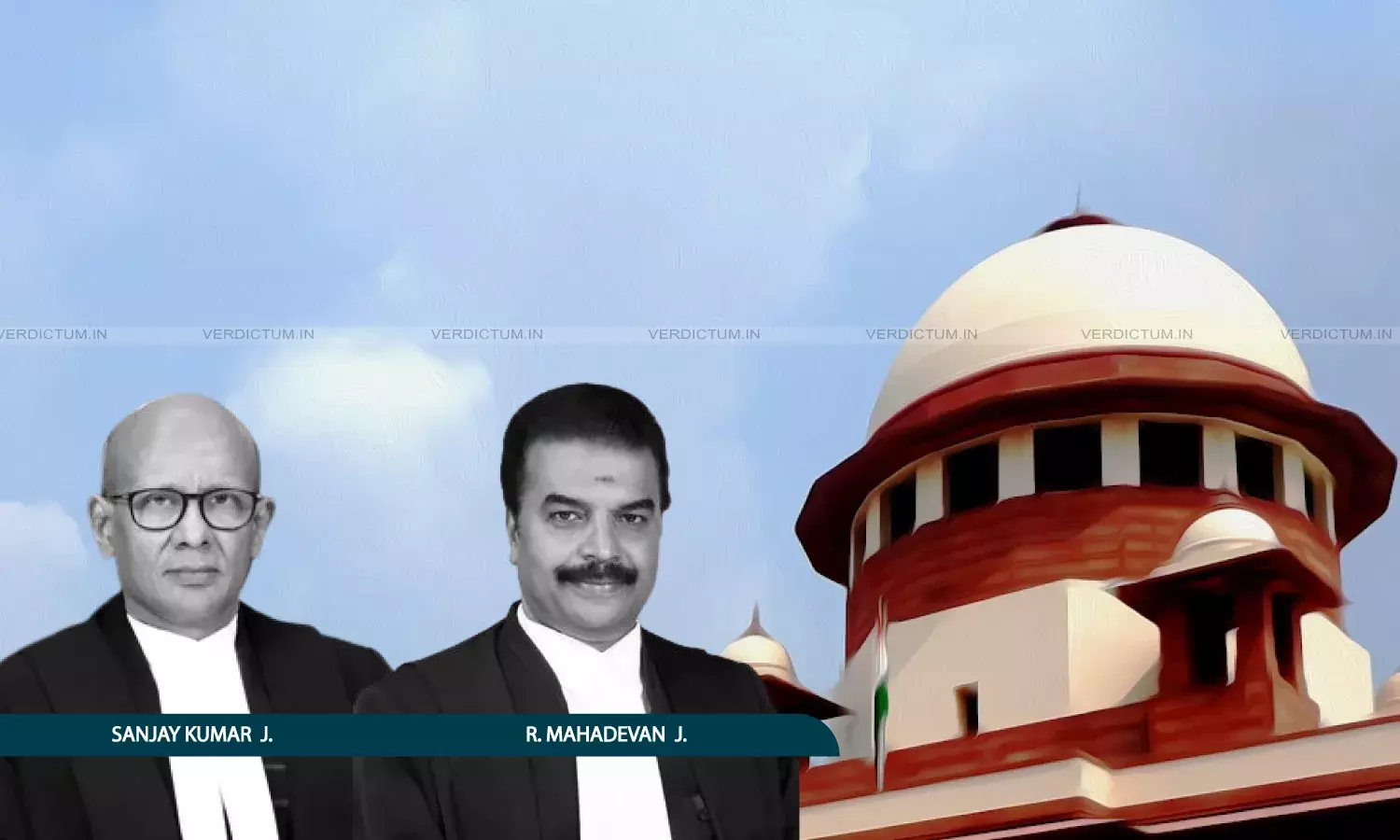
Justice Sanjay Kumar, Justice R. Mahadevan, Supreme Court
While holding that the NCLAT was not justified in reversing the decision of the NCLT, the Supreme Court has held that all that is required for the adjudicating authority is to satisfy itself as to the existence of a plausible pre-existing dispute, which was not spurious, hypothetical or illusory, while considering an application filed under Section 9 of the Insolvency and Bankruptcy Code, 2016.
The appeal before the Apex Court was filed by the corporate debtor after the adjudicating authority denied the initiation of the corporate insolvency resolution process, but the appellate authority reversed that decision.
The Division Bench of Justice Sanjay Kumar and Justice R. Mahadevan held, “Given the obtaining facts and the aforestated settled legal position, it was not for the NCLAT to delve into the appellant’s dispute to decide whether it had actual merit. All that is required is for the adjudicating authority to satisfy itself as to the existence of a plausible pre-existing dispute, which was not spurious, hypothetical or illusory. Whether the party raising that dispute would succeed on the strength thereof is not within the ken of such inquiry. That being so, we are of the opinion that the NCLT was correct in concluding that the application filed by the respondent under Section 9 of the Code did not merit consideration, owing to pre-existing disputes. The NCLAT was not justified in reversing the said decision.”
Factual Background
The respondent claimed that it had supplied chemicals to the appellant over a period of time, and a sum of Rs 2,92,93,223 was due and payable to it. A Demand notice was issued by it under Section 8 of the Code. In response, the appellant addressed an email disputing the claim. The respondent filed the subject application under Section 9 of the Code. The appellant contested the proceedings, claiming that there was a pre-existing dispute between the parties prior to issuance of the demand notice. According to it, the respondent had supplied two consignments of solvent at its factory premises at Gurugram, but the same were found to be defective. The respondent assured the appellant that it would compensate it for the losses suffered and supplied another batch of solvent, which again was found defective.
According to the appellant, the respondent was called upon time and again to come and settle accounts and compensate the appellant for the losses suffered by it. However, no steps were taken in that regard, but the authorised representative of the respondent started applying arm-twisting tactics by threatening to commit suicide if payment was not made for the defective supplies. The appellant filed a police complaint. After adjusting the account, per the appellant, the respondent was still due and liable to pay it a sum of ₹70,09,430. The NCLT, accordingly, concluded that there existed a dispute between the parties prior to issuance of the demand notice, which necessitated a detailed investigation, and this was beyond the scope of its summary jurisdiction under the Code. The respondent’s application was accordingly dismissed by the NCLT. When the matter reached NCLAT, it directed admission of the respondent’s application under Section 9 of the Code.
Reasoning
The Bench was of the view that once the respondent admitted that written correspondence commenced only after disputes arose, and the first such written correspondence dated long before issuance of the demand notice, this was sufficient in itself to show that there were pre-existing disputes between the parties. As per the Bench, when the appellant sought reconciliation of accounts in that context, and the respondent failed to oblige, its demand for a sum of money in excess of ₹1 crore was not sufficient to meet the threshold for maintaining an application under Section 9 of the Code.
“More so, when the respondent had raised a demand for ₹4.60 crore just two months prior to issuance of the demand notice and clarified the same only on 09.12.2021, that is almost a month after issuance of the demand notice. This confusion and lack of clarity on the part of the respondent in deciding as to what was the amount allegedly due to it, clearly supports the case of the appellant that the accounts required reconciliation”, it added.
On a perusal of the facts of the case, the Bench noted that the respondent’s belated reply followed by its multiple debit notes for interest in quick succession, were just afterthoughts to build up a case to file an application under Section 9. The Bench thus held that the NCLT was correct in concluding that the application filed by the respondent under Section 9 of the Code did not merit consideration, owing to pre-existing disputes and the NCLAT was not justified in reversing the said decision.
Thus, allowing the appeal, the Bench set aside the judgement passed by the National Company Law Appellate Tribunal and restored the order of the National Company Law Tribunal.
Cause Title: GLS Films Industries Private Limited v. Chemical Suppliers India Private Limited (Neutral Citation: 2026 INSC 344)