

Supreme Court: Giving Contractual Employees Same Status As Regular Employees Amounts To Giving Premium To Arbitrarily Selected Process
The Court said that if distinctions between a regular employee and contractual employees are not made, then the basic concept of hiring through various modes and in different capacities would lose its purpose.

The Supreme Court has observed that if the persons who are employed through a contractor, and have come to work, are given equal benefits and status as a regular employee, it would amount to giving a premium and sanction to a process which is totally arbitrary.
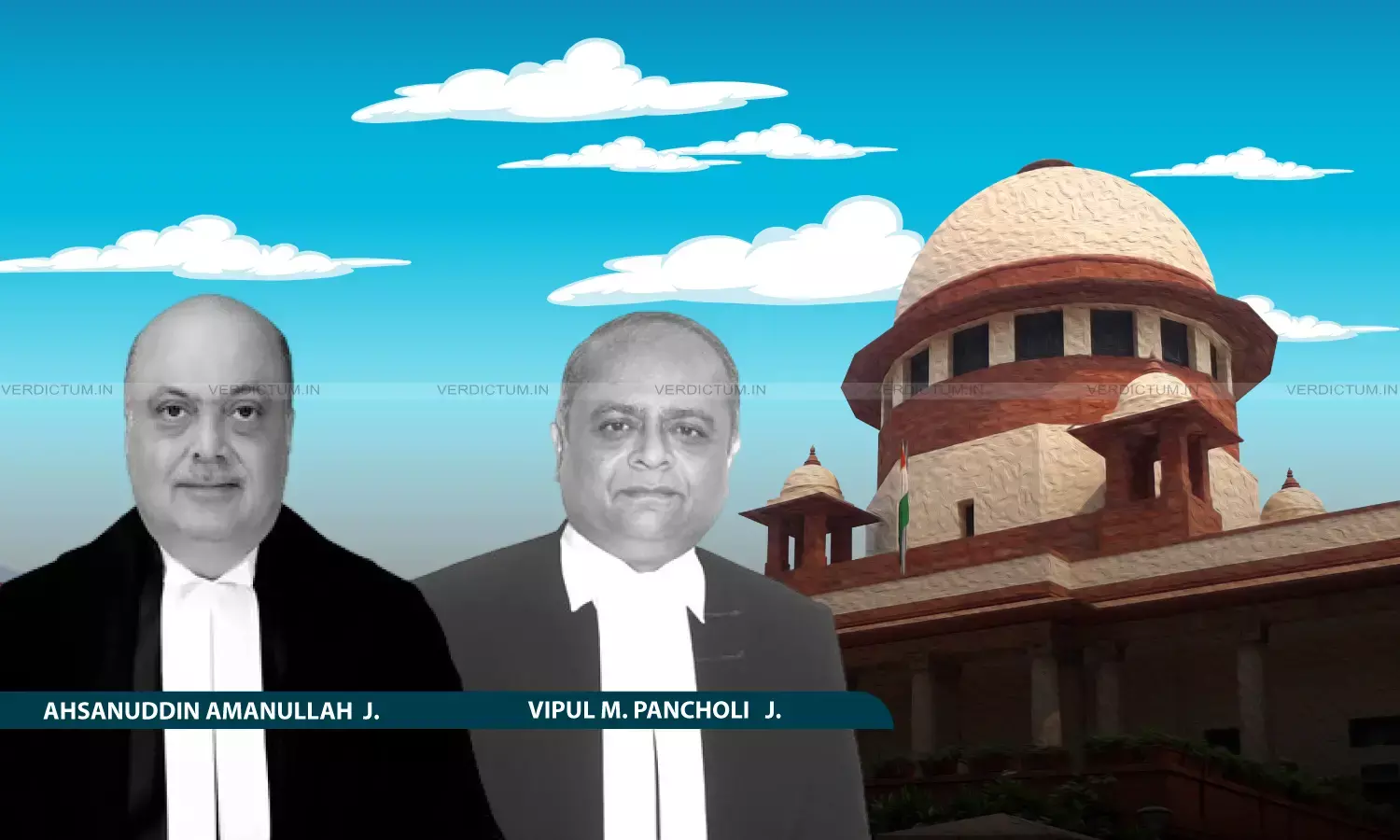
The Bench of Justice Ahsanuddin Amanullah and Justice Vipul M. Pancholi observed, “The reason why there are safeguards in regular appointment is that there should not be any favouritism or other extraneous consideration where persons, only on merit, are recruited through a fully transparent procedure known in law. If the persons who are employed through a contractor, and have come to work, are given equal benefit and status as a regular employee, it would amount to giving premium and sanction to a process which is totally arbitrary as there is no mode prescribed in any contract as to how the contractor would employ or choose the persons who are to be sent, except for the basic qualification, i.e., knowledge in the field for which they are required.”
AOR Y. Raja Gopala Rao appeared for the Appellant, while Senior Advocate L. Narasimha Reddy appeared for the Respondents.
Factual Background
Appeals were filed assailing the order passed by the Telangana and Andhra Pradesh High Court by which the appellant has been directed to grant a minimum time scale of pay to the respondents and also to add annual grade increments as and when they fell due from time to time.
The Appellant had engaged the Respondents not directly, but through a third-party contractor starting from the year 1994. However, upon the change of contractors, they continued to perform their duties and work for the Appellant. They had approached the A.P. Administrative Tribunal, Hyderabad, seeking regularization and payment of the minimum of the scale of that post, which was given to the regular employees. The Tribunal ruled against them, and they approached the High Court. The High Court vide the impugned order, has reversed the order of the Tribunal.
Contention of the Parties
The Appellant submitted that the High Court has failed to consider the basic issue involved in the present case, which is that the Respondents were never the direct employees of the Appellant, inasmuch as there was no such relationship created by the Appellant. The only connection which the Appellant had with the Respondents is that the contractor who had been given the contract of providing manpower to the Appellant had engaged them, and on that basis, they were assigned various works to be performed by the Appellant, for which payment was made directly to the contractor and the contractor, in turn used to pay the Respondents.
It was submitted that the contract was given with sufficient safeguards regarding the basic rights of an employee, inasmuch as it was stipulated that the payment should not be below the minimum wages prescribed by the Government from time to time and further, that statutory deductions/contributions would be made by the contractor with regard to such employees, including the Respondents.
Per contra, the Respondents submitted that the stand of the Appellant is totally arbitrary and violates the basic constitutional rights of the Respondents. It was submitted that, besides being discriminatory, it was highly arbitrary as, at the end of the day, the Respondents had been directed to be paid only the minimum time scale of the pay attached to the regular post of their respective cadre. This cannot be objected to by any employer, much less an employer which is the State under Article 12 of the Constitution of India, he said. Further, it was contended that similarly situated persons in other municipalities had been given the same benefit and denying the same to the Respondents in the present case itself would not stand the constitutional requirement of it not being discriminatory.
Observations of Court
The moot point on which the issue revolved was the nature of the employment/ relationship of the Appellant with the Respondents.
The Court observed, “Thus, at first blush the reasoning may seem to be attractive that there was discrimination as they were also performing the duties as was being performed by other regular employees and were required to be suitably paid and, at least, the minimum time scale of the pay attached to the regular post, however, a deeper probe would reveal that the matter cannot be dealt with in such a simplistic way”.
The test which was applied by the Court was whether the relationship, which is direct between two parties in whatever manner, can be differentiated from a relationship which had no direct connection with the two parties who are contesting, but rather the relationship is through a third-party, which in the present case is the contractor.
“From the facts discussed above, it is clear that the appellant had no direct connection with the actual persons who were employed by the contractor, i.e., the respondents. The obligation and responsibility of the appellant was to pay to the contractor the amount which had been contracted and agreed to between the appellant and the contractor, and the responsibility then was that of the contractor to ensure payment of wages and other emoluments as per the terms of the contract to the persons who were actually sent by the contractor to the appellant for performing various types of job.”
The Court clarified that it was not the case that the mode of employment through a contractor itself was illegal or that there was any illegality in the terms and conditions of the contract so as to make it ultra vires any constitutional provision or to make it discriminatory.
Another issue which was dealt by the Court was that the Respondents being in the position, and the relief given being the minimum of the time scale of the pay attached to the regular post cannot be termed as giving them something which was not due or something excessive, for ultimately they also have a family to support and they were also performing the job which is performed by people on the regular establishment.
“The Court feels that the mode of contractual employment, that too, by a contractor and not directly by the employer will have to be seen in a different light in the eyes of law. If all such distinctions between a regular employee and such contractual employees is not made, then the basic concept of hiring through various modes and in different capacity would lose its purpose and sanctity and ultimately everybody would be getting exactly the same benefit. This cannot be permitted in law for the reason that employment under a State entity is a public asset and every citizen of the country has a right to apply for it.” the Court said.
It was also observed that when employees/workmen are taken through a contractor, it is the absolute discretion of the contractor as to whom and through which mode he would choose such persons to be sent to the principal.
Conclusion
The Court concluded, “Having passed the order, we feel that sometimes justice is required to be tempered with mercy as human factors cannot be totally lost sight of. In such view of the matter, we would require the appellant to look into whether the jobs which were being done by the respondents, in the background that they have not been disengaged or returned to the contractor on the ground of being unsatisfactory, having uninterrupted service under the appellant for decades can be regularized on posts, which prima facie appears to be perpetual in nature.”
Accordingly, the Court allowed the appeals.
Cause Title: The Municipal Council, Rep. By Its Commissioner Nandyal Municipality, Kurnool District, A.P. v. K. Jayaram and Others [SLP No. 17711-17713 of 2019]
Appearances:
Appellant: AOR Y. Raja Gopala Rao, Advocate Dhuli Gopi Krishna, Advocate Akshay Singh, Advocate Sanjana Jain, AOR N. Rajaraman, Advocate Prerna Singh, AOR Guntur Pramod Kumar, and Advocate Keshav Singh.
Respondent: Senior Advocate L. Narasimha Reddy, Advocate P. Raghavender Reddy, Advocate C. Raghavendren, Advocate Ch. Leela Sarveswar, Advocate C. Rubavathi, Advocate Nandi Kiran Kumar, Advocate Saurabh Gupta, AOR M. A. Chinnasamy, Senior Advocate DVSS Somayajulu, Advocate Goli Rama Krishna, AOR Vandana Sharma, Advocate Koppula Gopal, AOR N. Rajaraman, and AOR Guntur Pramod Kumar.