

Motive Alone Cannot Sustain Conviction In Absence Of Complete Chain Of Circumstantial Evidence: Supreme Court Acquits Murder Accused
The Court reiterated that motive is merely a corroborative circumstance and cannot substitute requirement of complete and unbroken chain of evidence.
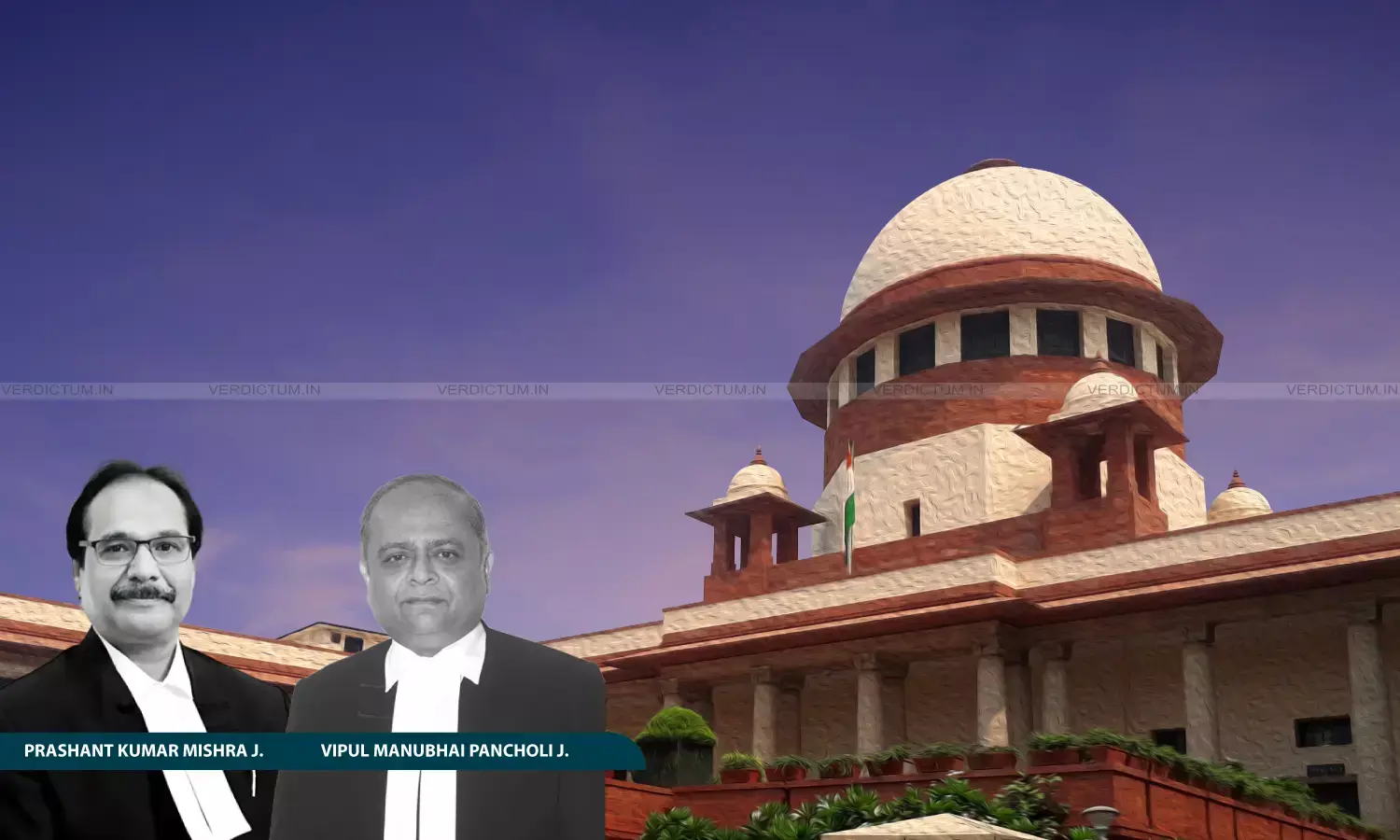
Justice Prashant Kumar Mishra, Justice Vipul M. Pancholi, Supreme Court
The Supreme Court has held that in a case resting on circumstantial evidence, motive by itself cannot form the basis of a conviction and can only serve as a supporting factor where the chain of circumstances is otherwise complete and conclusive.
The Court was hearing a criminal appeal challenging the conviction of the appellant under Section 302 IPC, where the prosecution's case was based entirely on circumstantial evidence.
A Bench of Justice Prashant Kumar Mishra and Justice Vipul M. Pancholi observed: “motive is a supporting factor which strengthens an otherwise complete chain of evidence. It cannot replace such a chain where other circumstances are missing or weak.”
Senior Advocate A. Sirajudeen represented the appellant, while Standing Counsel Vinayak Sharma represented the respondents.
Background
The prosecution's case was that the appellant, owing to prior enmity with the deceased, had committed the murder by inflicting multiple injuries with an axe. The case rested entirely on circumstantial evidence, including alleged last-seen evidence, recovery of weapon and clothes, and proof of motive arising out of past disputes.
The Trial Court convicted the appellant while acquitting the co-accused on the same set of evidence. The High Court affirmed the conviction. The appellant approached the Supreme Court, challenging the findings on the ground that the chain of circumstances was incomplete and unreliable.
Court’s Observation
The Court reiterated the settled principles governing cases based on circumstantial evidence, particularly the requirement of a complete chain of circumstances that must exclude every hypothesis except that of guilt. It referred to the well-established “five golden principles” governing such cases. The Court emphasised that each circumstance relied upon must be fully established and must form a coherent chain pointing unequivocally towards the guilt of the accused.
The Court found that the ‘last seen’ evidence was weak and unreliable. The witness had only placed the appellant near the scene of the occurrence and not in the company of the deceased at the relevant time. It noted that the identification of the accused in poor lighting conditions was doubtful, and the testimony lacked the necessary certainty to form a conclusive link in the chain of circumstances.
The Court also scrutinised the recovery of weapons and clothes allegedly made pursuant to disclosure statements under Section 27 of the Evidence Act. It found serious deficiencies, including hostile witnesses, a lack of corroboration, and an absence of conclusive forensic linkage between the recovered articles and the crime. It noted that the mere presence of blood stains without establishing their origin or connection to the deceased was insufficient.
The Court highlighted multiple contradictions in witness testimonies and procedural irregularities in the investigation, including delayed recording of statements and doubtful seizure procedures. It also noted that even the recovery of the appellant’s driving licence from the scene was not conclusively proved and remained shrouded in doubt.
The Court observed that the co-accused had been acquitted on the same evidence, and in the absence of any distinguishing circumstance of a conclusive nature, the appellant could not be treated differently. It held that similar evidence cannot result in the conviction of one accused and the acquittal of another without a clear and sustainable distinction.
Addressing the issue of motive, the Court held that although there was some material suggesting prior animosity, it was neither strong nor proximate enough to independently sustain a conviction. It is observed that motive, at best, supplements other evidence but cannot replace the requirement of a complete chain of circumstances.
Conclusion
The Supreme Court held that the prosecution had failed to establish a complete and unbroken chain of circumstances pointing to the guilt of the appellant. It held that the evidence on record raised only suspicion, which cannot take the place of proof in criminal law. The appellant was accordingly granted the benefit of doubt.
The conviction and sentence were set aside, and the appellant was acquitted of the charge under Section 302 IPC.
Cause Title: Gautam Satnami v. State of Chhattisgarh (Neutral Citation: 2026 INSC 325)
Appearances
Appellant: Senior Advocate A. Sirajudeen; Advocates Manjeet Chawla, Shaik Soni Ahamed & Jyoti
Respondent: Standing Counsel Vinayak Sharma; Advocates Ravinder Kumar Yadav, Yashvardhan Shah & Kritika Yadav
