

Mainstream Media Is By And Large Responsible, Problem Is Atomized Social Media: Supreme Court Flags Concerns In Plea Highlighting Misuse Of Digital Platforms By Police
Chief Justice Surya Kant highlighted a harrowing shift in public sensitivity, noting that people often record videos of accident victims rather than helping them.

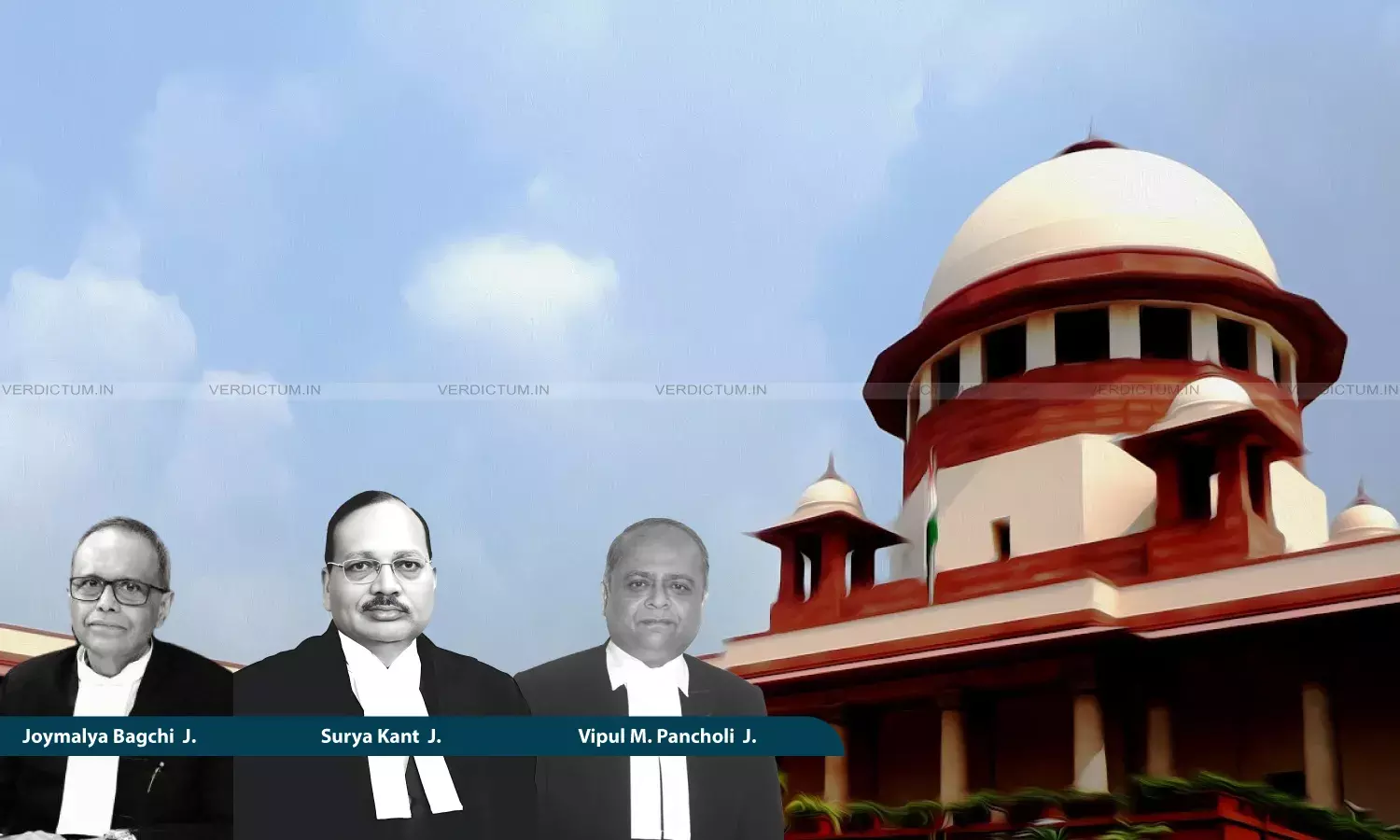
Supreme Court of India, Justice Surya Kant, Justice Joymalya Bagchi, Justice Vipul M. Panhcoli
The Supreme Court, today, expressed deep concern over the "vitiating atmosphere" created by unregulated social media and the evolving challenges of ensuring a fair trial in a digital age.
The Court was hearing a Public Interest Litigation, inter alia, seeking directions against such posts uploaded by their respective police organisations on their social media handles, which reveal the faces/ identities of accused persons and/or depict them in a dehumanizing manner (e.g. being handcuffed, tied by ropes, beaten with sticks, kneeling on the floor, dragged or pulled down a flight of stairs etc.).
The Bench observed that while a formal police manual is a positive step to restrain "over-enthusiastic" statements by investigating agencies, the larger canvas of justice is increasingly clouded by third parties and "atomized" social media platforms.
The Bench of Chief Justice Surya Kant, Justice Joymalya Bagchi and Justice Vipul M Pancholi ordered, "The Senior Counsel for the petitioner seeks to withdraw this petition. As the petitioner wishes to file a comprehensive petition, they view some allied issues as well. This is withdrawn with the liberty to file a fresh petition."
During the hearing, Justice Bagchi said, "Mr. Solicitor, the problem with the media is that the media feels it should be an irritant. In being an irritant, it sometimes kills the process. The difficulty is that we have mainstream media, which is by and large responsible. The problem is the atomized social media. How do we control it?"
Mehta replied, "We have tabloids only on virtual platforms who are working as blackmailers."
Justice Bagchi added, "And the Podcasts. Podcasts and the like..."
Senior Advocate Gopal Shankarnarayan appeared for the Petitioner.
Senior Advocate Gopal Shankarnarayan highlighted the growing misuse of digital platforms by law enforcement. "It is getting out of hand where police officials are using their social media handles... to put out pictures of accused etc. and it is also used to show parading of the accused. This is a gross breach of privacy," he argued, noting that the entire function of the criminal justice system is being compromised.
Justice Bagchi responded that media briefing guidelines will "definitely take within its sweep the social media handles of the police" to ensure information is handled responsibly.
Justice Bagchi remarked, "The official handle of the police department is its window on social media platforms. It represents the police's stance in respect of its functioning. Your media briefing guidelines will definitely take care of this. It is prudent, it shows identity, and it must show respect for human rights, among other things."
Senior Advocate Shankarnarayan suggested, "I have a suggestion then. I take what is falling from your Lordship. Would your Lordship put this, say, in May or after the vacation? Because if by then they have not taken care of this issue as per your..."
Justice Bagchi said, "It is about seeing it on a larger canvas of a fair trial. We understand that the media briefing from the police must be responsible and reasonable so as not to expose bias. In a criminal justice system, the investigating agency is neither pro-victim nor pro-accused. It is an independent investigation to unravel the truth. To ensure that the balance is maintained, the manual is a very positive step. The manual will restrain the police from making over-enthusiastic statements regarding guilt, which is subject to adjudication in a forensic and dispassionate manner. What happens when such an exercise, though restraining the police, is unable to remove the cloud or the vitiating atmosphere created by third parties and indulgent media who spin yarns and stories either way?"
The Senior Counsel added, "This question, in fact, came before your Lordships in the Sahara v. SEBI case, a 2012 judgment. Your Lordships said that in order to balance the Article 21 right with that of the media and publication, there should be a postponement of publication."
Justice Bagchi pointed out, "Sahara was in a more innocent society. It was. Sahara never had to deal with intermediaries or social media platforms."
Chief Justice Kant then added, "It is not only your police people. Consider the "busiest person on earth." He will stop his scooter, he will stop his car, get out, and prepare a video with his mobile. A person is bleeding to death; nobody will help, but a hundred people will have their mobile phones out to take a video. People are dying on the road in an accident, and they will record a video. This is the level of sensitivity. Now, how do we regulate them?"
Counsel said that the question came up in PUCL. He added that the problem is that the minute they try to invite any attention to the media to try to control themselves, it becomes a conflagration.
"Article 19(1)(a) is pressed into service. For the television media, we have the National Broadcasting Standards Authority, but those standards are self-regulated", he added.
Justice Kant remarked, "See, they are by and large responsible people."
Shankarnaryan highlighted, "But now, every person with a mobile phone is a media person. How do we control it? Every single person who is a witness is media. It gets out of hand. That is why the narrow focus here is only on the police."
Justice Kant said, "In Delhi, perhaps it cannot happen. But if you go beyond Delhi to district or sub-divisional headquarters, every third or fourth car will have a red sticker, flag, or poster. The light says: "Don’t you dare touch me, I am so-and-so." To be fair, I have had friends from the Bar here who have said they managed to go through toll plazas by saying, "I am a Supreme Court lawyer, the sticker is attached." The possibility of abuse is high. The only thing is, with the police, we expect that..."
Gopal Shankaranarayanan asked the Solicitor General Tushar Mehta, who was present in the Court, "Mr. Mehta, I think, has very strong views on this, and I could file a petition."
Mehta responded, "On what? I have strong views on many things. On the media? Media undermining the justice system? No, I have no strong views on the media. I have said this: they should not be irresponsible."
Justice Kant remarked, "If you ask me, that is another format of something like 'digital arrest'."
It was prayed, "Direct the Respondents to ensure that any posts uploaded by their respective police organisations on their social media handles, which reveal the faces/ identities of accused persons and/or depict them in a dehumanizing manner (e.g. being handcuffed, tied by ropes, beaten with sticks, kneeling on the floor, dragged or pulled down a flight of stairs etc.), are taken down and removed from the said social media handles forthwith, including the posts mentioned in this writ petition, and that no such posts are uploaded in the future;...Direct the Respondents to frame appropriate guidelines regulating the use of social media platforms by their respective police organisations, particularly to prevent the upload of any such content which reveals the faces/ identities of accused persons and/or depicts them in a dehumanizing manner..."
Cause Title: Hemendra Patel v. Union of India and Ors. [W.P.(C) No. 311/2026]