

If National Capital Cannot Respond to Challenges, Who Else Will?: Supreme Court Expresses Concern Over 2009 Acid Attack Trial Delay
The SC issued notice in a PIL highlighting a critical legislative gap that prevents victims of forceful acid ingestion from being recognised under the RPwD Act.

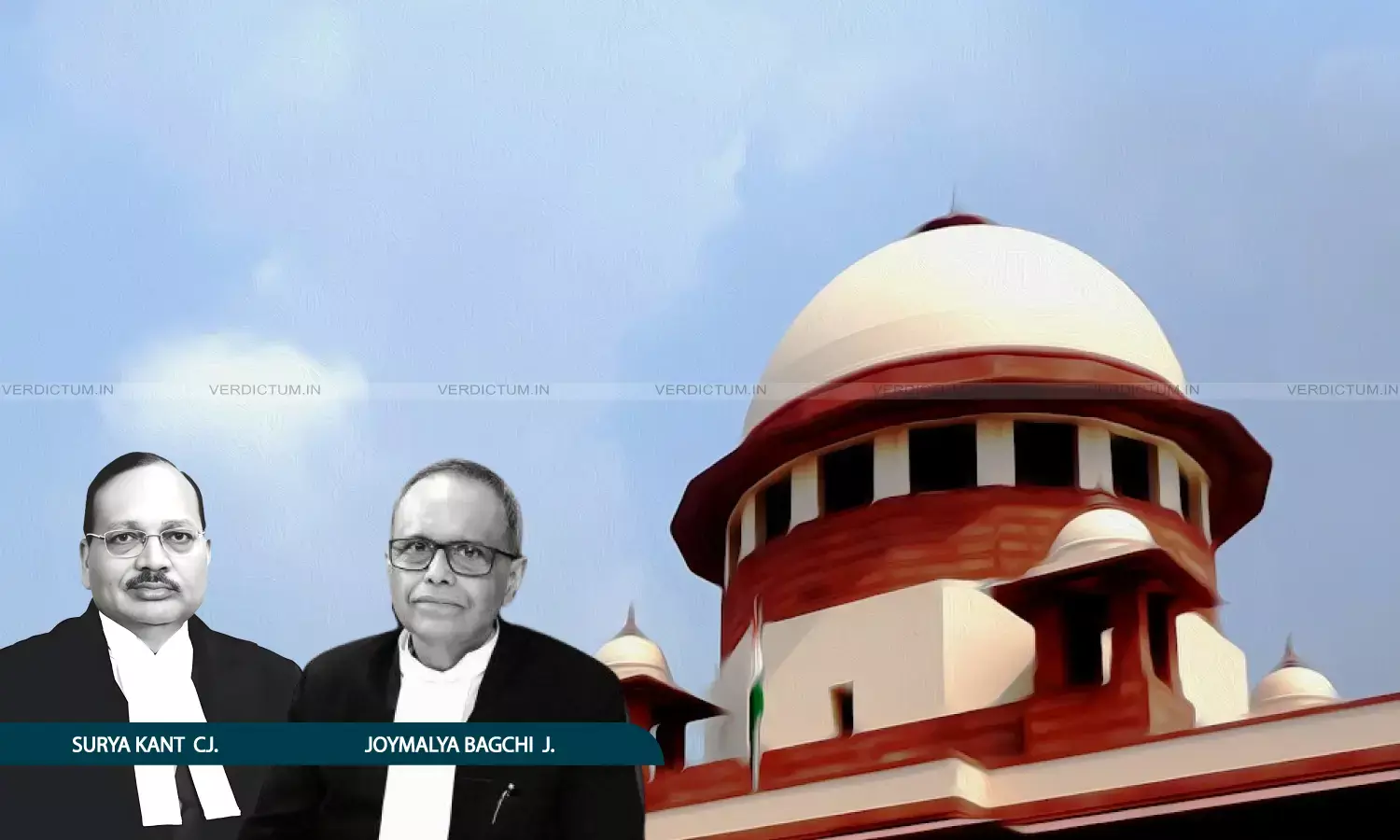
The Supreme Court, today, expressed shock over a 16-year delay in the 2009 Delhi acid attack trial still pending at the Rohini court.
The Bench issued notice in a PIL highlighting a critical legislative gap that prevents victims of forceful acid ingestion from being recognised under the Rights of Persons with Disabilities Act, 2016 (RPwD Act).
The bench of Chief Justice Surya Kant and Justice Joymalya Bagchi ordered, “Issue notice. The Learned Solicitor General of India is present and graciously accepted the notice…We direct the Registrar General of all the High Courts to furnish details of pending trials in the cases of acid attack victims in their respective jurisdiction.”
Advocates Sija Nair and AOR Anuj Kapoor appeared on behalf of the Petitioner.
The Plea stated that these individuals suffer from severe and lasting internal injuries that significantly impair their ability to perform basic life functions like eating, swallowing, and speaking; yet they are currently unable to access the statutory support systems available to other acid attack survivors.
The Petitioner appeared in person and requested to address the Court. She stated that she suffered an acid attack in 2009, and till 2013, no steps were taken by the authorities.
CJI Kant asked, “Phele toh ye batye jinhone attack kia kya unki saza hui?...2009 me attack hua tha or abhi tak trial chal rha hai?”
To which the Petitioner responded that the trial is still going on and it is pending in the Rohini District Court, Delhi.
CJI Kant remarked, “Please file an appropriate application as to why the 2009 case trial has not been concluded. You file the appropriate application, we will take suo moto action that this trial must be held every day. If the National Capital cannot respond to these challenges, then who else will do it in the country?”
The Petitioner said, “2009 se 2013 kuch nhi…fortunately jab mera kannon se, police se bharosa uth gya tha tb ek aap ke hi department se judicial lady hai Dr Parminder Kaur…Unhone mera case reopen kraya, aur waha se mujhe hope mili…Aur mai ab dusre acid-attack survivors ke leye kaam kr rhi hu, mujhe isme satisfaction milti hai…par Sir jo acid pilaya jata hai, mera toh dikhta hai chehre par, unke chehra par nahi dikhta but wo same humare jese pareshaniyo se guzar rhe hote hai…and unko koi benefit nhi milta hai hai disability ka, pension ka, unko minimum muawza milti hai.”
CJI Kant said, “Jab mene aapka kal raat ko brief padha toh mujhe khud hairani thi ki dhakke se acid pilane wale incident mene suna nhi tha…and mujhe ye bhi hairani hoti hai ki agar kisine acid ko forcibly pila dia yak hila dia toh ye bachega kese?”
The Petitioner then explained the problems these women faced due to such forceful acid ingestion.
Solicitor General Tushar Mehta was present in the Court and accepted the notice on behalf of the Union of India.
He said, “This I don’t think any of the Respondents will oppose, this has to be treated as a disability for the purpose…under this Act they will have to be covered.”
The Bench said, “If there is affirmative action from your side, some one small explanation…and secondly, please also consider…all these cases should also be tried by the Special Court on a day-to-day basis, we will fix the timeline. This is a mockery of the system. The system must respond against these persons (Accused).”
The PIL, filed by AOR Anuj Kapoor, highlighted a legal disparity arising from the definition of “acid attack victims” in the Schedule to the RPwD Act. The Act commendably includes acid attack survivors as persons with disabilities, but limits the definition to individuals “disfigured due to violent assaults by throwing of acid”.
“As such, this petition seeks to protect the rights of individuals who have been forcibly administered acid but are not recognized as acid attack victims under the Rights of Persons with Disabilities Act (RPwD Act), 2016. While the Respondents have commendably included ‘acid attack victims’ as being included in the ‘Specified Disability’ category under the Act, the current definition of “acid attack victims” contained in Clause 1(e) of the Schedule to the Act only covers those ‘disfigured by violent assaults involving the throwing of acid or similar substances.’ The petition highlights the need for a broader definition to include victims who have been forcefully ingested with acid, allowing them access to the same rehabilitative benefits as other survivors.”, the Petition said.
The Petition stated that this classification is contrary to Article 14 of the Constitution. It said that he law creates an arbitrary distinction based on the method of the attack (throwing vs. administering) rather than the result of the attack (severe, long-term disability).
Addressing the medical issues, the Petition stated, “When acid is forcibly ingested orally, the damage is even more severe, extending beyond the external wounds. The corrosive substance causes intense burns and significant harm to the internal organs, particularly the gastrointestinal system. This often results in lifelong medical complications, including the need for ongoing gastroenterological care. Victims of oral acid ingestion may experience long-term issues such as difficulty eating, swallowing, and digestion, as well as the risk of developing other serious health conditions. The extent of internal damage further complicates the recovery process, highlighting the need for comprehensive rehabilitation, specialized medical care, and long-term support for survivors of such attacks.”
The Petitioner prayed, “Issue a writ in the nature of mandamus, or any other appropriate writ, order, or direction, declaring that the exclusion of persons disabled due to forceful acid ingestion from the definition of “acid attack victims” in the Schedule to the Rights of Persons with Disabilities Act, 2016, is arbitrary, unreasonable, and violative of Articles 14 and 21 of the Constitution of India;…In consequence of the declaration above, hold and direct that the definition of “acid attack victims” under the said Act shall be purposively interpreted and applied to include persons who have been disfigured or disabled as a result of the forceful administration or ingestion of acid or similar corrosive substances.”
The Petition also highlighted, “Unfortunately, since the RPwD Act, 2016 does not recognize victims of forced acid ingestion as acid attack survivors, these individuals are excluded from eligibility for a disability certificate. The current definition under the Act only includes those disfigured by acid attacks involving the throwing or splashing of acid, leaving victims of oral acid ingestion without official recognition. As a result, when these individuals approach the Medical Board for certification, they are not considered qualified to receive a disability Certificate…This exclusion severely limits their access to essential financial aid, medical support, and rehabilitation services available to other acid attack survivors.”
It said that the gap in the definition effectively hinders their recovery and reintegration, making it vital to broaden the scope of individuals recognized as victims of acid attacks in the Act to ensure all acid attack victims, regardless of the method of attack, receive equal support.
Accordingly, the Court listed the matter for a further date.
Cause Title: Shaheen Malik v. Union of India [Writ Petition(s)(Civil) No(s).1112/2025]