

"Once You Enter India Illegally, Are You Entitled To Benefits?": Supreme Court While Hearing Plea Related To Rohingyas

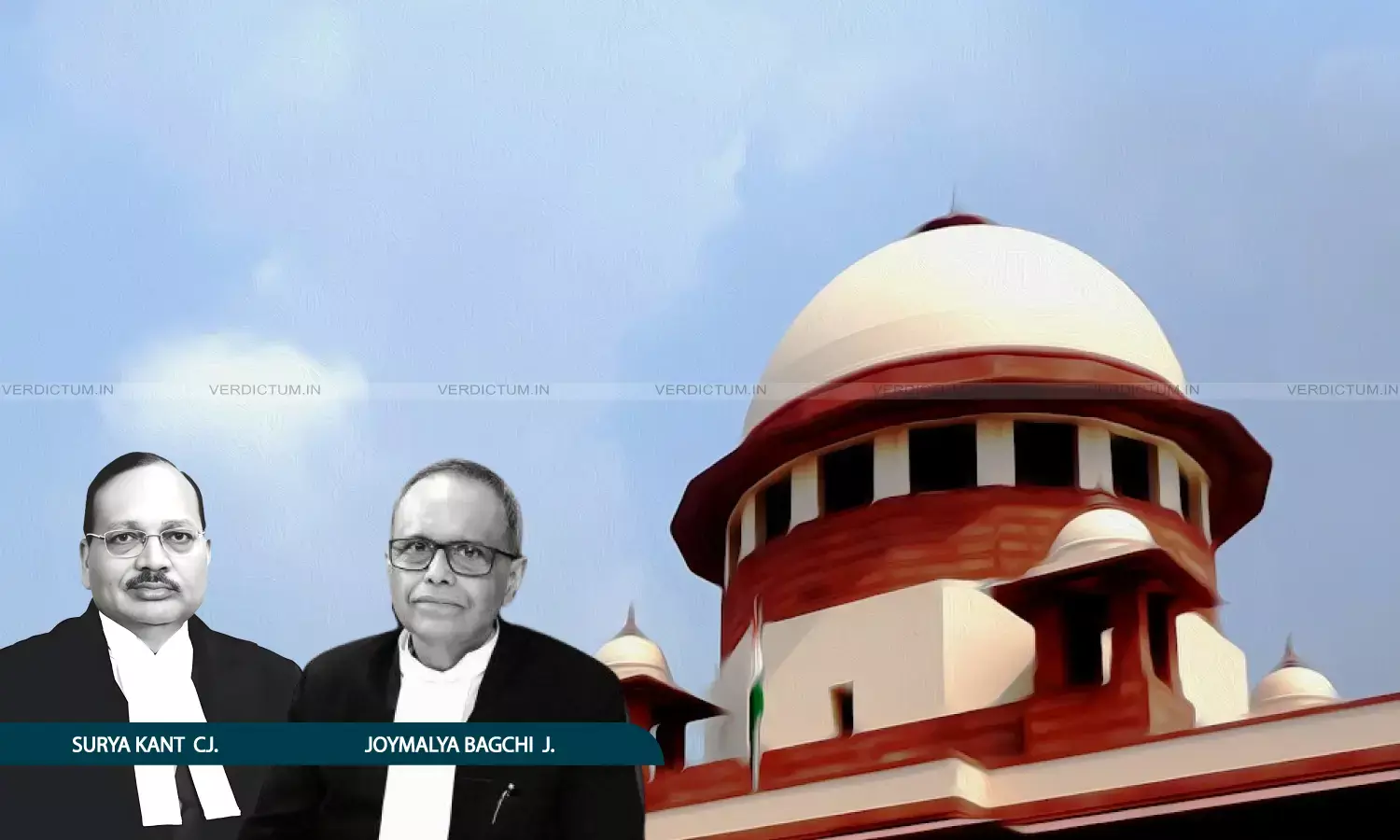
The Supreme Court, today, raised a question as to whether someone who has entered the country illegally will be entitled to the benefits and amenities and whether the State has an obligation to keep the individual in the country.
The bench of Chief Justice Surya Kant and Justice Joymalya Bagchi was hearing a habeas corpus petition alleging the custodial disappearance of Rohingya individuals and urging that any deportation follow due process.
During the hearing Chief Justice Kant remarked, “Once you enter, you cross the fencing border, you cross illegally, you enter, you dug a tunnel and then you enter India and declare that now that I have entered your laws must be applied to me. I haven't been given a showcase notice, I'm entitled to food, I am entitled for the shelter, my children are entitled to this, and all these things will start operating. Do you want to stretch the law like this? We also have poor people in this country, and they are born citizens, are they not entitled to certain privileges, benefits and amenities?”
“Where is the order by the government of India declaring them as ‘refugees’…there is a prescribed authority in the Government to declare that somebody is a ‘refugee’. ‘Refugee’ is a well-defined legal term.” CJI Kant further added.
In response to the remark, the Counsel representing the Petitioner submitted that the present case is not to recognize whether somebody is a ‘refugee’ and they are not contesting the issue of deportation.
She said, “We are stating that it is the obligation of the State to deport anybody who is living unlawfully in the country. The case here is of custodial disappearance.”
CJI Kant remarked, “There is no legal status as a refugee and somebody as an intruder, and he enters illegally, do we still have an obligation to keep that fellow here?”
Solicitor General Tushar Mehta intervened and said, “The affected parties are approaching the court, and this person is a PIL petitioner. The petitioner is not affected, and he has filed some other petitions also. The affected parties are approaching the court.”
The petition, filed by activist Rita Manchanda, alleged that certain Rohingyas were detained by Delhi police in May without information on their whereabouts, emphasizing adherence to government deportation procedures rather than seeking refugee status.
Further, CJI asked the Counsel for the Petitioner if they are approaching the Court to acquire the legal status. To which Counsel responded, “Let me please clarify this is not to acquire a legal status…the question is on how to deport someone or push somebody out of the border. We are not disputing that. What we cannot do is what is harmful for national security and safety.”
CJI Kant responded, “If you don't have a legal status to stay as a refugee-support and you are an intruder…you know very well that we have a very very sensitive border on the North India side…suppose somebody comes there from and you have seen what has been happening with inside the country…now if an intruder comes, you want a red carpeting for him and to provide you all these facilities.”
Counsel for the Petitioner replied, “We must not deviate from the rules that have been made by the Respondents themselves.”
“Never ask for something which is very fanciful and which can have very logistical issues. The law will apply to everyone equally…Whatever assistance you want to give to us as a counsel or as a as somebody who is public-spirited person, all of you are most welcome. But don't multiply the litigation. Issuing of notices, getting pleadings and completed, then it will keep an endless loop.”, CJI Kant orally remarked.
SG Mehta then said, “These people may have filed their own petitions; we do not know, she may implead herself not as an impleader or something.”
Cause Title: Rita Manchanda v. Union Of India [W.P.(Crl.) No. 505/2025]