

Society Or Resident Welfare Association Which Is Not A Creditor Can’t Intervene In Proceedings U/S.7 IBC Petition: Supreme Court
The appeals before the Supreme Court were directed against the final judgment of the National Company Law Appellate Tribunal, directing admission of the application filed under Section 7 of the Insolvency and Bankruptcy Code.

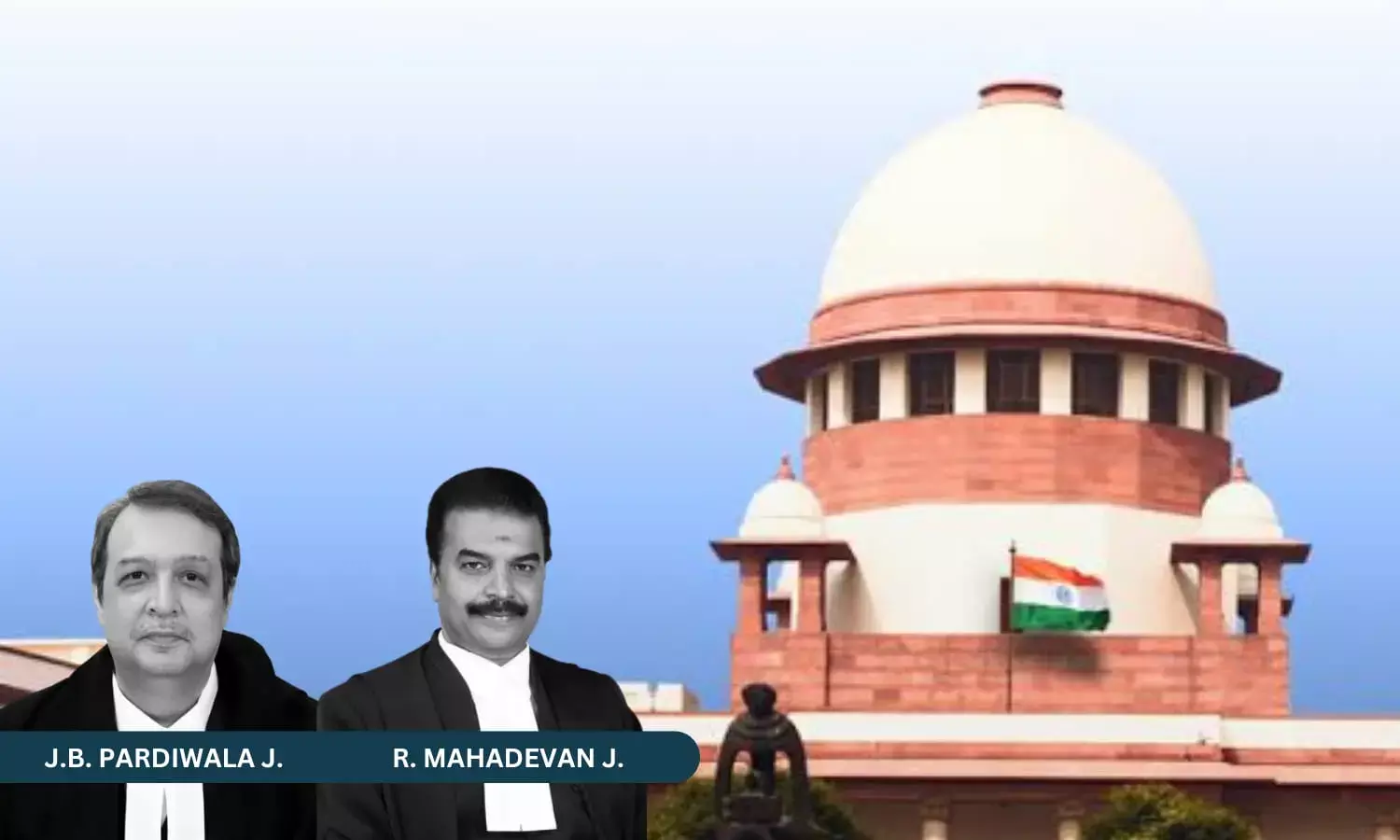
Justice J.B. Pardiwala, Justice R. Mahadevan, Supreme Court
While observing that the right to initiate or participate in insolvency proceedings is statutory, the Supreme Court has held that a society or Resident Welfare Association, not being a creditor in its own right and not recognised as an authorised representative of allottees under the IBC, has no locus standi to intervene in proceedings arising out of a petition under section 7 of the Insolvency and Bankruptcy Code, 2016 (IBC).
The appeals before the Apex Court were directed against the final judgment and order of the National Company Law Appellate Tribunal, directing admission of the application filed under Section 7 of the Insolvency and Bankruptcy Code, 2016, thereby initiating the Corporate Insolvency Resolution Process against the appellant (real estate developer), Takshashila Heights India Private Limited.
The Division Bench of Justice J.B. Pardiwala and Justice R. Mahadevan held, “The right to initiate or participate in insolvency proceedings is statutory, not equitable”
“A society or Resident Welfare Association, not being a creditor in its own right and not recognised as an authorised representative of allottees under the IBC, has no locus standi to intervene in proceedings arising out a Section 7 petition”, it stated while also adding, “The NCLAT was justified in rejecting the Society’s intervention application.”
AOR Henna George represented the Appellant, while AOR Abhishek Agarwal represented the Respondent.
Factual Background
The appellant (Corporate Debtor) availed financial assistance of Rs 70 crore from ECL Finance Ltd. (Original Lender) for the purpose of developing a residential -cum- commercial project titled “Takshashila Elegna”. To secure the said facilities, the Corporate Debtor and its promoters executed loan agreements, promissory notes, and other security documents. There was a delay in repayment of the loan instalments, and the Corporate Debtor made its last payment, after which the loan accounts were classified as Non-Performing Assets (NPA). Pursuant to certain commercial discussions, the Corporate Debtor and the Financial Debtor entered into a Restructuring – cum – One Time Settlement Agreement under which the Corporate Debtor agreed to discharge its outstanding liability of Rs. 55 crores in a phased manner.
The Financial Creditor declined to issue NOC and subsequently revoked the restructuring arrangement, citing default in payment of instalments. Thereafter, the EARCL – Financial Creditor filed a petition under Section 7 of the IBC before the NCLT, seeking initiation of the CIRP against the Corporate Debtor. During the pendency of the said proceedings, the Financial Creditor issued a sale notice. The NCLT dismissed the Section 7 petition, holding that the facts of the case did not warrant initiation of the CIRP as the IBC was being invoked as a recovery mechanism rather than as a tool for insolvency resolution.
Challenging the order of the NCLT, the Financial Creditor preferred a Company Appeal before the NCLAT. The Society filed an intervention application under Rule 11 of the NCLAT Rules, 2016, on the ground that the outcome of the appeal would directly affect the proprietary and contractual rights of its members. The NCLAT allowed the appeal filed by the Financial Creditor and directed admission of the Section 7 petition, thereby initiating CIRP against the Corporate Debtor. The NCLAT, however, rejected the intervention application, holding that the Society did not have locus standi as it was not a party to the financial transaction forming the subject matter of the appeal. Aggrieved thereby, the Society as well as the Corporate Debtor preferred the Civil Appeals.
Reasoning
Considering how the Court has, time and again, been called upon to protect the rights of homebuyers navigating the turbulent waters of India’s real estate sector, the Apex Court held that it has made sustained efforts, within the four corners of the law, to safeguard the legitimate interests of homebuyers. The Bench explained that the Corporate Debtor possesses no adjudicated or realisable claim exceeding the amount in default. “Its reliance on business viability, unsold inventory, project status, or anticipated receivables does not constitute “good reasons” in law to defer or deny admission of CIRP”, it added.
Coming to the facts of the case, the Bench noted that the existence of a financial debt owed to EARCL was undisputed. Persistent defaults stood admitted and were conclusively established on record, including the breach of the restructuring agreement and failure to pay instalments within the stipulated cure period. The restructuring arrangement failed due to non-payment by the Corporate Debtor, thereby triggering an express event of default under its terms. “Any alleged non-cooperation by EARCL occurred subsequent to the default and cannot absolve the Corporate Debtor of its admitted failure to comply with its payment obligations. The NCLAT correctly held that considerations such as ongoing operations, partial project completion, or anticipated receivables are extraneous to the statutory mandate under Section 7”, it stated.
The Bench also noticed that the NCLAT, upon a detailed examination of the material on record, found that the Corporate Debtor had persistently acknowledged defaults under both the sanction letters and the restructuring agreement. It further noted that the Corporate Debtor was facing acute financial distress, had failed to comply with regulatory requirements, was unable to obtain mandatory compliance certificates, and could not sell units at prevailing market rates despite multiple attempts. Finding that the debt and default were conclusively established, the Bench held that the NCLAT was fully justified in admitting the Corporate Debtor into the CIRP.
The Bench further held that the appellant society cannot claim a vested right to be heard at the appellate stage, for such a right flows from the statute and is not a matter of right. The Bench also noticed that the homebuyers already in possession stand outside the insolvency estate and pending allottees are recognised financial creditors who are entitled to file claims and participate in the CoC through authorised representatives.
The Bench explained that regulation 4E protects possession subject to 66% CoC approval, and the approved resolution plan binds all stakeholders and ensures equitable treatment. “RERA rights stand harmonized with the IBC, as held by this Court in Pioneer Urban Land and Mansi Brar Fernandez”, it added.
The Bench thus dismissed the appeal challenging the admission of the Corporate Debtor into CIRP as well as the appeal challenging rejection of the intervention application, subject to the clarification on the limited scope of locus standi and inherent powers. To safeguard the interests of homebuyers, the Bench directed that the information memorandum shall mandatorily disclose comprehensive and complete details of all allottees.
Cause Title: Elegna Co-op. Housing and Commercial Society Ltd. v. Edelweiss Asset Reconstruction Company Limited (Neutral Citation: 2026 INSC 58)
Appearance
Appellant: AOR Henna George, AOR Purti Gupta
Respondent: AOR Abhishek Agarwal, AOR Henna George