

Confirmed Auction Sale Not Absolute Where Process Violates SARFAESI Rules And Borrower Discharges Liability: Supreme Court
The Court held that protection afforded to a confirmed auction sale is not absolute and must yield where the process is legally infirm, particularly when statutory timelines are breached, and the borrower has discharged the entire liability.
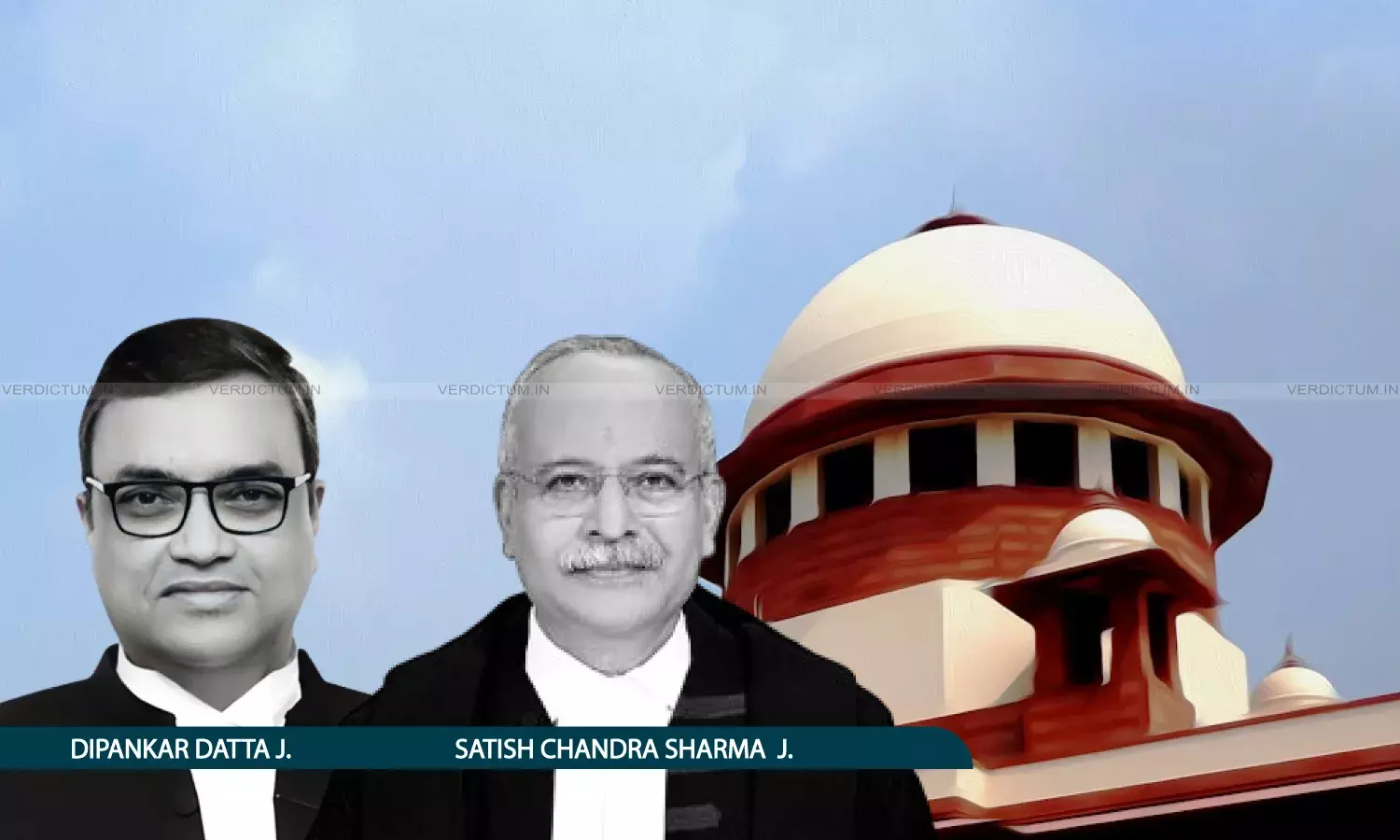
Justice Dipankar Datta, Justice Satish Chandra Sharma, Supreme Court
The Supreme Court has held that the mere confirmation of an auction sale under the SARFAESI Act does not render it immune from judicial scrutiny where the sale process is vitiated by non-compliance with statutory timelines and material irregularities, especially when the borrower has, in the interregnum, discharged the entire outstanding liability.
The Court was hearing appeals filed by auction purchasers and the secured creditor challenging the judgment of the Madras High Court, which had set aside the auction sale and permitted redemption of the secured assets by the borrowers.
A Bench of Justice Dipankar Datta and Justice Satish Chandra Sharma observed: “In the present factual milieu, where the completion of the sale was delayed beyond stipulated timelines due to judicial interventions and procedural constraints, and where such delay is not attributable to the borrowers, the mere factum of confirmation cannot preclude judicial scrutiny. The raison d'être of proceedings under the SARFAESI Act is not the mechanical completion of a sale, but the lawful realization of the secured asset in a manner that is fair, transparent, and conducive to securing the best possible value while balancing the interests of all stakeholders involved”.
Senior Advocate Dr S. Muralidhar represented the appellants, while Senior Advocate Guru Krishnakumar appeared on behalf of the respondents.
Background
The dispute arose from recovery proceedings initiated by a secured creditor under the SARFAESI Act after the borrower’s loan account was classified as a non-performing asset. Following the issuance of demand and possession notices, the secured assets were put to auction, and the auction purchasers emerged successful bidders, depositing 25% of the bid amount.
However, the confirmation of the sale remained subject to a series of judicial interventions before the Debts Recovery Tribunal, Debts Recovery Appellate Tribunal, and the High Court. During this period, the borrowers continued to pursue remedies and made substantial deposits towards the outstanding dues.
Ultimately, the sale was confirmed much later, after a delay of approximately fifteen months, and the balance consideration was deposited only thereafter. Meanwhile, the borrowers discharged the entire outstanding liability pursuant to judicial directions.
The High Court set aside the sale, holding that it was vitiated by delay and statutory non-compliance. The auction purchasers and the secured creditor challenged this before the Supreme Court.
Court’s Observation
The Apex Court began by recognizing that while the rights of a bona fide auction purchaser and the sanctity of a confirmed sale ordinarily deserve protection, such protection is not absolute. It observed that “the sanctity of a confirmed sale ordinarily merit[s] protection, [but] such protection is not absolute and must yield where the sale process itself is shown to be legally infirm…”
The Court emphasized that proceedings under the SARFAESI Act are not meant for mechanical completion of sale but must ensure fairness, transparency, and lawful realization of assets.
Examining the scheme of the SARFAESI Rules, particularly Rule 9(4), the Court noted that the balance sale consideration must be paid within the prescribed timeline, subject to a limited extension not exceeding three months. In the present case, the balance amount was deposited nearly fifteen months after the auction, far beyond the statutory outer limit.
The Court held that “a transaction which proceeds in violation of the statutory timeline cannot be pressed into service, for divesting the borrowers of their secured assets.” It further clarified that the delay was not attributable to the borrowers, who were actively pursuing remedies, but rather arose due to procedural and judicial constraints.
The Court analyzed the chronology of events and held that judicial orders had restrained completion of the sale at various stages. However, it found that nothing prevented the secured creditor from accepting the balance consideration within the statutory framework.
The Court observed: “Nothing prevented the secured creditor from accepting the balance consideration… The failure to receive the balance sale consideration… therefore, inures to the benefit of the borrowers and operates against the finality of the sale.” Thus, the delay could not be used to defeat the rights of the borrowers.
The Court reaffirmed that the borrower’s right of redemption must be preserved, particularly where the sale has not attained finality in accordance with law. It relied upon established principles that redemption survives until completion of the sale in accordance with statutory requirements.
The Court further noted that the borrowers had, in fact, discharged the entire outstanding liability during the pendency of proceedings. In such circumstances, divesting them of their secured assets would amount to disproportionate deprivation of property.
The Court distinguished precedents where auction sales had attained finality within statutory timelines and without judicial impediments. It held that such cases were inapplicable where the sale itself remained inchoate due to non-compliance with mandatory requirements.
“For the reasons discussed above, we find ourselves in complete accord with the conclusion arrived at by the High Court that (i) the impugned auction sale having not attained finality qua the auction purchasers in the manner contemplated by law and (ii) the borrowers, in the interregnum, having discharged the entire outstanding liability, they could not have been divested of the secured assets”, the Court concluded.
Conclusion
The Supreme Court upheld the High Court’s decision setting aside the auction sale, holding that the sale had not attained finality in accordance with law and was vitiated by breach of statutory timelines.
It further held that since the borrowers had discharged the entire outstanding liability during the pendency of proceedings, they could not be divested of their secured assets.
Accordingly, the appeals were dismissed.
Cause Title: E. Muthurathinasabathy & Ors. v. M/s. Sri International & Ors. (Neutral Citation: 2026 INSC 303)
Appearances
Appellants: S. Muralidhar, Senior Advocate, with Advocates Ayyam Perumal Karthik M, Ninni Susan Thomas, Megha, Venkataraman R., AOR, P.B.A. Srinivasan, Amit K. Nain, AOR, Barnali Paul, Rajshree Dhapola
Respondents: Senior Advocate Guru Krishnakumar, with Advocates Vinodh Kanna B., Aswin Kumar, Thilagavathi P
