Search Ordered By Single Member Of Appropriate Authority In PCPNDT Proceedings Illegal, Evidence Seized In Such Searches Still Admissible: Supreme Court
The Apex Court held that although a search conducted on the direction of only the Chairperson of the District Appropriate Authority violates Section 30 of the PCPNDT Act, the illegality of the search does not automatically invalidate or render inadmissible the evidence collected during such search.
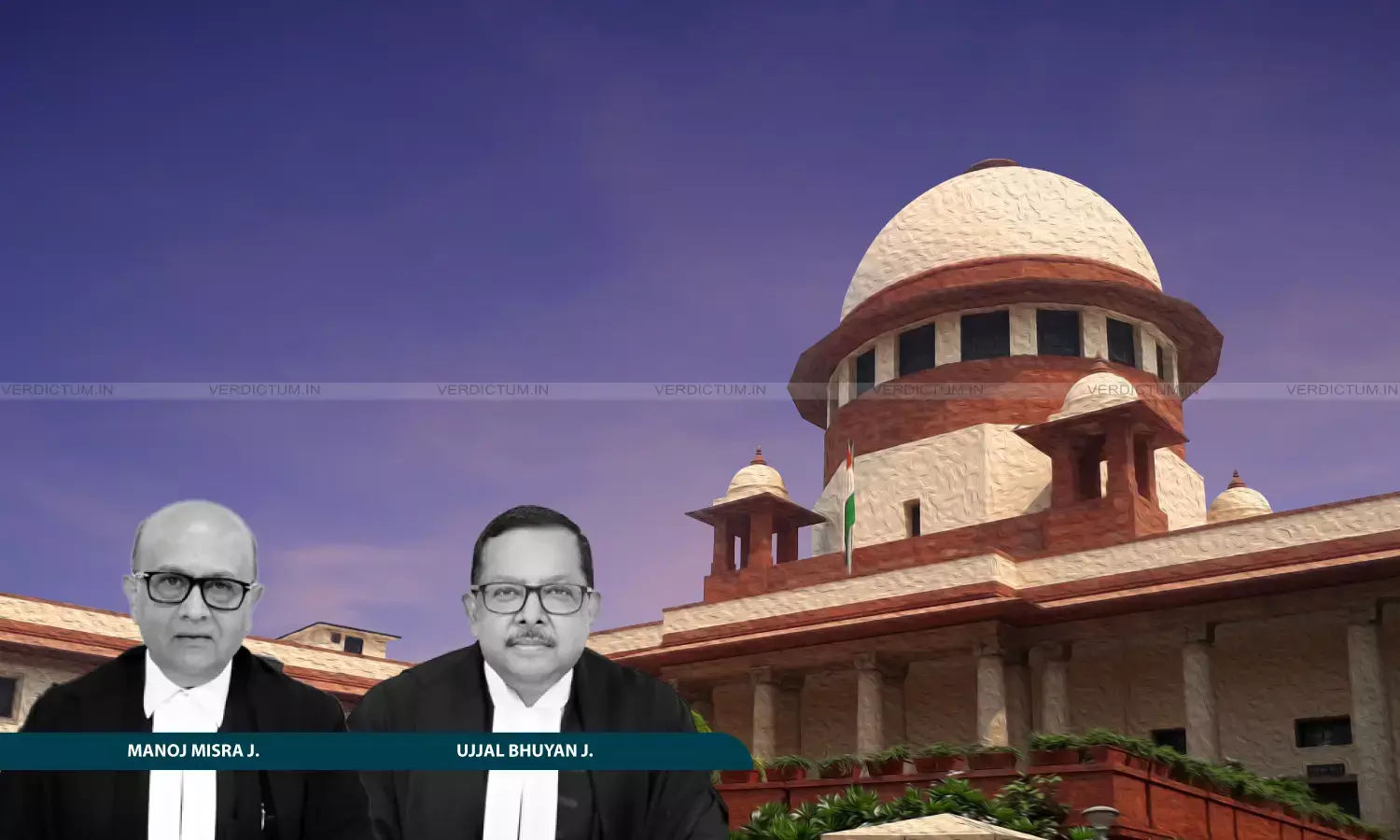
Justice Manoj Misra, Justice Ujjal Bhuyan, Supreme Court
The Supreme Court has held that a search carried out under the PCPNDT Act solely on the direction of the Chairperson of the District Appropriate Authority, without a collective decision of the authority, is vitiated for violating Section 30; however, evidence gathered during such a search cannot be discarded outright and may still be relied upon subject to relevancy and admissibility.
The Court further clarified that the illegality of search and the admissibility of evidence are distinct questions in criminal law, and that exclusion of relevant material solely due to a procedural defect in authorisation would not automatically follow.
The Court was hearing an appeal challenging the dismissal of a petition seeking the quashing of a complaint and summoning order issued under provisions of the PCPNDT Act.
A Bench comprising Justice Manoj Misra and Justice Ujjal Bhuyan, stating that “while there is an infraction of Section 30 of the PCPNDT Act qua the search carried out by the respondents, …in as much as it was an individual decision of the Chairperson instead of being the collective decision of the District Appropriate Authority which has vitiated the search”, further held that “while the search may be illegal, the materials or evidence gathered or collected in the course of such search can still be acted or relied upon subject to the rule of relevancy and the test of admissibility”.
Background
The appellant, a radiologist, sought quashing of a complaint filed under provisions of the PCPNDT Act and related rules along with the summoning order issued by a Magistrate.
The complaint arose from a raid conducted after a complaint alleging illegal prenatal sex determination. During the operation, a decoy patient was sent to a diagnostic centre, and money was allegedly paid to an intermediary who claimed that the ultrasound would be conducted without maintaining statutory records or documentation.
Subsequently, officials entered the premises, recovered marked currency from the intermediary, and examined records, where deficiencies such as unsigned forms and absence of entries were allegedly found.
Although the police later filed a discharge report in a criminal case arising from the same incident, the District Appropriate Authority independently authorized filing of a complaint under the PCPNDT Act after examining materials and recommendations of the advisory body.
The High Court declined to quash the complaint, leading to the present appeal.
Court’s Observation
The Supreme Court undertook a detailed examination of the statutory framework of the PCPNDT Act, emphasising that it is a social welfare legislation enacted to prevent sex selection and female foeticide and to protect the right to life of the girl child under Article 21.
The Court analysed provisions governing the regulation of diagnostic techniques, maintenance of records, powers of authorities, offences, and procedural requirements for prosecution, highlighting that maintenance of statutory records, particularly Form F, is mandatory and that deficiencies may constitute contraventions unless satisfactorily explained.
The Bench then considered the legal requirement under Section 30 concerning search and seizure. Relying on precedent, it reiterated that the decision to authorise a search must be that of the Appropriate Authority collectively and not of an individual member acting alone.
Examining the record, the Court found that the directive for the raid had been issued by the Chairperson alone, and there was nothing to indicate a collective decision or meeting of minds of all members of the authority. Therefore, the search was held illegal for non-compliance with the statutory mandate.
However, the Court distinguished the illegality of the search and the evidentiary value of materials recovered. It held that even though the search was vitiated, relevant evidence discovered during such a search could still be relied upon if admissible under the law.
The Court further clarified that the earlier precedent quashing proceedings after an illegal search was decided on its own facts because the prosecution in that case was entirely dependent on materials seized in such a search. The ratio of that decision, the Court explained, was limited to the principle that authorisation must be collective, not that evidence must invariably be excluded.
Addressing the remaining submissions, the Court held that discharge in a police case does not preclude independent complaint proceedings under the PCPNDT Act because cognizance can be taken only on a complaint by the appropriate authority; it further clarified that the advisory committee’s function is merely recommendatory and does not curtail the authority’s independent statutory powers, and that minor procedural irregularities cannot by themselves invalidate prosecution where the statutory requirements are otherwise satisfied.
The Court emphasised that enforcement of the Act must be effective, given its social objective of combating gender-biased sex selection.
Conclusion
The Supreme Court dismissed the appeal and declined to quash the complaint proceedings, holding that although the search suffered from a statutory infirmity, the prosecution could still rely on admissible evidence gathered during such search and the matter must proceed in accordance with the law.
While clarifying that “we have not expressed any opinion on the merit of the allegations and all contentions qua reliability and admissibility of evidence are kept open”, the appeal was dismissed with no order as to costs.
Cause Title: Dr Naresh Kumar Garg v. State of Haryana & Ors. (Neutral Citation: 2026 INSC 176)
Appearances
Petitioner: Shubham Bhalla, AOR; Yajur Bhalla; Gauri Bedi; Ragini Sharma; Neha Verma; Yash; Aman Khatri (Advocates)
Respondents: Neeraj, AAG; Samar Vijay Singh, AOR; Piyush Beriwal; Jyotsna Vyas; Sabarni Som; Aman Dev Sharma; Gaj Singh; Keshav Mittal; Vikramaditya Chauhan (Advocates)