Appeals U/S 14-A SC/ST Act Require Independent First Appellate Scrutiny; Mechanical Affirmation Of Charge Orders Impermissible: Supreme Court
Holding that an appeal under Section 14-A of the SC/ST Act is a statutory first appeal on facts and law, the Apex Court ruled that High Courts must independently evaluate the material on record while examining orders framing charge or refusing discharge, and cannot mechanically affirm the Special Court’s decision.
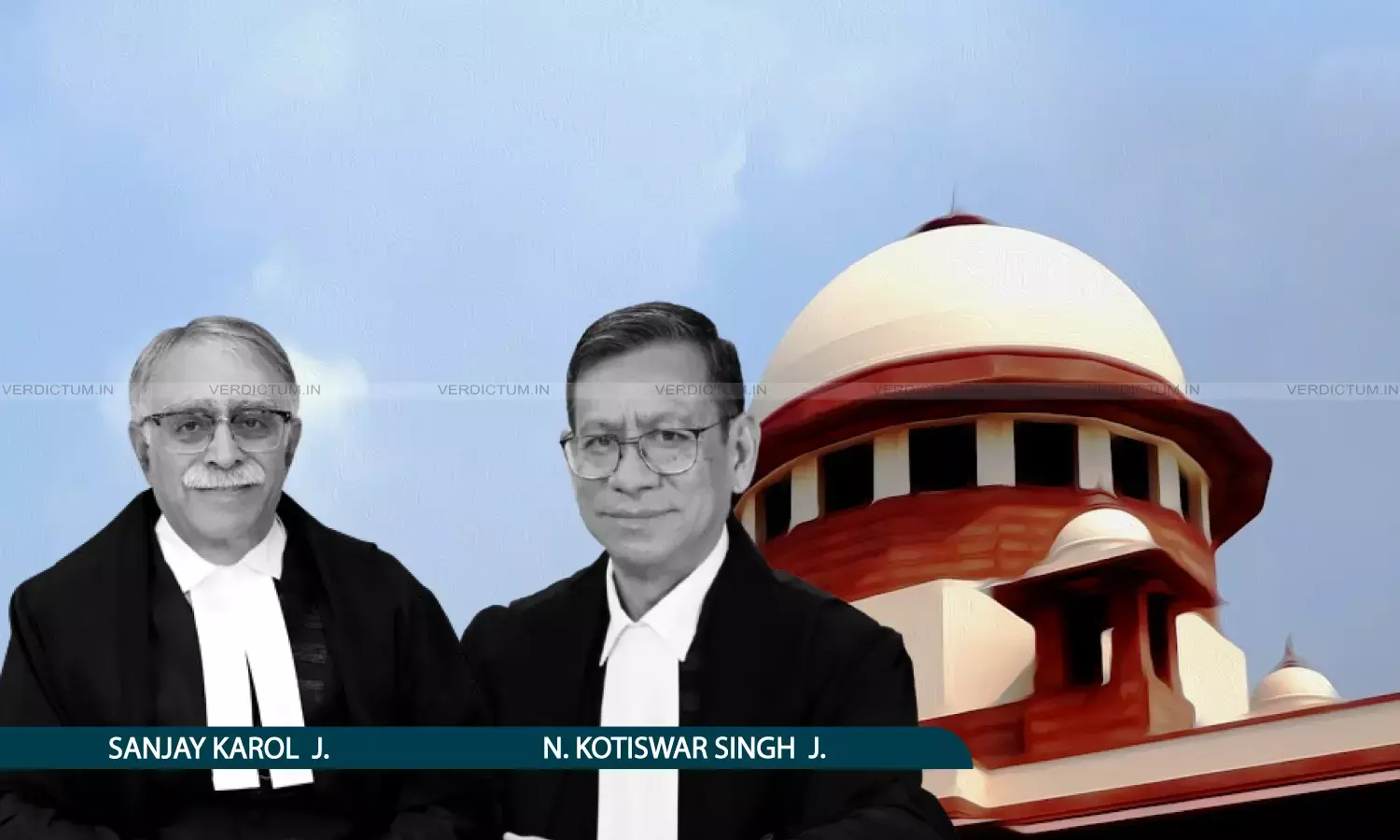
Justice Sanjay Karol, Justice N. Kotiswar Singh, Supreme Court
The Supreme Court has held that appeals filed under Section 14-A of the Scheduled Castes and Scheduled Tribes (Prevention of Atrocities) Act, 1989, are statutory first appeals requiring independent judicial scrutiny on facts and law.
The Apex Court clarified that High Courts exercising jurisdiction under this provision function as first appellate courts and must meaningfully evaluate the record rather than mechanically affirming orders of Special Courts, particularly in matters relating to discharge or framing of charge.
The Court was hearing an appeal challenging a Madhya Pradesh High Court judgment that upheld a Special Court’s decision to partly reject an application for discharge in a prosecution arising out of alleged unlawful assembly and assault involving public officials, where charges had been framed under provisions of the Indian Penal Code and Sections 3(2)(v) and 3(2)(va) of the SC/ST Act.
A Bench of Justice Sanjay Karol and Justice N K Singh, while stating that “an appeal under Section 14-A of the SCST Act is a statutory first appeal”, further observed: “…appeals under Section 14-A of the SC/ST Act do not curtail or dilute the ordinary appellate powers of the High Court, …the High Court does not function as a revisional or supervisory Court while exercising jurisdiction under Section 14-A but assumes the role of a first appellate court, …A mechanical affirmation of the order of the Special Court, without independent scrutiny, would therefore be inconsistent with settled appellate jurisprudence and would amount to a failure to exercise jurisdiction”.
Background
The prosecution stemmed from an incident involving a public gathering where officials and security personnel were allegedly obstructed and assaulted. A chargesheet followed, alleging offences under multiple IPC provisions and invoking the enhanced penal framework of the SC/ST Act.
The accused sought discharge, arguing that the materials on record did not disclose the essential ingredients required to sustain charges under the SC/ST Act, particularly the element of knowledge that the victim belonged to a Scheduled Caste or Scheduled Tribe. The Special Court rejected the application in part and framed charges. The High Court affirmed the order in appeal under Section 14-A.
Before the Supreme Court, the accused contended that the SC/ST charges were unsupported by the evidentiary record and that the High Court failed to independently assess the material while exercising appellate jurisdiction.
Court’s Observations
The Supreme Court undertook a structured examination of the statutory framework governing discharge and framing of charge, reiterating that the judicial task at that stage is limited to determining whether the allegations, taken at face value, disclose the ingredients of the offence. Courts are cautioned against conducting a mini-trial or weighing evidence, but must nonetheless apply judicial scrutiny to distinguish between suspicion and grave suspicion, the Bench reiterated.
Turning to the SC/ST charges, the Bench noted that neither the complaint nor witness statements demonstrated that the accused acted with knowledge of the victim’s caste identity, a foundational requirement under Sections 3(2)(v) and 3(2)(va). The absence of such averments, the Court held, rendered continuation of those specific charges unsustainable on a prima facie evaluation.
The Court then addressed the nature of appellate jurisdiction under Section 14-A. Referring to precedent, it clarified that although orders framing charge or refusing discharge are neither interlocutory nor final in the traditional sense, they are appealable under the statutory language covering “any judgment, sentence or order, not being an interlocutory order.” Such appeals, the Court noted, are valuable rights and require independent judicial examination.
While referring to the Apex Court’s previous ruling in Bani Singh v. State of Uttar Pradesh (1996), in which it was held that appellate Court cannot dispose of a criminal appeal in a cursory manner and must itself examine the evidence and the reasoning of the Trial Court, remarked: “the appellate power under Section 14-A of the SC/ST Act must be exercised in harmony with the broader framework of criminal procedure. While the High Court is duty-bound, as a first appellate Court, to independently apply its mind and correct errors committed by the Special Court, it must remain conscious of the stage of the proceedings and the corresponding limits of judicial scrutiny.”
The Bench emphasised that High Courts cannot treat Section 14-A appeals as supervisory or revisional proceedings. Even when agreeing with the Special Court’s reasoning, the appellate judgment must reflect conscious engagement with the material. A cursory affirmation amounts to failure to exercise jurisdiction.
At the same time, the Court underscored that appellate scrutiny at the threshold stage remains circumscribed by the limits governing discharge, disputed factual defences and evidentiary weighing remain matters for trial.
Applying these principles, the Court found that the High Court failed to independently evaluate whether the statutory ingredients of the SC/ST offences were prima facie established.
Conclusion
Holding that the essential ingredients required to sustain charges under Sections 3(2)(v) and 3(2)(va) of the SC/ST Act were absent on the face of the record, the Supreme Court quashed those charges against the appellant. The matter was remitted to the trial court to proceed on the remaining IPC charges in accordance with the law.
The Court clarified that its findings were confined to the SC/ST provisions and did not comment on the merits of the other charges. Pending applications stood disposed of.
Cause Title: Dr Anand Rai v. State of Madhya Pradesh & Anr. (Neutral Citation: 2026 INSC 141)
Appearances
Appellant: Senior Advocate Kapil Sibal with Advocates Sumeer Sodhi, AOR, Varun Tankha, Harshit Bari, Inder Dev Singh, Vipul Tiwari, Divyani Deepti, Divya Goyal, and Chaitanya Sharma.
Respondents: Senior Advocate Pashupathi Nath Razdan, AOR, with Advocates Abhinav Srivastav, Maitreyee Jagat Joshi, Astik Gupta, and Akanksha Tomar.